

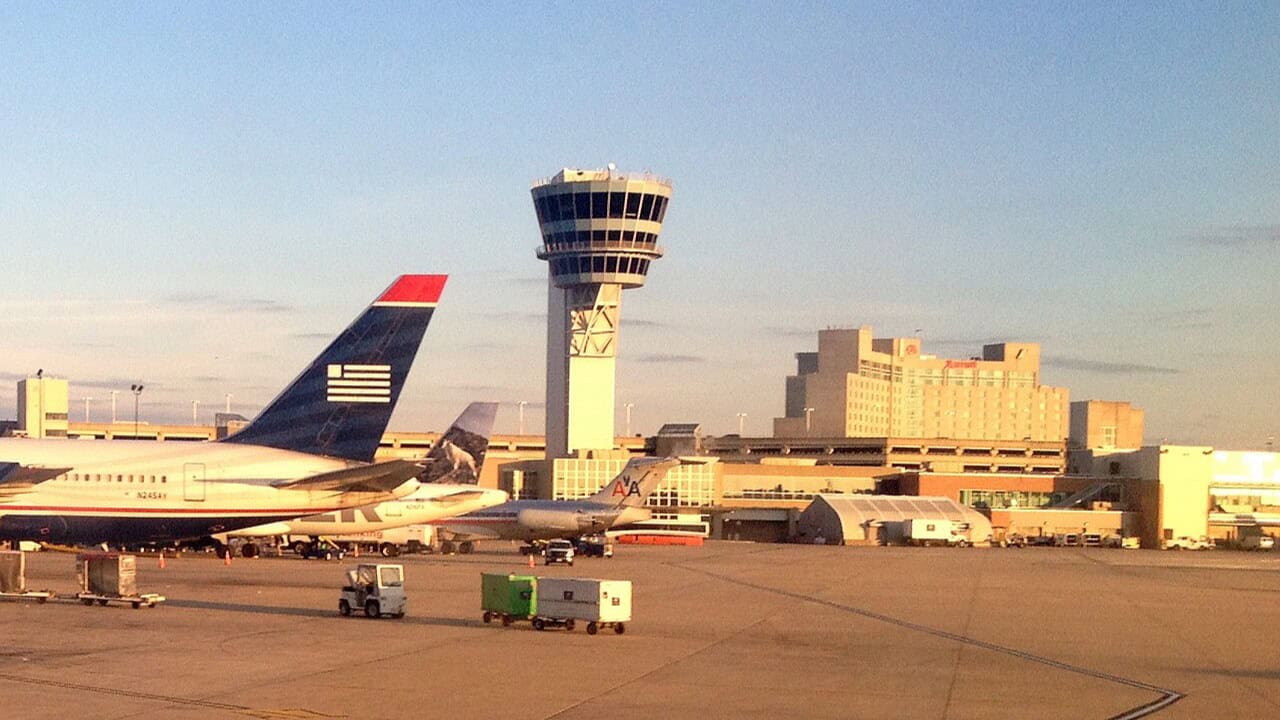
Transportation Secretary Sean Duffy said on September 22, 2026 that the administration will ask Congress for another $30 billion for air traffic control and airports. “We are going to ask Congress for $30 billion,” he said in remarks reported by AVweb, adding that the country should “look at how the country has changed and what the needs are at the airports.”
The timing was not subtle. The request came a day after a telecommunications failure at the Philadelphia TRACON stopped flights at five airports and disrupted thousands more across the Northeast.
Where the Money Would Go
The ask splits into three equal parts: $10 billion to replace aging control towers, $10 billion for telecommunications and air traffic control technology, and $10 billion for airport improvements.
That sits on top of the $12.5 billion over five years that Congress approved last year for air traffic control reform. FAA Administrator Bryan Bedford has put the first phase of modernization at $16 billion, with at least another $10 billion needed for phase two.
Reality check
This is a request, not money. Nothing here is appropriated until Congress writes it into a bill, and the $12.5 billion already approved is being spent across five years. Announcing a number is the easiest step in the sequence.
The estimates are also moving. The telecommunications line alone has climbed from $4.75 billion to $5.91 billion, a jump of more than a billion dollars on one workstream before the bulk of it is built.
That matters because telecom is the part of the system that failed on Monday, and it is the part with the widest blast radius when it does.
The AI Went Live the Same Day the Cable Was Cut
Part of the technology money would expand SMART, a predictive air traffic management tool the FAA began running on Monday, September 21. It is built to move airspace management from reactive to predictive, planning hours, days and weeks ahead instead of responding once delays have formed.
Duffy said the system “will slash those frustrating delays, reduce stress on air traffic controllers and lower travel prices” by “fundamentally reshaping how we manage our airspace and preventing problems before they happen,” in comments carried by The Baltimore Sun.
The same day, controllers in Philadelphia lost their primary circuit and then their backup, and the fix was a physical repair to a severed line.
This is the distinction worth holding onto. A predictive tool is aimed at a demand and capacity problem: too many aircraft wanting the same airspace at the same hour, with weather narrowing the options.
Monday was not that. It was an availability problem, where the controllers’ ability to talk to aircraft and to each other went away, and the only safe response to that is to stop launching aircraft into the gap.
Two different fixes
Software that forecasts congestion cannot route around a severed circuit. Redundant physical paths can. The $10 billion telecom line is the half of this request aimed at what actually broke at Philadelphia, and it is the half whose price has already risen.
Both problems are real, and the funding request covers both. The risk in a headline number is that the visible, demonstrable technology absorbs the attention while the unglamorous work of replacing buried cable and old control towers runs long and over budget.
Newark Liberty was one of the five airports stopped on Monday, and it is the kind of facility where the two problems meet: heavy demand that a predictive tool is meant to smooth, running on infrastructure that has to be there at all.
Money is also not the only constraint. The controller staffing shortfall is measured in people and training pipelines, and no appropriation shortens the time it takes to certify a controller at a busy facility.
Sources and references used for research and fact-checking.
Get the Newsletter
The latest aviation news and stories sent to your inbox.
About the Author

Tim is the owner and lead editor of AeroCorner since 2019, overseeing aviation content covering aircraft, airlines, airports, and the broader aviation industry. Through years of researching, writing, editing, and publishing aviation-focused content, he has developed extensive practical knowledge of commercial aviation and air travel. Based in Asia and a frequent traveler himself, Tim also brings firsthand passenger experience to AeroCorner’s coverage. Outside of publishing, he has also explored aviation firsthand through hands-on flight training in New Zealand.