


Thunderstorms in North Texas led the FAA to stop flights bound for Dallas Fort Worth International Airport and Dallas Love Field on Thursday morning, October 1, 2026. By about 9:40 a.m. Central time, FlightAware showed 85 departures and 86 arrivals canceled at DFW, the highest count of any airport on its worldwide list.
American Airlines, which runs its central hub at DFW, and Southwest Airlines, whose home base is Love Field, have both issued travel waivers. The knock-on effect reached San Antonio, where KSAT reported at least five flights between San Antonio and the two Dallas airports canceled by 8:20 a.m.
Ground stops, then a long ground delay
Both airports were under FAA ground stops early Thursday. NBC DFW reported the DFW stop running through 9:15 a.m. and the one at Love Field through 9 a.m.
DFW’s stop had been lifted by 9:15 a.m., The Dallas Morning News reported, while Love Field’s was pushed back. The FAA’s NAS Status feed at 9:37 a.m. still listed a ground stop for Love Field, now ending at 10 a.m.
DFW remains under a ground delay program, which NBC DFW reported runs until 9:59 p.m. Around 8 a.m., the FAA’s figure for the average delay on DFW-bound flights was 78 minutes, the station reported.
By 9:37 a.m. that average had more than doubled. The NAS Status feed put it at 2 hours and 49 minutes, and the maximum at 10 hours and 27 minutes.
American’s regional flights took the first cuts
Most of the early cancellations were on Envoy Air and PSA Airlines, the two American-owned carriers that fly regional routes for American, according to NBC DFW. American’s own mainline operation had canceled 27 flights by 6:45 a.m.
FlightAware’s airline table at about 9:40 a.m. showed the same pattern across each carrier’s whole network, not only at DFW. Envoy topped FlightAware’s worldwide airline list with 80 cancellations, 7% of its flights, against 33 for American mainline and 30 for PSA.
Delays ran far deeper than cancellations at DFW. FlightAware counted 219 delayed departures and 376 delayed arrivals there, nearly a third of all inbound flights.
Dallas Love Field got off lighter. FlightAware showed 9 departures and 5 arrivals canceled there at the same point, with 68 departures and 51 arrivals delayed.
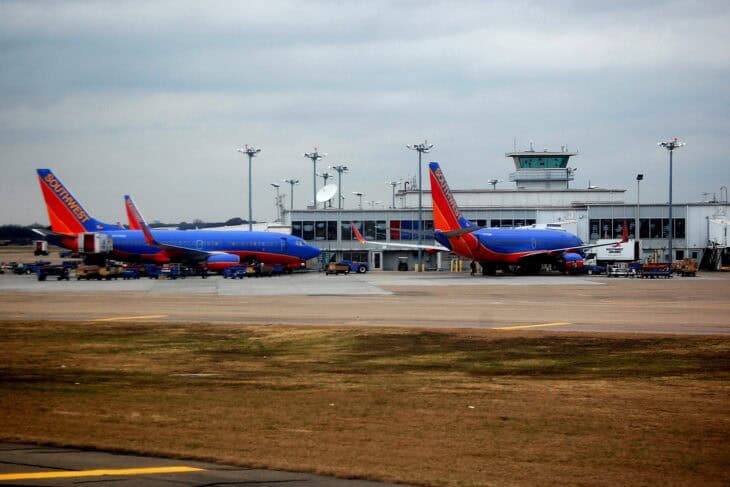

Thursday was the second rough day running. The Dallas Morning News reported that the FAA had issued a ground stop at DFW on Wednesday afternoon, September 30, which was downgraded to a ground delay by 4 p.m.
Up to 3 inches of rain around the airport
The National Weather Service office in Fort Worth issued a Flood Watch at 1:43 a.m. Thursday that runs until 7 a.m. Friday. It forecast widespread rain of 2 to 4 inches, with up to 6 inches in places.
At 8:43 a.m. the same office issued a Flash Flood Warning until 10:30 a.m., saying up to 3 inches had already fallen. The warning named Grapevine, Irving, Euless and Coppell, the four cities the DFW airfield sits in.
Why a Dallas storm delays flights in San Antonio
A ground stop does not close the airport under the storm. In the FAA’s own definition, flights headed to the affected airport are held at their departure point until the stop ends.
The FAA uses one when demand will exceed what the airport can accept for a short time, when the arrival rate drops to zero, or as a bridge to a longer-term fix such as a ground delay program, which gives each inbound flight a set departure time at its origin.
So a passenger in San Antonio feels a storm over Dallas before it ever reaches them. Their DFW flight is held on the ground in San Antonio, and any connection they planned at DFW can slip with it.
The FAA’s definitions say the most common reason an airport’s acceptance rate drops is bad weather. AeroCorner’s explainer on ground stops and flow control goes further into how the system works.
What American and Southwest passengers can do
American’s DFW travel alert waives the change fee for tickets in any fare class, Basic Economy included, bought by September 29 for travel to, from or through DFW on September 30 or October 1. The new flight must be between the same cities and fall between September 30 and October 4; moving to a different cabin means paying the difference.
American’s alert says those changes must be booked by October 1. Southwest’s advisory lets customers flying to, from or through Love Field on October 1 rebook or fly standby within 14 days of the original date, between the same cities, without paying a fare difference.
Southwest also says that if it cancels or significantly delays a flight and the customer chooses not to travel, the customer may be eligible for a refund of the unused ticket, even a non-refundable one.
Sources and references used for research and fact-checking.
- FAA, NAS Status: airport status information (DAL ground stop, DFW ground delay program)
- FAA Air Traffic Control System Command Center, Air traffic control message definitions (Ground Stop, Ground Delay Program)
- National Weather Service Fort Worth, Flood Watch and Flash Flood Warning, October 1, 2026
- American Airlines, Travel alerts: Thunderstorms, Dallas-Fort Worth, Texas
- Southwest Airlines, Travel advisory: Dallas inclement weather
Get the Newsletter
The latest aviation news and stories sent to your inbox.
About the Author

Tim is the owner and lead editor of AeroCorner since 2019, overseeing aviation content covering aircraft, airlines, airports, and the broader aviation industry. Through years of researching, writing, editing, and publishing aviation-focused content, he has developed extensive practical knowledge of commercial aviation and air travel. Based in Asia and a frequent traveler himself, Tim also brings firsthand passenger experience to AeroCorner’s coverage. Outside of publishing, he has also explored aviation firsthand through hands-on flight training in New Zealand.