



Table of Contents
| Question | MiG-15 | MiG-17 |
|---|---|---|
| NATO name | Fagot | Fresco |
| First flight | 30 December 1947 | January 1950 |
| Entered service | 1949 | October 1952 |
| Number built | About 13,100 in the USSR, plus licence builds | 10,649, including Polish, Czechoslovak and Chinese builds |
| Wing sweep | 35 degrees | 45 degrees inboard, 42 degrees outboard |
| Wing fences | Two per wing | Three per wing |
| Afterburner | None | MiG-17F only |
| Guns | One 37 mm and two 23 mm cannon | One 37 mm and two 23 mm cannon |
| First big combat | Korea, from 1 November 1950 | Taiwan Strait, 1958; Vietnam from 1965 |
What is the difference between the MiG-15 and the MiG-17
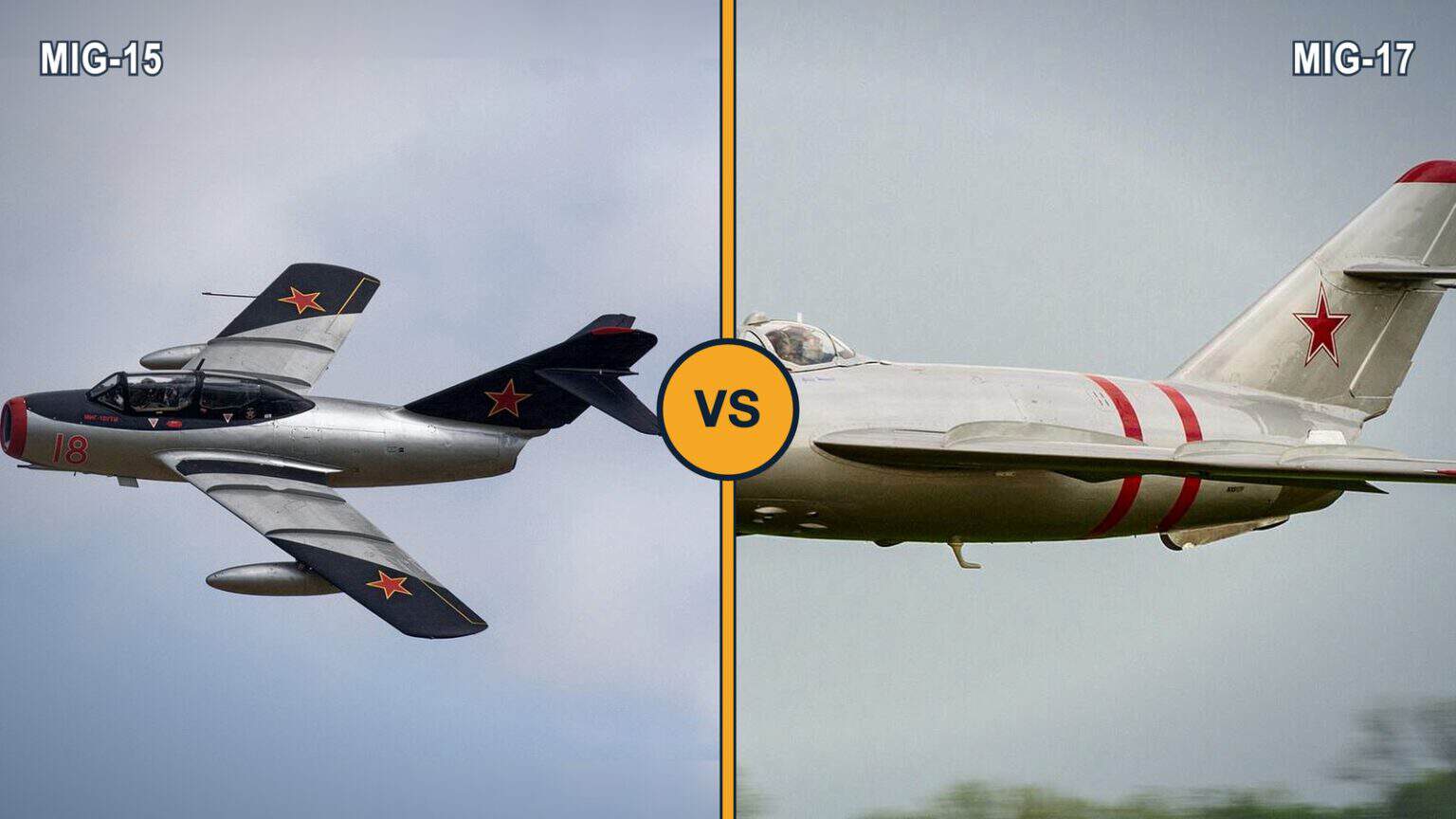
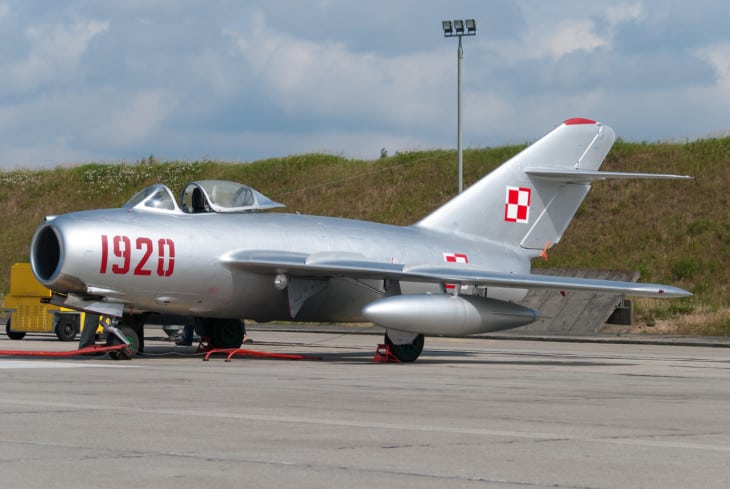
The quickest tell is the wing. The MiG-15 has a single 35-degree sweep, while the MiG-17 has a compound sweep of 45 degrees inboard and 42 degrees outboard.
The MiG-17 also has a thinner wing and tailplane, a third wing fence on each wing and a ventral fin. Its rear fuselage is about 1 m longer and less tapered.
Underneath, it is an evolution rather than a new design. The forward fuselage, landing gear and gun installation carry over from the MiG-15.

Engines and the afterburner
Both fighters use Klimov VK-1 family engines. Early MiG-17s kept the plain VK-1.
The MiG-17F switched to the VK-1F, which adds an afterburner. It was the first Soviet fighter to carry one and the F-model has more thrust than the plain VK-1 version.
The MiG-15 never had an afterburner. The widget above lists the thrust, speed and climb figures for the two.
Handling: the MiG-15 problem the MiG-17 was built to fix
The MiG-15 was simple and rugged, but unforgiving. Pilots were told not to exceed Mach 0.92, where the controls lost effectiveness, and US testing found heavy buffeting past that point and pitch-up near Mach 0.95.
It also spun easily after a stall and gave little warning. UN pilots saw MiGs enter spins 56 times in Korea, with at least 25 crashes and ten ejections.
The MiG-17 was designed to stay controllable at higher Mach numbers. Skilled pilots could briefly go supersonic in a shallow dive, though it still tended to pitch up just short of Mach 1.
Which one fought in Korea
The MiG-15. It entered combat on 1 November 1950, when the 50th Fighter Aviation Division joined the war and the first jet-versus-jet combat took place.
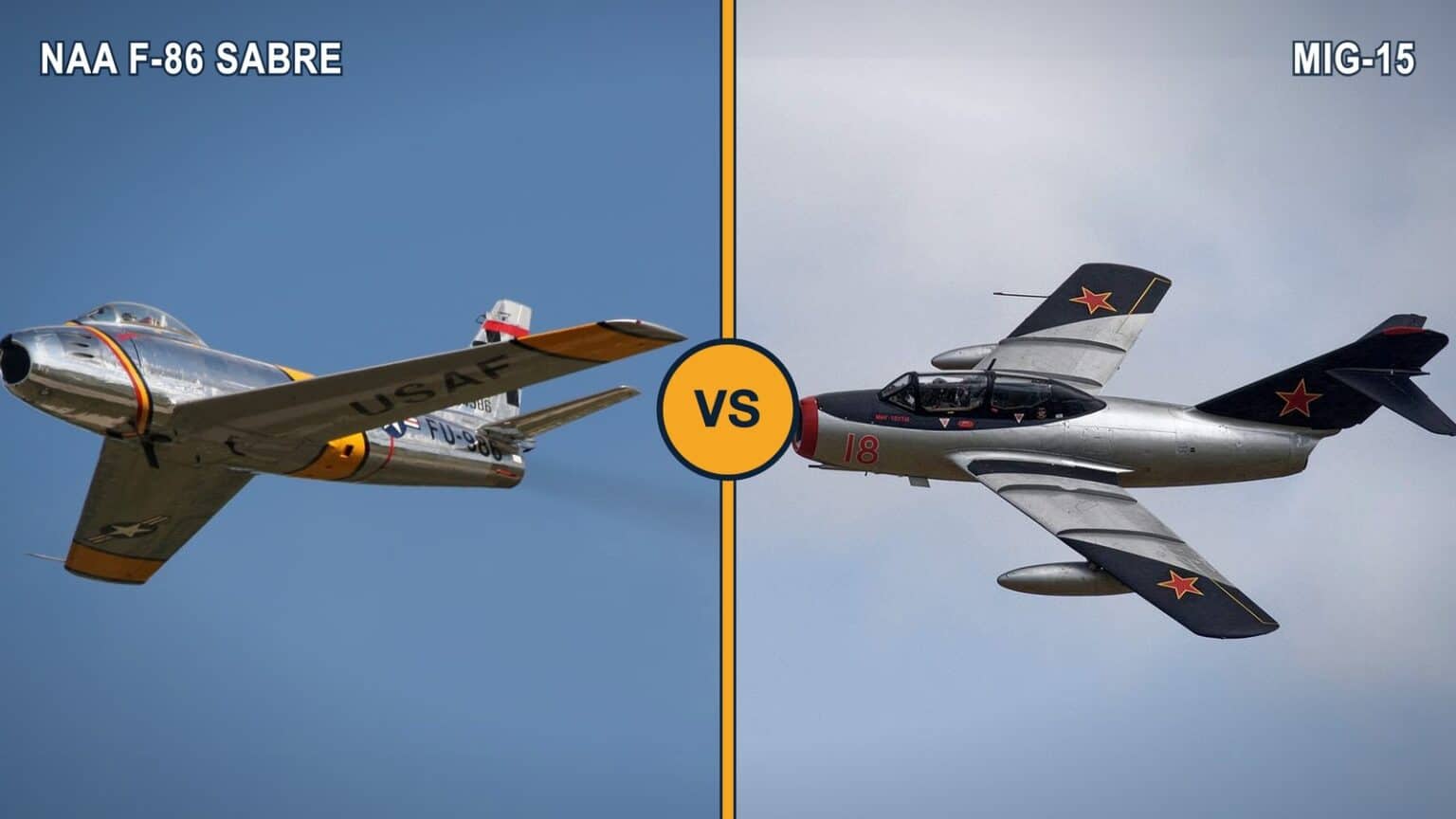
The US rushed F-86 Sabre squadrons to Korea in December 1950. The Sabre was the only close contemporary that matched the MiG-15 in most performance measures.
A RAND report estimated the F-86’s overall kill-to-loss ratio at 1.8 to 1, and about 1.3 to 1 against Soviet-flown MiGs. Other authors put it closer to 2 to 1, and Soviet claims were likely overstated.
The MiG-17 sat the war out. Production started too late, and output went to the MiG-15 instead.
Vietnam: where the MiG-17 earned its reputation
The MiG-17’s first combat came earlier, over the Taiwan Strait in 1958 against Nationalist Chinese F-86s. Vietnam was where it fought in numbers.
On 3 April 1965, six MiGs from Noi Bai attacked US Navy aircraft supporting a strike on the Thanh Hoa Bridge. The next day the MiG-17s struck back at the bridge raiders.
The MiG-17 first saw heavy combat over North Vietnam. On 4 April 1965, four MiG-17s of the 921st Fighter Regiment shot down two F-105Ds attacking the Thanh Hoa Bridge.
Between 1965 and 1972, MiG-17 units claimed 71 aerial victories, including 32 F-4s and 16 F-105s. North Vietnam lost 63 MiG-17s in air combat. Wikipedia flags those totals as approximate.
Top MiG-17 ace Nguyen Van Bay claimed 7 victories.

Variants and production: bis, F and the rest
The MiG-15 family was built in huge numbers. The USSR produced 1,344 MiG-15s, 8,352 improved MiG-15bis fighters and 3,434 two-seat trainers.
The MiG-15bis entered service in early 1950 with the Klimov VK-1 engine, revised airbrakes and a new canopy. Czechoslovakia and Poland added licence production.
The MiG-17 family was smaller. By 1958 the Soviet Union had built 5,467 MiG-17s, 1,685 afterburning MiG-17Fs, 225 MiG-17P radar-equipped fighters and 668 MiG-17PFs.
Poland and China built more than 2,600 under licence. That is why so many surviving MiG-17s are Polish Lim-5 or Chinese J-5 airframes.
Guns and firepower
The two jets carry the same basic gun package: one 37 mm cannon and two 23 mm cannon. On the MiG-17 that is an N-37 cannon with 80 rounds per gun.
The MiG-15 carried 80 rounds for each 23 mm gun and 40 rounds for the 37 mm gun. The MiG-15bis moved the 23 mm guns closer together.
How many were lost, and what the West learned
About 659 MiG-15s are admitted lost in Korea: 335 Soviet, 224 Chinese and roughly 100 North Korean. The North Korean figure rests on defector accounts.
The US also tested captured MiG-17s in its Have Drill program. Wikipedia reports a kill ratio of about 2 to 1 for US aircraft against North Vietnamese MiG-17s and MiG-21s.
Is the MiG-15 or the MiG-17 better
The MiG-17 is the better fighter. It has the thinner wing, the better high-speed control and, in F-model form, an afterburner.
The MiG-15 is the more historically important one. It changed air combat in 1950 and forced the US to rush the F-86 into the war.
Neither could match a supersonic fighter. The Korean War fighter jets story covers the MiG-15’s opponents in more detail.
A MiG-15 you can still see
On 21 September 1953, North Korean Lieutenant No Kum-sok landed his MiG-15 at Kimpo Air Base. US test pilots, including Chuck Yeager, evaluated it.
Yeager reached Mach 0.98 in it but could go no faster and lost roll control. That aircraft is now displayed at the National Museum of the United States Air Force.

FAQ
Sources and references used for research and fact-checking.
About the Author

Tim is the owner and lead editor of AeroCorner since 2019, overseeing aviation content covering aircraft, airlines, airports, and the broader aviation industry. Through years of researching, writing, editing, and publishing aviation-focused content, he has developed extensive practical knowledge of commercial aviation and air travel. Based in Asia and a frequent traveler himself, Tim also brings firsthand passenger experience to AeroCorner’s coverage. Outside of publishing, he has also explored aviation firsthand through hands-on flight training in New Zealand.