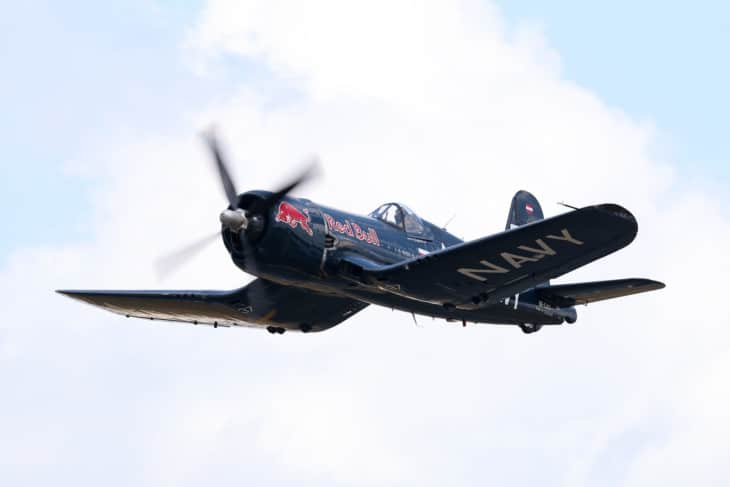
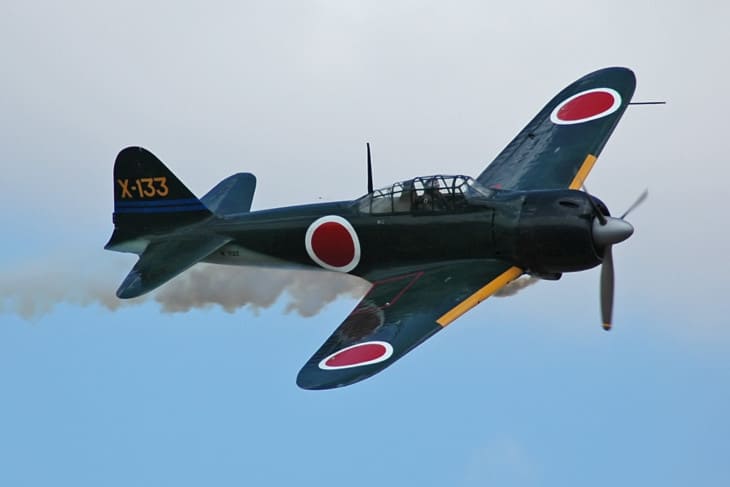
The F4U Corsair and the A6M Zero are World War II’s iconic fighter planes. Both planes had strengths and weaknesses, but F4U Corsair vs Zero, which ultimately came out on top? Let’s take a closer look at these two warbirds and find out.
Vought F4U Corsair
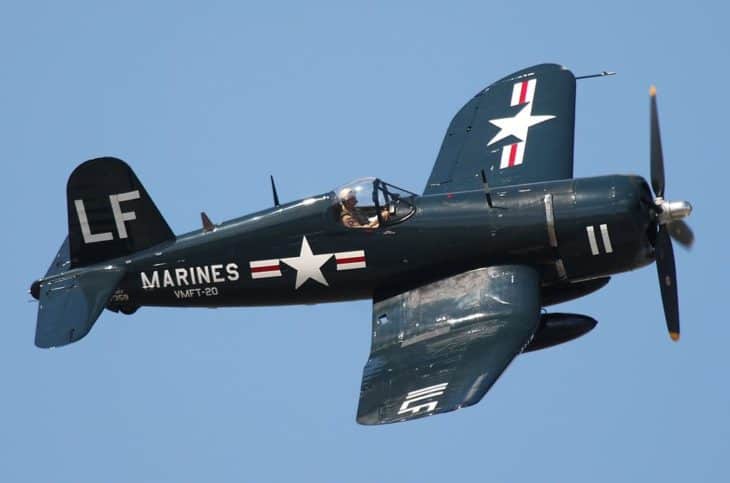
The Corsair had a powerful engine, and its unique inverted gull-wing design gave it excellent handling characteristics. The plane was also armed with six .50-caliber machine guns, making it a fearsome opponent in dogfights.
Throughout the war, the Corsair was used by the US Navy and the US Marine Corps, quickly becoming one of the most feared planes in the skies.
Why was it developed and built?
The F4U Corsair was a highly successful fighter aircraft used by the United States during World War II. The plane was first flown in 1940, and it quickly became clear that Corsair was a superior fighter to anything else in the sky.
What purpose did it serve?
The F4U Corsair was a carrier-based fighter plane used by the United States Navy and Marine Corps. It first flew in 1940 and saw action in World War II, Korea, and Vietnam.
By the war’s end, more than 12,000 Corsairs had been built, and the plane remained in service for many years afterward. Today, the F4U Corsair is widely considered one of the greatest fighter aircraft ever built.
Mitsubishi A6M Zero

Aircraft zero was a Japanese fighter aircraft used during World War II. The aircraft proved extremely successful against Chinese fighters, outclassing them in speed and maneuverability. Nevertheless, the Zero remains an iconic symbol of Japanese engineering and military might.
Why was it developed and built?
The Mitsubishi A6M Zero was designed by a team of Japanese engineers led by Jiro Horikoshi. The initial design specification for the aircraft was created in 1937 to create a lightweight carrier-based fighter with good maneuverability and long range. It first flew in 1940 and saw action in World War II.
What purpose did it serve?
The aircraft’s excellent performance during the early years of the war helped push Japan to victory after victory across Southeast Asia and the Pacific Islands. It played a major role in subsequent Japanese victories in Southeast Asia and the Pacific Islands.
However, as Allied forces began to field better-trained pilots and more advanced aircraft, the Zero gradually lost its superiority over enemy fighters. The aircraft’s superb performance during the early years of the war helped propel it.
How are F4U Corsair and Zero different?
In the early days of World War II, the Japanese Zero ruled the skies. It was a maneuverable, fast, and deadly fighter plane, and American pilots fighting in the Pacific learned to fear it.
But in 1942, the tide began to turn with the debut of a new American fighter plane: the F4U Corsair. Let’s look at how these two planes stack up against each other.
Maneuverability
When it comes to maneuverability, the Zero has the Corsair beat. The Zero can make tight turns and change directions quickly, thanks to its lightweight design. The Corsair is a bit heavier and not quite as nimble, but it’s still a formidable opponent in aerial combat.
Speed
The Corsair is faster than the Zero, plain and simple. It can reach up to 440 miles per hour, while the Zero tops at around 400 miles per hour. That extra speed gives the Corsair a crucial advantage in battle.
Armament
The armament of these two planes is fairly similar. Both are armed with six .50 caliber machine guns, and both can carry bombs and other ordnance. However, the Corsair has one significant advantage: thanks to its larger size, it can carry more bombs than the Zero.
How are the F4U Corsair and Zero similar?
The F4U Corsair and the Zero were both designed for carrier-based operations and had folding wings to save space on deck. They were among the first aircraft to have tricycle landing gear, with their wheels arranged in a nose-wheel/main-wheel configuration.
This made them more stable during takeoff and landing and easier to control on the carrier deck. Both aircraft were also highly maneuverable, making them difficult targets in a dogfight.
In addition, they were both armed with machine guns and could carry bombs or torpedoes. However, there were also some significant distinctions between the two aircraft.
The Corsair was faster and had a longer range than the Zero, while the Zero was more agile and had a better climb rate. In addition, the Zero was designed for easy maintenance, while the Corsair was notoriously difficult to work on.
What’s better about the F4U Corsair?
The F4U Corsair is a much better aircraft than the competition for several reasons. It has a more powerful engine, which gives it a higher top speed and rate of climb. It also has a more aerodynamic design, which makes it more maneuverable.
Additionally, the Corsair is armed with six .50-caliber machine guns, while most other fighter planes only have four. Finally, Corsair’s cockpit is located further back on the fuselage, which gives the pilot better visibility.
All of these factors combine to make the F4U Corsair a superior aircraft.
What’s better about the Zero?
The A6M Zero had a range of over 3,000 miles, which was twice that of the American fighters at the time, and could reach speeds of up to 400 mph. The aircraft was also armed with 20 mm cannon and could carry a variety of bombs and torpedoes.
In addition, the A6M Zero was incredibly maneuverable due to its low weight and powerful engines, making it one of the most dangerous dogfighters of the war.
The A6M Zero was such a feared opponent that it was nicknamed “Zeke” by the Allies. Although newer Allied fighters eventually outclassed the A6M Zero, it remained a formidable opponent throughout the war.
Conclusion
The F4U Corsair and the A6M Zero were excellent fighter planes in their own right. However, when pitted against each other, the A6M Zero comes out on top thanks to its agility and lighter weight.