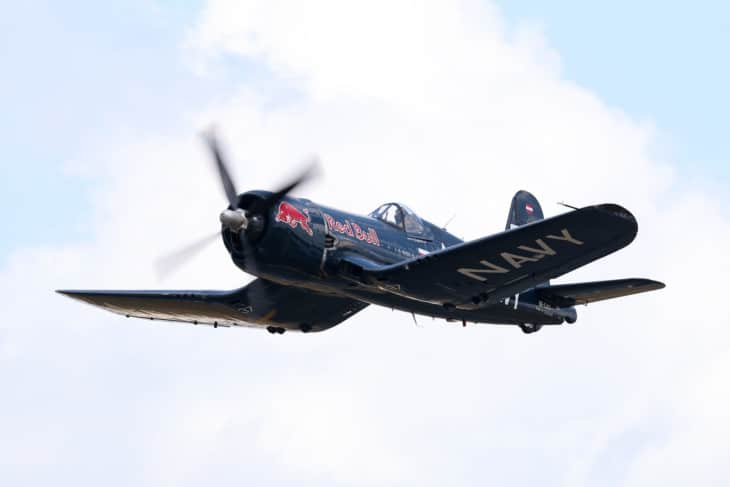

Both planes were designed for naval combat during World War II, but they couldn’t have been more different. The Corsair was a larger plane with a longer range, while the Bearcat was smaller and more agile. So, F4U Corsair vs F8F Bearcat, which one was better? Let’s take a closer look at each plane to find out.
About the F4U Corsair
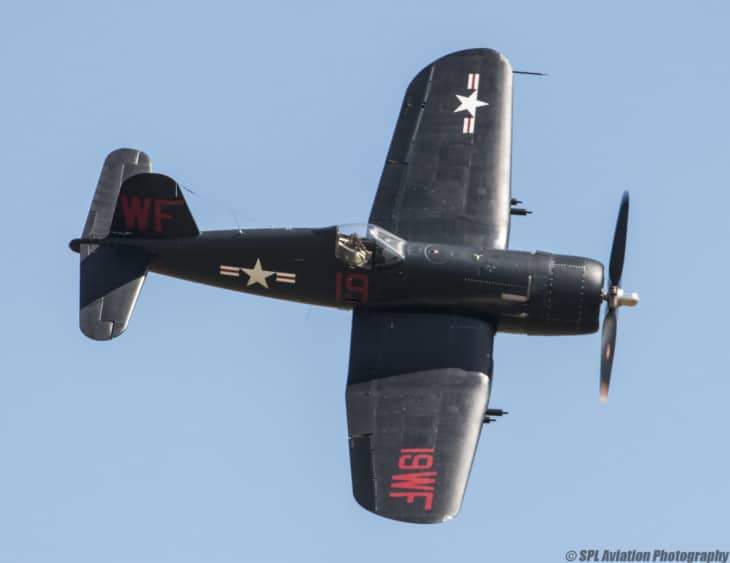
The F4U Corsair was a fighter aircraft that operated primarily in World War II and the Korean War. The aircraft quickly became known for its superior speed, aerodynamic design, and innovative gull-winged configuration.
In addition, the Corsair was highly maneuverable and well-suited for carrier-based operations. With its powerful engine and long range, the Corsair was also effective as a bomber escort.
The Corsair was initially used by the United States Navy and later adopted by the Royal Navy, the Royal Canadian Navy, and the Fleet Air Arm. Ultimately, the aircraft proved one of World War II’s most successful and versatile fighters.
Why was it developed and built?
Chance Vought designed the F4U Corsair to be a carrier-based fighter plane for the US Navy. It first flew in 1940 and quickly became one of the most recognizable aircraft of World War II thanks to its unique inverted gull-wing design.
What purpose did it serve?
The Corsair operated exclusively from aircraft carriers and achieved most of its successes in the Pacific Theater against Japanese forces. It also saw action in Europe towards the end of World War II against German forces and Korea during the Korean War.
About the F8F Bearcat

The F8F Bearcat was one of World War II’s fastest and most maneuverable piston-engine fighter aircraft. Grumman developed it as a successor to the earlier F6F Hellcat and first flew in 1944.
The Bearcat was powered by a powerful radial engine and featured a sleek, streamlined airframe. It was armed with four 20 mm cannons and could carry up to eight rockets or bombs.
Why was it developed and built?
The F8F Bearcat was also designed by Chance Vought as a carrier-based fighter plane for the US Navy. It first flew in 1944 and was originally intended to be an upgraded version of the F4U Corsair.
However, engineering challenges led to the Bearcat’s design being significantly different from its predecessor’s. A total of 1,265 Bearcats were built between 1945 and 1949, and they saw action in both World War II and the Korean War.
What purpose did it serve?
The Bearcat also operated exclusively from aircraft carriers and achieved most of its successes in the Pacific Theater against Japanese forces; however, it saw action after World War II ended due to production delays.
The Bearcat saw action in the closing stages of World War II, the Korean War, and the Vietnam War. Today, a handful of Bearcats remain in flying condition and are flown by private collectors and warbird enthusiasts.
How are the F4U Corsair and F8F Bearcat different?
The F4U Corsair and F8F Bearcat are two of the most iconic fighter planes of the Second World War. Though the United States Navy used both planes, they differed in several important ways.
The Corsair was a larger plane, with a wingspan of 41 feet and a length of almost 32 feet. It also had a more powerful engine, which gave it a top speed of over 400 miles per hour.
In contrast, the Bearcat was smaller and lighter, with a wingspan of only 35 feet and a length of just under 28 feet. Its engine was less powerful, making the Bearcat more maneuverable than the Corsair.
As a result, the Bearcat was often used in dogfights, while the Corsair was typically used for longer-range missions. Though both planes were instrumental in winning the war, their different strengths meant they were used for different purposes.
How are the F4U Corsair and F8F Bearcat similar?
F4U Corsair vs F8F Bearcat are both World War II’s most iconic fighter aircraft. Though they served in different theatres and played different roles, they were both exceptional aircraft in their own right.
- The Corsair was a larger and heavier aircraft with a more powerful engine than the Bearcat. It was also faster and had a longer range.
- On the other hand, the Bearcat was more agile and had a higher rate of climb. In addition, the Bearcat could carry more weapons than the Corsair.
Both aircraft were extremely successful in combat, with the Corsair shooting down 2,140 enemy aircraft and the Bearcat destroying 24 enemy planes in just six months. Though they differed in many ways, the Corsair and the Bearcat were excellent examples of American military engineering.
What’s better about the F4U Corsair?
The Corsair is a unique aircraft. While it shares many similarities with other fighters of its time, several features set it apart from the competition. One key advantage is its powerful engine.
The Corsair is equipped with a 14-cylinder radial engine that provides significantly more power than the inline engines used in most other fighters. This allows Corsair to reach higher speeds and climb faster than its counterparts.
Corsair’s large wing area also gives it superior handling characteristics, particularly at low speeds. This makes Corsair a more versatile aircraft, capable of operating from aircraft carriers and land-based airfields.
Finally, Corsair’s distinctive gull-wing design sets it apart from other fighters and makes it instantly recognizable. With its powerful engine, excellent handling, and unique design, the Corsair is truly a one-of-a-kind aircraft.
What’s better about the F8F Bearcat?
The F8F Bearcat is a single-engine fighter aircraft used by the United States Navy during World War II.
- It was designed to be smaller and lighter than its predecessor, the F4U Corsair, and it was successful in this regard.
- The Bearcat was also faster and more maneuverable than the Corsair, making it a superior dogfighter.
- In addition, the Bearcat’s armament was more effective than the Corsair’s due to its four 20mm cannons.
Consequently, the Bearcat was a highly effective fighter aircraft, and it saw action in both the Pacific and European theaters of World War II.
Conclusion
So which plane came out on top in this legendary rivalry? It’s hard to say for sure. The F4U Corsair and F8F Bearcat were excellent aircraft that played essential roles in WWII and beyond. They both had their strengths and weaknesses, but ultimately, it’s up to each pilot to decide which plane best suits their needs.