

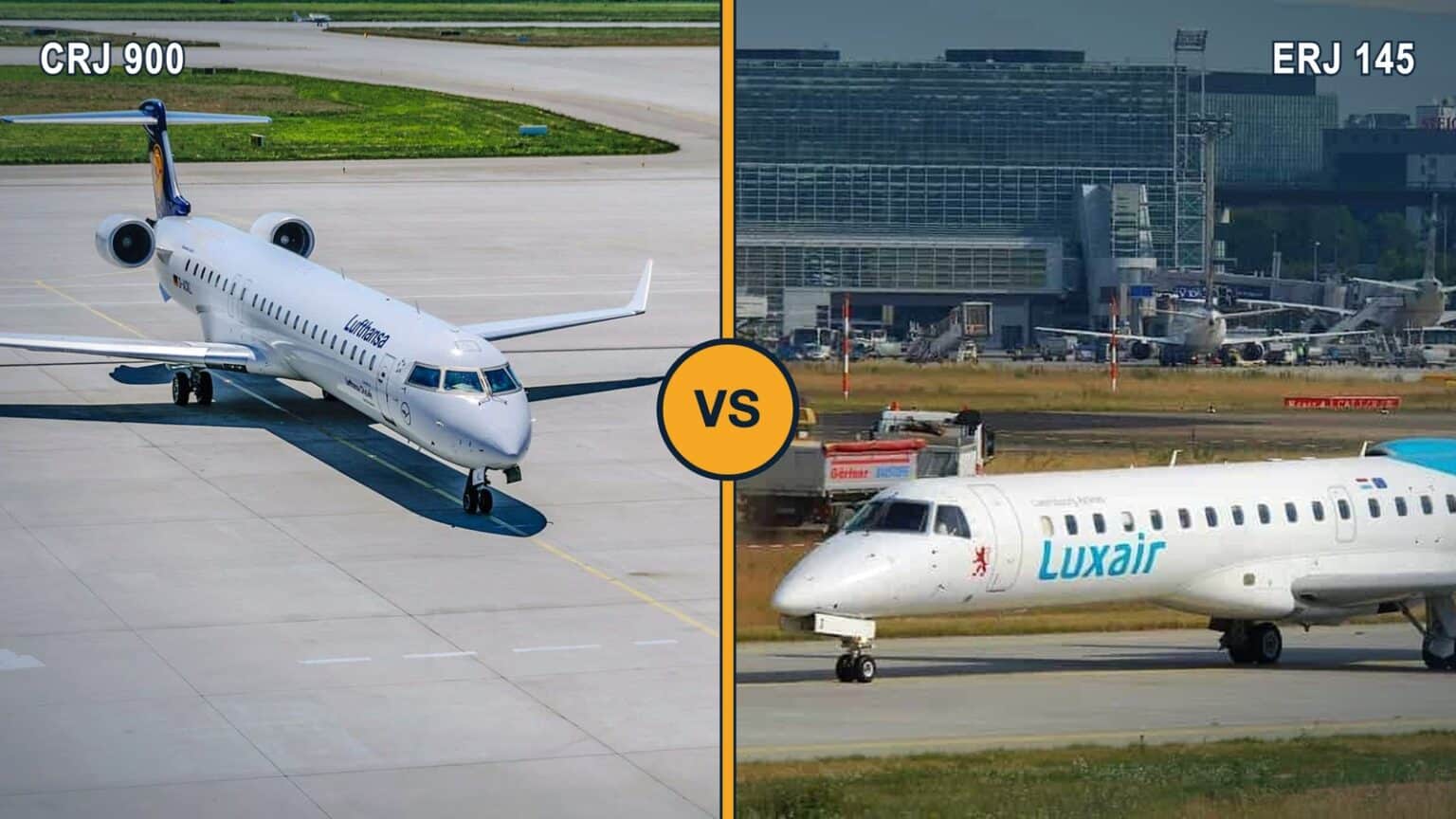
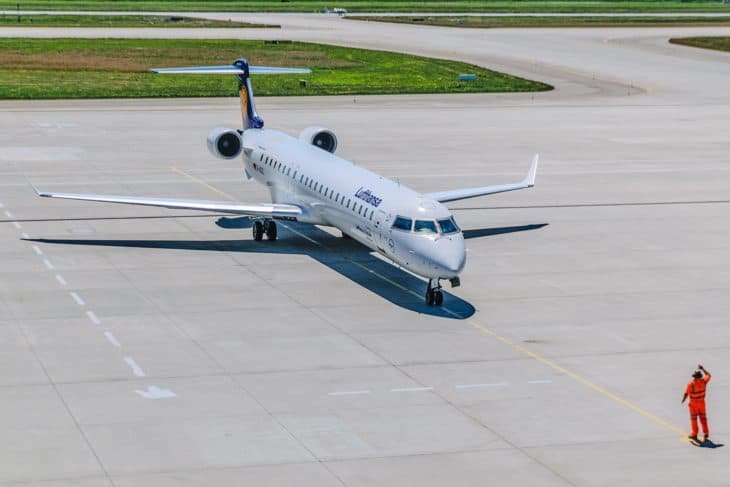
The Bombardier CRJ900 is the bigger and more powerful regional jet, with a longer fuselage, a wider cabin and a higher ceiling. The Embraer ERJ 145 is the smaller 50-seat jet that cost far less to buy.
On range they are almost level. The real choice is how many seats a route needs and how long a runway the airport has.

General
Bombardier CRJ 900
Manufacturer
Bombardier
ICAO code
CRJ9
Produced
2001–2020
Price
$46.5 million (1900)
Engine
2 × General Electric CF34-8C5 turbofans
Engine type
Turbofan
Thrust
2 × 13,123 lbf · 58 kN
+61% (total)
Avionics
Rockwell Collins ProLine 4
Wing tips
No winglets
Seats
38 economy · 20 business · 12 first
Crew
—
Embraer ERJ 145
Manufacturer
Embraer
ICAO code
E145
Produced
1992–2020
Price
$21 million (1900)
Engine
2 × Rolls-Royce AE3007 A
Engine type
Turbofan
Thrust
2 × 8,169 lbf · 36 kN
-38% (total)
Avionics
Honeywell Primus 1000
Wing tips
No winglets
Seats
50
Crew
2
Dimensions
Bombardier CRJ 900
Cabin width
8 ft 5 in
2.57 m
8 ft 5 in
2.57 m
+22%
Cabin height
6 ft 2 in
1.89 m
6 ft 2 in
1.89 m
+4%
Cabin length
69 ft 5 in
21.16 m
69 ft 5 in
21.16 m
+28%
Exterior length
118 ft 11 in
36.25 m
118 ft 11 in
36.25 m
+21%
Tail height
24 ft 7 in
7.50 m
24 ft 7 in
7.50 m
+11%
Fuselage diameter
8 ft 10 in
2.69 m
8 ft 10 in
2.69 m
+18%
Wing span
81 ft 7 in
24.87 m
81 ft 7 in
24.87 m
+24%
Baggage volume
82 ft 7 in
25.17 m
82 ft 7 in
25.17 m
+174%
Embraer ERJ 145
Cabin width
6 ft 11 in
2.10 m
6 ft 11 in
2.10 m
-18%
Cabin height
6 ft 0 in
1.82 m
6 ft 0 in
1.82 m
-4%
Cabin length
54 ft 1 in
16.49 m
54 ft 1 in
16.49 m
-22%
Exterior length
98 ft 0 in
29.87 m
98 ft 0 in
29.87 m
-18%
Tail height
22 ft 2 in
6.75 m
22 ft 2 in
6.75 m
-10%
Fuselage diameter
7 ft 6 in
2.28 m
7 ft 6 in
2.28 m
-15%
Wing span
65 ft 9 in
20.04 m
65 ft 9 in
20.04 m
-19%
Baggage volume
30 ft 2 in
9.20 m
30 ft 2 in
9.20 m
-63%
Weights
Bombardier CRJ 900
Max payload
23,300 lb
10,600 kg
23,300 lb
10,600 kg
+83%
Fuel capacity
2,897 gal
10,967 L
2,897 gal
10,967 L
+71%
Max takeoff weight
84,500 lb
38,300 kg
84,500 lb
38,300 kg
+74%
Max landing weight
—
—
—
Embraer ERJ 145
Max payload
12,800 lb
5,800 kg
12,800 lb
5,800 kg
-45%
Fuel capacity
1,690 gal
6,397 L
1,690 gal
6,397 L
-42%
Max takeoff weight
48,500 lb
22,000 kg
48,500 lb
22,000 kg
-43%
Max landing weight
42,500 lb
19,300 kg
42,500 lb
19,300 kg
Performance
Bombardier CRJ 900
Max cruise speed
475 kt · 547 mph
880 km/h
475 kt
547 mph
880 km/h
+5%
Approach speed
—
—
—
Rate of climb
2,000 ft/min
10 m/s
2,000 ft/min
10 m/s
0%
Range
1,553 nm · 1,790 mi
2,880 km
1,553 nm
1,790 mi
2,880 km
+0%
Service ceiling
41,000 ft
12,500 m
41,000 ft
12,500 m
+11%
Takeoff distance
6,400 ft
1,940 m
6,400 ft
1,940 m
-14%
Landing distance
5,300 ft
1,620 m
5,300 ft
1,620 m
+16%
Embraer ERJ 145
Max cruise speed
453 kt · 521 mph
839 km/h
453 kt
521 mph
839 km/h
-5%
Approach speed
135 kt · 155 mph
250 km/h
135 kt
155 mph
250 km/h
Rate of climb
2,000 ft/min
10 m/s
2,000 ft/min
10 m/s
0%
Range
1,550 nm · 1,780 mi
2,870 km
1,550 nm
1,780 mi
2,870 km
0%
Service ceiling
37,000 ft
11,300 m
37,000 ft
11,300 m
-10%
Takeoff distance
7,450 ft
2,270 m
7,450 ft
2,270 m
+17%
Landing distance
4,600 ft
1,400 m
4,600 ft
1,400 m
-14%
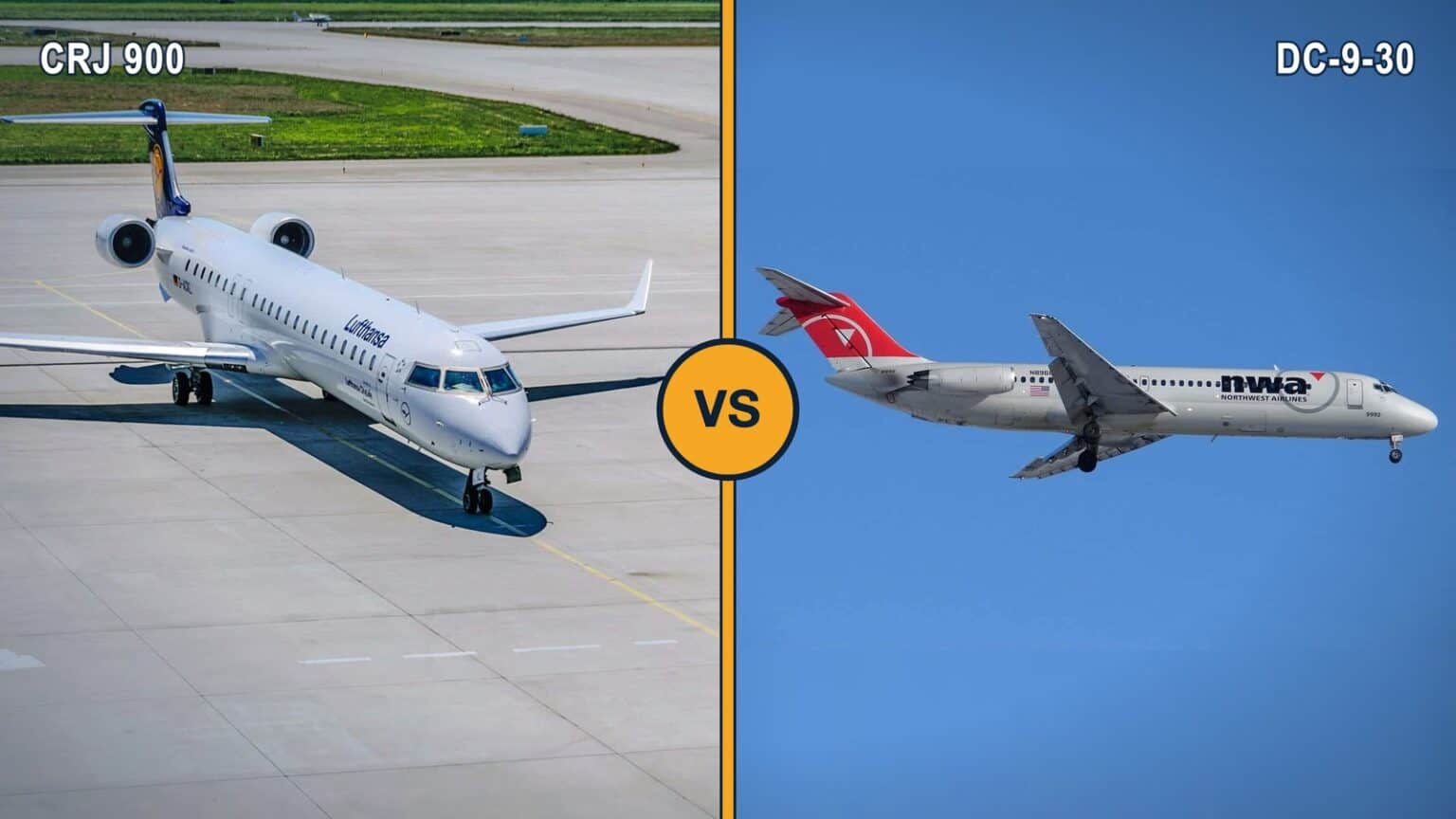
Bombardier CRJ 900 comparisons
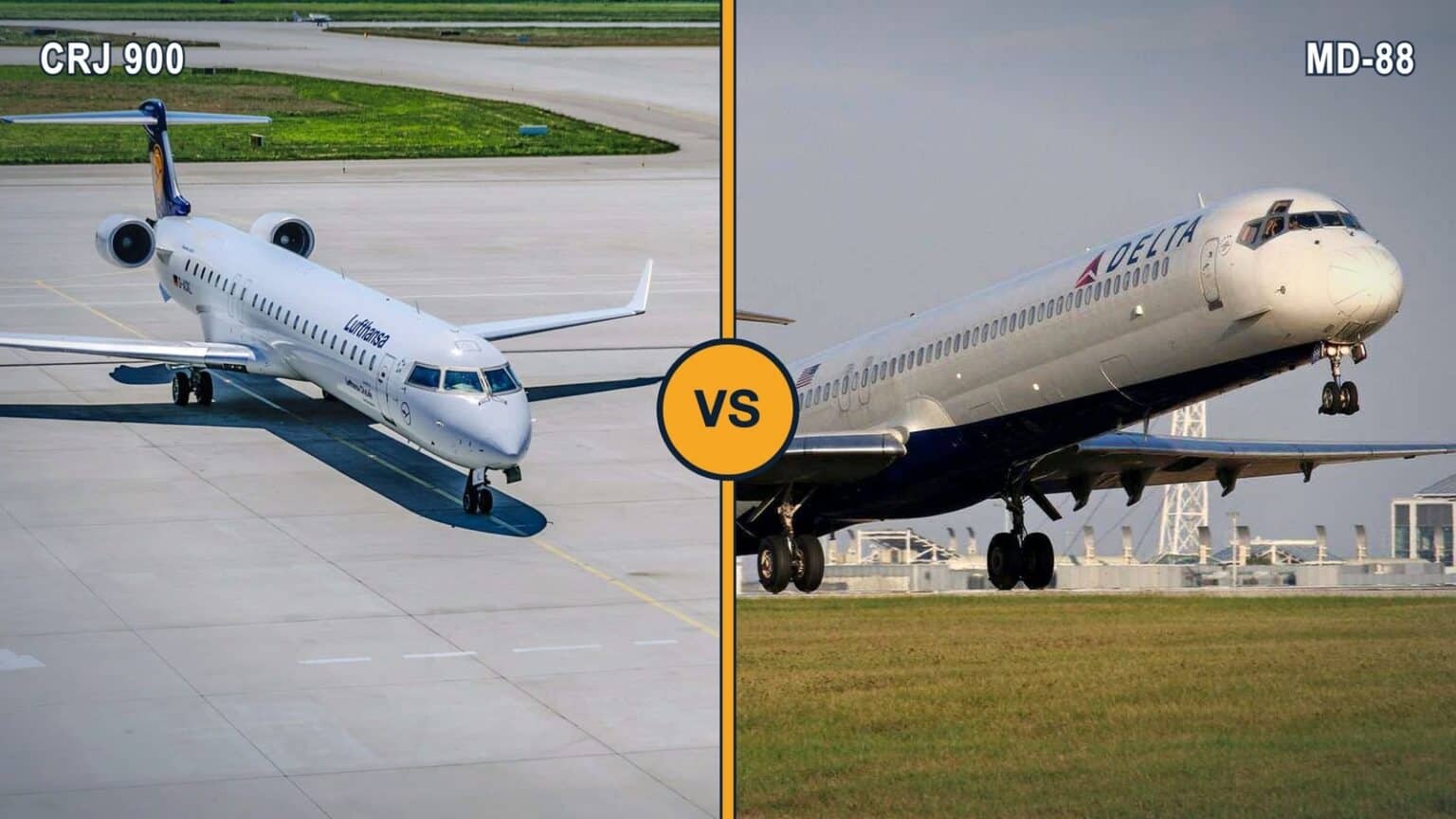
Embraer ERJ 145 comparisons

Table of Contents
Size and cabin: the CRJ900 is a much bigger jet
The CRJ900 is the largest gap between these two jets. It is 118 ft 11 in (36.25 m) long, against 98 ft 0 in (29.87 m) for the ERJ 145.
The wing tells the same story: 81 ft 7 in (24.87 m) on the CRJ900 and 65 ft 9 in (20.04 m) on the ERJ 145. The CRJ900 also weighs far more, with a maximum takeoff weight of 84,500 lb (38,300 kg) against 48,500 lb (22,000 kg).
Inside, the ERJ 145 is a 50-seat jet with three seats across, one on one side of the aisle and two on the other. The CRJ900 carries up to 90 passengers in one dense class, or a three-class layout of 38 economy, 20 business and 12 first-class seats in our database.

Power and speed: more thrust, higher ceiling
The CRJ900 uses two General Electric CF34-8C5 turbofans rated at 13,123 lbf each. The ERJ 145 uses two Rolls-Royce AE3007 A turbofans at 8,169 lbf each.
That extra thrust shows up in the numbers. The CRJ900 lists a maximum cruise speed of 547 mph (880 km/h) and a ceiling of 41,000 ft (12,500 m), while the ERJ 145 lists 521 mph (839 km/h) and 37,000 ft (11,300 m).
Climb rate is a tie at 2,000 ft/min (10 m/s). A higher ceiling lets the CRJ900 climb above more weather and traffic on its longer routes.
Range and fuel: nearly identical on paper
Range barely separates them. The CRJ900 lists 1,790 miles (2,880 km) and the ERJ 145 lists 1,780 miles (2,870 km).
Fuel use differs more, but not in a way that settles the argument. The database lists 0.63 nm/gal for the CRJ900 and 0.92 nm/gal for the ERJ 145, and the CRJ900 moves many more seats on every flight.
Fuel capacity is 2,900 gal (11,000 L) on the CRJ900 and 1,690 gal (6,400 L) on the ERJ 145. Both burn Jet A.
Runways: short fields and landing speeds
Listed takeoff distance is 6,400 ft (1,940 m) for the CRJ900 and 7,450 ft (2,270 m) for the ERJ 145. Listed landing distance is 5,300 ft (1,620 m) and 4,600 ft (1,400 m).
Treat these as published figures at specific weights, not a promise for every airport. A hot day, a full load or a short runway changes the answer for either jet.
The ERJ 145 lists an approach speed of 155 mph (250 km/h). Our database has no approach speed for the CRJ900, so that comparison is left open.
The passenger view: cabin width and comfort
The CRJ900 cabin is 8 ft 5 in (2.57 m) wide and 6 ft 2 in (1.89 m) high. The ERJ 145 cabin is 6 ft 11 in (2.10 m) wide and 6 ft 0 in (1.82 m) high.
The CRJ900 also has the larger hold, at 889 ft³ (25.2 m³) of baggage volume against 325 ft³ (9.2 m³).

Where each jet wins
The CRJ900 wins on capacity, cabin room, speed, ceiling and baggage space. It suits airlines that want a bigger regional jet on busier routes and can use first and business seats.
The ERJ 145 wins on price and on being the right-size jet for thin routes. Our database lists it at $21 million against $46.5 million for the CRJ900.

Its three-across cabin has no middle seat, since each row has a single seat on one side and a pair on the other.

History: two different timelines
The ERJ 145 came first. The definitive ERJ 145 flew on August 11, 1995, and entered revenue service with ExpressJet Airlines on April 6, 1997.
The CRJ900 flew on February 21, 2001. Its first delivery was in April 2003, and Mesa Air Group was the launch customer.
Both are now out of production. Mitsubishi Heavy Industries closed its purchase of the CRJ program on June 1, 2020, and the last CRJ, a CRJ900, was delivered to SkyWest Airlines on February 28, 2021.
Who flies them today
Wikipedia names Endeavor Air as the largest CRJ900 operator, with PSA Airlines and Mesa Airlines also flying the type. Delta Connection is the main brand it flies under.
The ERJ 145 fleet has shrunk to a handful of operators. As of May 2025, Wikipedia lists JSX with 79 aircraft, Piedmont Airlines with 61 and CommuteAir with 53.
Both jets carry their two engines on the rear fuselage, so a quick way to tell them apart is size. The CRJ900 is the longer, bigger jet, and the ERJ 145 is the stubby 50-seater.
Airlines also pick between them for contract reasons. Wikipedia notes that some US airlines have an agreement with the pilots’ union that limits the number of 50-seat aircraft their affiliates can fly, which is one reason the ERJ 145 is not simply the default small jet.
What the specs do not cover
This table covers the history and the business behind each jet, which the spec widget above does not.
| Item | CRJ900 | ERJ 145 |
|---|---|---|
| First flight | February 21, 2001 | August 11, 1995 (definitive ERJ 145) |
| Launch customer | Mesa Air Group | ExpressJet Airlines (first revenue service, April 6, 1997) |
| Program owner today | Mitsubishi Heavy Industries (sale closed June 1, 2020) | Embraer |
| Last delivery | February 28, 2021, to SkyWest Airlines | Family production ended 2020 |
| Largest operator named by Wikipedia | SkyWest Airlines (series) | CommuteAir, 165 aircraft in August 2021 |
Verdict: which is better?
The CRJ900 is the better jet if you want capacity and performance. The ERJ 145 is the better fit if you want the lowest-cost 50-seater.
Neither wins everywhere, because they were built for different jobs. Pick by seats, route length and runway, not by reputation.
FAQ
The CRJ900 is the bigger, heavier and more powerful jet, while the ERJ 145 is the smaller 50-seat jet. The CRJ900 has a wingspan of 81 ft 7 in (24.87 m) against 65 ft 9 in (20.04 m) for the ERJ 145. Both carry their engines on the rear fuselage and both are out of production.
The CRJ900 is bigger on every main dimension. It is 118 ft 11 in (36.25 m) long, against 98 ft 0 in (29.87 m) for the ERJ 145, and its maximum takeoff weight is 84,500 lb (38,300 kg) against 48,500 lb (22,000 kg).
The ERJ 145 seats 50 passengers. The CRJ900 holds up to 90 passengers in a single dense class, and our database lists 38 economy, 20 business and 12 first-class seats for a three-class layout.
They are almost level. Our database lists a range of 1,790 miles (2,880 km) for the CRJ900 and 1,780 miles (2,870 km) for the ERJ 145, so route length rarely separates them.
No. Production of the ERJ family ended in 2020. Mitsubishi Heavy Industries closed its purchase of the CRJ program on June 1, 2020, and the last CRJ, a CRJ900, was delivered to SkyWest Airlines on February 28, 2021.
The ERJ 145 is the cheaper jet. Our database lists a price of $21 million for the ERJ 145 and $46.5 million for the CRJ900, which fits the size gap between them.
Sources and references used for research and fact-checking.
About the Author

Tim is the owner and lead editor of AeroCorner since 2019, overseeing aviation content covering aircraft, airlines, airports, and the broader aviation industry. Through years of researching, writing, editing, and publishing aviation-focused content, he has developed extensive practical knowledge of commercial aviation and air travel. Based in Asia and a frequent traveler himself, Tim also brings firsthand passenger experience to AeroCorner’s coverage. Outside of publishing, he has also explored aviation firsthand through hands-on flight training in New Zealand.