



Table of Contents
There’s no greater rivalry in the aviation world than between Airbus and Boeing, with the Airbus A-340 and Boeing 777 epitomizing this. This competitiveness has helped shape the market, leading to better travel experiences for all.
[compare-aircraft a=”7768″ b=”7732″]
We have more variants of each aircraft in our database. On the compare aircraft page you can compare any two aircraft yourself.
The Airbus A340
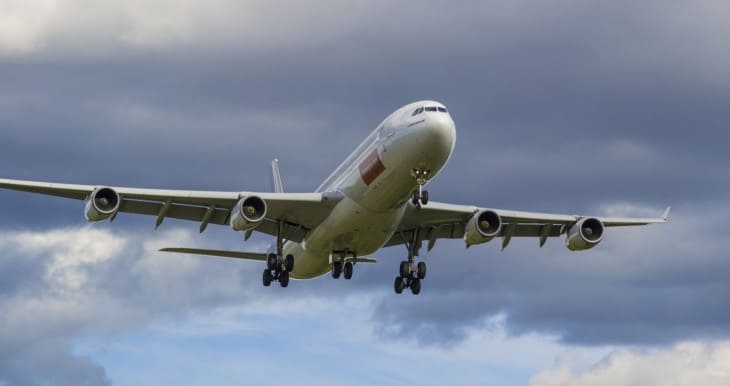
In 1985, ICAO introduced the Extended Range Twin-Engine Operations (ETOPS) regulations. They were meant to increase the operational safety of twin-engine airplanes. This meant that airlines with twin engines could only fly routes that were 60 minutes away from a nearby airport- in the event of emergencies.
In an attempt to work around this, Airbus developed the A-340, which had four engines but a smaller capacity. It was meant to offer a new way of transporting passengers across long distances. The A-340 owes its origins to the A-300 and A-320.
A340 Variants
Currently, there are four variants of this aircraft. These are:
- A340-200
Made its first maiden flight in 1987 and is the shortest variant in the series. It has a capacity of 303 passangers.
- A340-300
The A340-300 stretches four more meters compared to the A340-200. This has the advantage of adding capacity from 303 to 335. A second enhanced model- the A340-300E was later developed- with upgraded avionic and improved engines.
- A340-500
Compared to the other two, the A340-500 and 600 variants boast a higher capacity and extended range. The first client- Emirates- received its first craft in 2003.
The Boeing 777
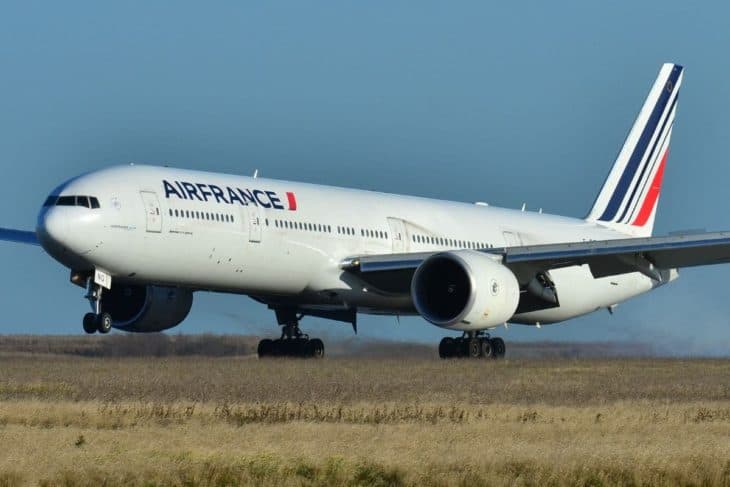
Not one to be left behind in the twin-engine long-haul category, Boeing came up with the 777 in response to Airbus’ A-330-200. Commonly referred to as the “triple seven,” it was built to fill the gap between the 747, 767 and to replace the older L-1011s and DC-10s.
The 777 has a capacity of between 305 to 440 passengers and a range of 4,210 to 8,270 miles. As of August 2019, the 777 was the most widely ordered and delivered wide-body aircraft. The most successful variant of the 777 being the 300ER- with over 844 placed orders.
777 Variants
- 777 Freighter
The 777F is a cargo version of the twinjet and shares similar features with the 200LR. It has a maximum payload of 224,900 lb and a range of 4,970.
- 777-200
This is the initial variant in the family. It has a maximum thrust of 340 kN each, 247.2 tonnes maximum take-off weight, 9700km range, and a capacity of 305 spread across three classes.
- 777-200ER
Originally going by the 777-200IGW, the 777-200ER (extended range) featured additional fuel capacity and increased MTOW, making it ideal for transatlantic routes. It has a capacity of 301 (3 classes), a range of 13747 Km, 417 kN each worth of thrust, and maximum take-off weight of 298.46 tonnes.
- 777-200LR
The 200 LR (longer range) entered into service in 2006 and is currently one of the longest-range commercial airliners. It has a capacity of 301 (3 classes), an engine thrust of 513 kN each, and a range of 8555 nautical miles.
- 777-300
It has an additional 60 extra seats, bringing the capacity to nearly 370 in three classes. Its engines produce 340 kN, 247,200 MTOW, and a range of 5,240 nautical miles.
- 777-300ER
The 300ER (extended range) has an increased fuel capacity that permits it a range of up to 7,370 nautical miles. It has a capacity of 396 passengers in a 2-class arrangement. The jet is powered by the GE90-115B turbofan, producing a maximum thrust of 513 kN each.
Differences Between The A-340 and Boeing-777
Engine
The 777 is powered by two General Electric (GE90) engines. They are the most powerful engines ever installed in the 777, each having a thrust rating of between 360 to 510 kN. It was later replaced by the G29X on the 777x in January 2020.
On the other hand, early A340-200/300 featured four CFM56s, with each producing 141 kN instead of the high-thrust turbofans on the A330 to bypass ETOPS restrictions. Later, the A340-500/600 upgraded to the Rolls-Royce Trent 500– thanks to the craft’s massive wings and additional weight.
Range
The triple seven was the first aircraft to be entirely designed in three-dimension by a computer. It has improved airfoil technology, flight deck design, and passenger comfort. Despite being smaller than the 747, it has an impressive range of between 5,240 to 9,385 nautical miles.
The A-340 is a true globe trotter. Over the years, it has covered some of the most challenging terrains while providing excellent passenger comfort. The airliner offers a range of up to 9,000 nautical miles.
Capacity
Boeings’ 777 can accommodate a typical three-class arrangement, with an up to ten abreast seating layout. It has a capacity of between 301 to 368 passengers. Keeping an eight-abreast economy cross-section, the A340-200/300 accommodates between 250 to 290 passengers.
How Are the Two Similar
Both the A340 and 777 series are aesthetically pleasing to look at. And to the untrained eye, distinguishing the two might be challenging. The two long-haul wide-body airplanes have little in similarity.
What’s Better About the A-340
Range
Following their inception, the A-340 family was unrivaled in terms of their range, thanks to the four CFMI CFM56-5C engines.
MTOW
Thanks to their elongated fuselage, more massive wings, and additional engines, the A340-200/300 could haul massive cargo than most other crafts. Their MTOW (maximum take-off weight) figures are 606,000 lb and 609,600 lb, respectively.
Size
The A340-300/600 managed to enjoy significant sales thanks to their large sizes. Clients were particularly interested in them due to their lower cost per seat. The two enjoyed enviable sales volume; though the same can’t be said about the smaller -200 and -500.
Higher Fuel Capacity
The A340-600 fuselage is stretched by 11.7 meters, while the wings by 3.15 meters. Hence, it is capable of carrying a staggering 204,500 liters of fuel.
What’s Better About The 777
Range
Since its debut in October 1990, the 777 series has captured over 60% of the market, with more than 38 clients placing close to 680 orders. This is in part, thanks to its long-range. In January 2006, the 777-200LR completed the world’s longest-range, under chief project pilot- Darcy-Hennemann and Chief program pilot- Santoni.
Fuel Efficiency
During an air show in Abu-Dhabi, the US planemaker launched a new-wide body aircraft- the B777-X. Boeing revealed that the model would be 12% more fuel-efficient than its main competitor- Airbus A350. In turn, airlines will enjoy a 10% reduction in operational costs. In essence, this makes the 777-X one of the most fuel-efficient aircraft to date.
Largest Jet Engine
Already crowned as the world’s largest, the GE9X mounted on the 777X is recognized as the world’s most powerful by the Guinness World Records on November 10th, 2017. The engine produced an impressive 134,300 pounds of thrust.
At the front fan, the engine measures 11 feet in diameter and houses advanced 4th generation carbon fiber composites. The ceramics offer a 60:1 pressure ratio; this drastically increases efficiency- despite being the largest in the GE90 family.
Technology
The 777 is a pioneer in overall aircraft design. It was the first major airliner to be digitally designed. Additionally, it makes use of powerful engines and advanced materials to produce an efficient and reliable plane.
The company has been at the forefront of research and development. Thanks to this, there have been continuous improvements in the 777 series- which is currently in the third generation with several variations.
Conclusion: A340 vs 777
Both pieces of engineering are impressive in their own rights. But, figures don’t lie. As of August 2020, nearly 2,048 Boeing 777 aircrafts of all variants have been manufactured and delivered to more than 80 clients.
With nearly 844 orders and 810 deliveries, the 777-300ER is by far the most popular variant, most of which were delivered to Emirates- the largest operator of the 777.
More airlines are increasingly grounding and retiring their fleet of 4 engine aircraft due to the high fuel and maintenance costs. They are simply not as competitive.
Seeing that it was nearly impossible to compete with the 777, Airbus decided to cease producing the A340 series in 2011. A total of 377 planes had been delivered.
In the end, my personal favorite is the 777. It’s an elegant, reliable, comfortable, high performing aircraft. It’s a shame that the A340 series production came to a halt, but Darwin said it best, its survival for the fittest.
About the Author

Articles credited to the AeroCorner Editorial Team are created or maintained by multiple aviation contributors working under a shared editorial framework. Content is researched using authoritative aviation sources and reviewed to ensure clarity, technical accuracy, and consistency across AeroCorner.