

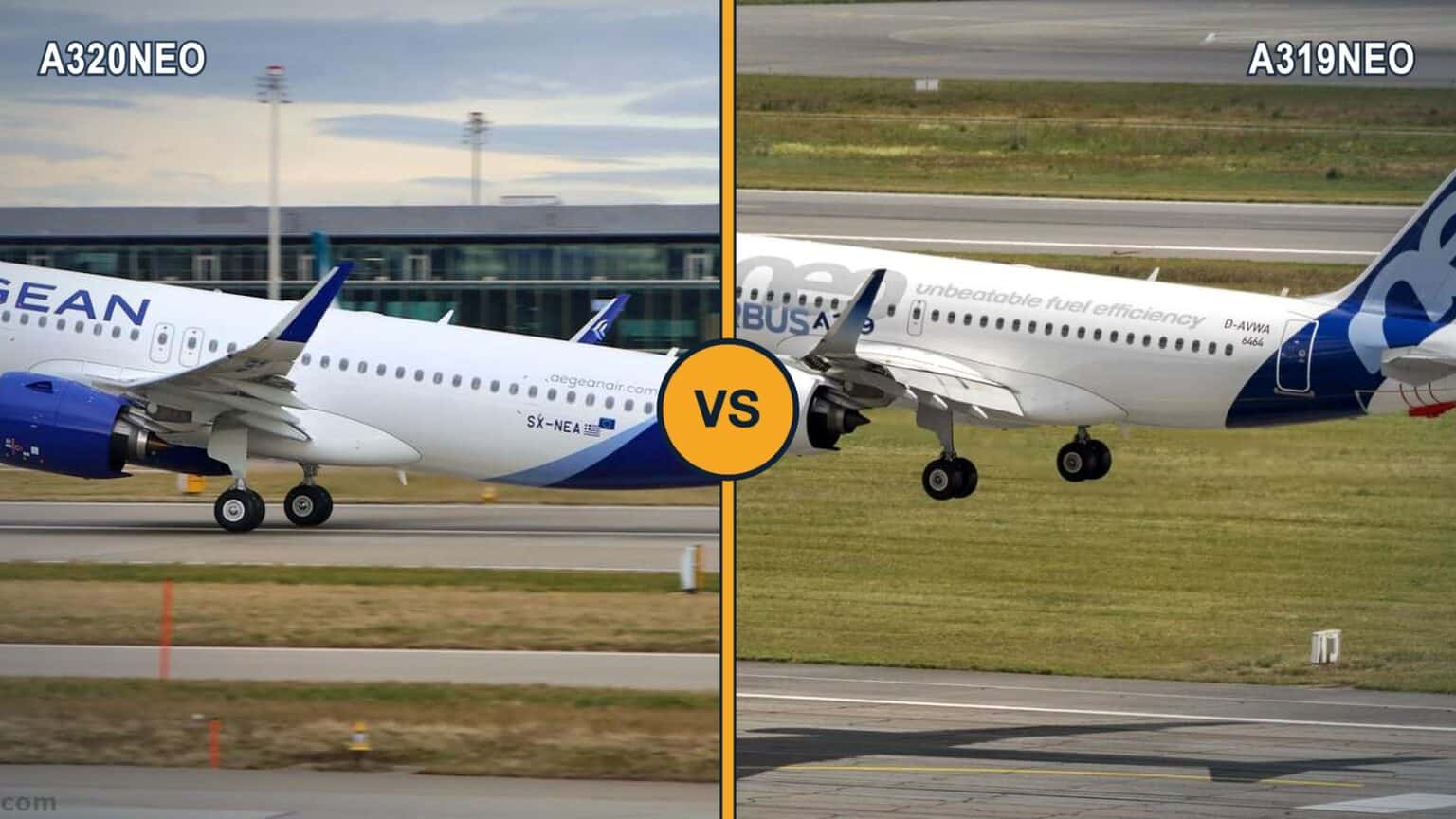

The Airbus A320neo is the bigger plane. It is 123 ft 3 in (37.57 m) long and seats up to 194 passengers, against 111 ft 0 in (33.84 m) and 160 for the A319neo.
The A319neo is the lighter, cheaper jet, with a 2018 list price of $101.5 million against $110.6 million. It also flies further, at 3,650 nm (4,200 mi, 6,760 km) against 3,400 nm (3,910 mi, 6,300 km).
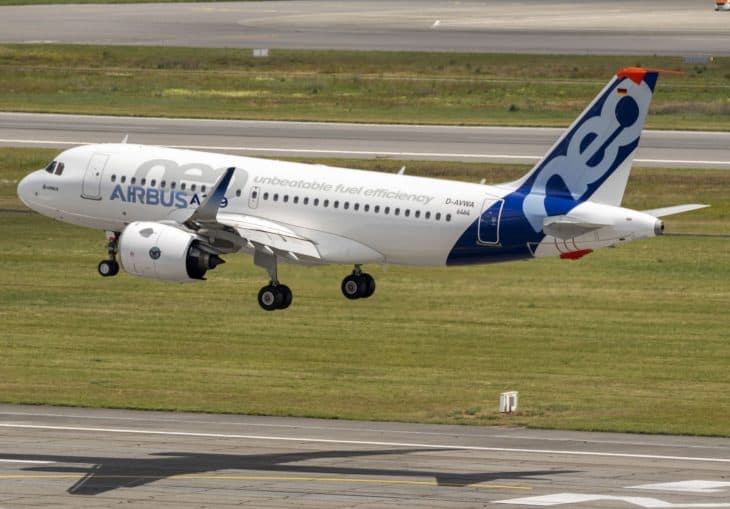
General
Airbus A320neo
Manufacturer
Airbus
ICAO code
A20N
Produced
2014–Present
Price
$110.6 million (2018)
Engine
2 × Pratt & Whitney PurePower PW1100G-JM / CFM International LEAP-1A
Engine type
Turbofan
Thrust
2 × 27,120 lbf · 121 kN
+13% (total)
Wing tips
Blended tips
Seats
194
Crew
2
Airbus A319neo
Manufacturer
Airbus
ICAO code
A19N
Produced
2012–Present
Price
$101.5 million (2018)
Engine
2 × CFM International LEAP-1A or Pratt & Whitney PW1100G
Engine type
Turbofan
Thrust
2 × 24,100 lbf · 107 kN
-11% (total)
Wing tips
Blended tips
Seats
160
Crew
2
Dimensions
Airbus A320neo
Cabin width
12 ft 2 in
3.70 m
12 ft 2 in
3.70 m
0%
Cabin length
90 ft 3 in
27.51 m
90 ft 3 in
27.51 m
+16%
Exterior length
123 ft 3 in
37.57 m
123 ft 3 in
37.57 m
+11%
Tail height
38 ft 7 in
11.76 m
38 ft 7 in
11.76 m
0%
Fuselage diameter
13 ft 0 in
3.95 m
13 ft 0 in
3.95 m
0%
Wing span
117 ft 5 in
35.80 m
117 ft 5 in
35.80 m
0%
Baggage volume
121 ft 5 in
37.00 m
121 ft 5 in
37.00 m
+37%
Airbus A319neo
Cabin width
12 ft 2 in
3.70 m
12 ft 2 in
3.70 m
0%
Cabin length
78 ft 0 in
23.78 m
78 ft 0 in
23.78 m
-14%
Exterior length
111 ft 0 in
33.84 m
111 ft 0 in
33.84 m
-10%
Tail height
38 ft 7 in
11.76 m
38 ft 7 in
11.76 m
0%
Fuselage diameter
13 ft 0 in
3.95 m
13 ft 0 in
3.95 m
0%
Wing span
117 ft 5 in
35.80 m
117 ft 5 in
35.80 m
0%
Baggage volume
88 ft 7 in
27.00 m
88 ft 7 in
27.00 m
-27%
Weights
Airbus A320neo
Empty weight
97,665 lb
44,300 kg
97,665 lb
44,300 kg
+4%
Max payload
44,100 lb
20,000 kg
44,100 lb
20,000 kg
+13%
Fuel capacity
6,303 gal
23,859 L
6,303 gal
23,859 L
0%
Max takeoff weight
174,000 lb
79,000 kg
174,000 lb
79,000 kg
+5%
Max landing weight
148,500 lb
67,500 kg
148,500 lb
67,500 kg
+5%
Airbus A319neo
Empty weight
93,917 lb
42,600 kg
93,917 lb
42,600 kg
-4%
Max payload
39,000 lb
17,700 kg
39,000 lb
17,700 kg
-12%
Fuel capacity
6,303 gal
23,859 L
6,303 gal
23,859 L
0%
Max takeoff weight
166,500 lb
75,500 kg
166,500 lb
75,500 kg
-4%
Max landing weight
141,000 lb
64,000 kg
141,000 lb
64,000 kg
-5%
Performance
Airbus A320neo
Max cruise speed
473 kt · 544 mph
876 km/h
473 kt
544 mph
876 km/h
0%
Max speed
473 kt · 544 mph
876 km/h
473 kt
544 mph
876 km/h
0%
Cruise speed
449 kt · 517 mph
832 km/h
449 kt
517 mph
832 km/h
0%
Approach speed
—
—
—
Rate of climb
—
—
—
Range
3,400 nm · 3,910 mi
6,300 km
3,400 nm
3,910 mi
6,300 km
-7%
Service ceiling
39,800 ft
12,100 m
39,800 ft
12,100 m
0%
Takeoff distance
6,400 ft
1,950 m
6,400 ft
1,950 m
+7%
Airbus A319neo
Max cruise speed
473 kt · 544 mph
876 km/h
473 kt
544 mph
876 km/h
0%
Max speed
473 kt · 544 mph
876 km/h
473 kt
544 mph
876 km/h
0%
Cruise speed
449 kt · 517 mph
832 km/h
449 kt
517 mph
832 km/h
0%
Approach speed
126 kt · 145 mph
233 km/h
126 kt
145 mph
233 km/h
Rate of climb
3,500 ft/min
18 m/s
3,500 ft/min
18 m/s
Range
3,650 nm · 4,200 mi
6,760 km
3,650 nm
4,200 mi
6,760 km
+7%
Service ceiling
39,800 ft
12,100 m
39,800 ft
12,100 m
0%
Takeoff distance
6,000 ft
1,830 m
6,000 ft
1,830 m
-6%
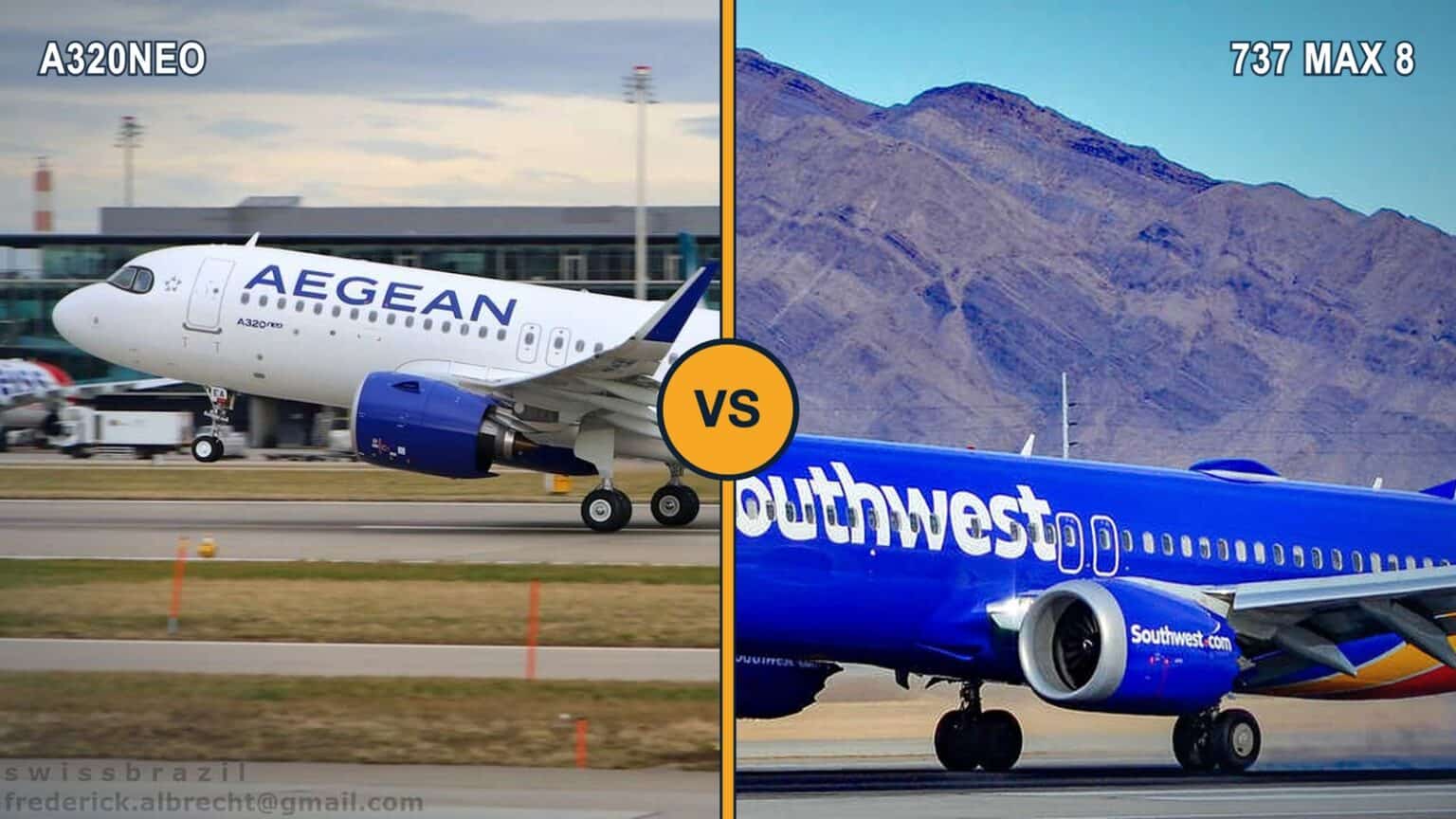
Airbus A320neo comparisons
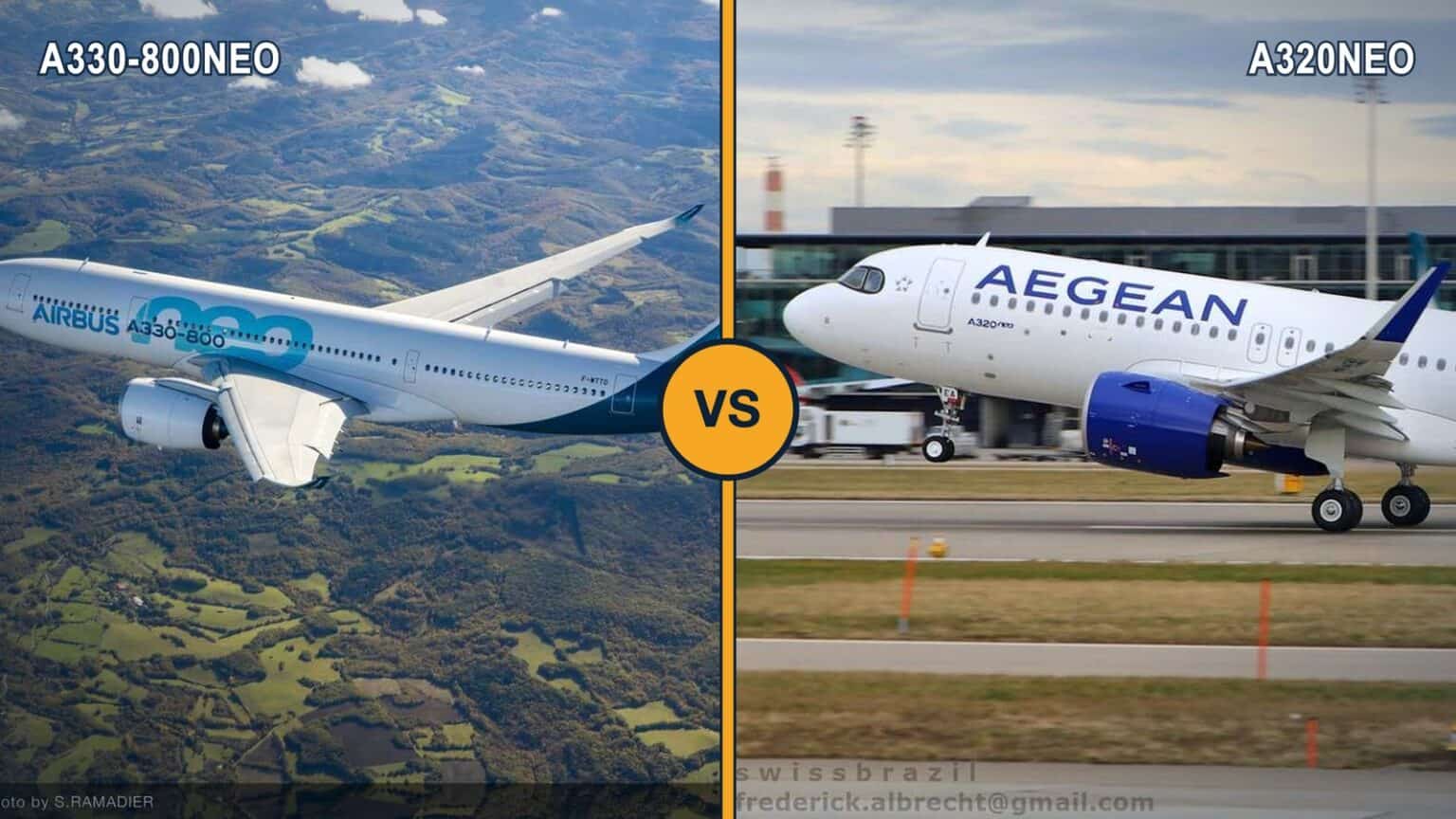
Airbus A319neo comparisons
No other comparisons yet.
Table of Contents
| Measure | A320neo | A319neo |
|---|---|---|
| First flight | September 25, 2014 | March 31, 2017 |
| Type certification | November 24, 2015 (EASA and FAA) | By December 21, 2018 (FAA and EASA) |
| Two-class layout | 165 typical | 140 |
| Orders as of May 2017 | 3,617 | 49 |
The short answer: the A320neo is the bigger jet
The Airbus A320neo is the core model of the neo family. The Airbus A319neo is the shortened version, with two fewer fuselage rows to sell.
Both are single-aisle jets with two engines, a crew of two and blended wingtips. Airlines choose between them by how many seats they need to fill on a route.
The twist: the wing is identical
Both jets span 117 ft 5 in (35.80 m) and share the same 39,800 ft (12,100 m) ceiling and 449 kt (517 mph, 832 km/h) cruise speed. The A320neo carries about 7,500 lb (3,400 kg) more at takeoff on a wing the same size.
How the two jets were developed
Airbus launched the A320neo on December 1, 2010, as a re-engined A320 with sharklets as standard. The prototype first flew on September 25, 2014, and it received joint EASA and FAA certification on November 24, 2015.
The A319neo came last. It first flew on March 31, 2017, with CFM LEAP engines, and was certified by December 21, 2018. A Pratt & Whitney version flew on April 25, 2019.
Airbus says its neo jets burn less fuel than the ceo models they replaced. Lufthansa reported 16% fuel savings with Pratt & Whitney engines, and Avianca said its LEAPs were 15% to 20% more efficient, according to Wikipedia.
A320neo vs A319neo: size and seats
The A320neo is 123 ft 3 in (37.57 m) long. The A319neo is 111 ft 0 in (33.84 m), about 12 feet (3.7 m) shorter.
The cabin width is the same at 12 ft 2 in (3.70 m), so the extra length goes into extra rows. The A320neo cabin is 90 ft 3 in (27.51 m) long against 78 ft 0 in (23.78 m).
The A320neo seats up to 194 and the A319neo up to 160. Airlines fit fewer, with about 165 typical in two classes on the A320neo against 140 on the A319neo, according to Wikipedia.

Where the A320neo wins
Seats, cargo and power
The A320neo has 34 more seats at the maximum, and it holds more freight. Its hold is 1,307 ft³ (37.0 m³) against 953 ft³ (27.0 m³).
Its maximum payload is 44,100 lb (20,000 kg) against 39,000 lb (17,700 kg). Its maximum takeoff weight is 174,000 lb (79,000 kg) against 166,500 lb (75,500 kg).
Each A320neo engine makes 27,120 lbf (121 kN), against 24,100 lbf (107 kN) for each A319neo engine on the spec panel. The longer jet needs the extra thrust to lift its extra weight.

Where the A319neo wins
Range and short runways
The A319neo flies 3,650 nm (4,200 mi, 6,760 km), against 3,400 nm (3,910 mi, 6,300 km) for the A320neo. It is lighter and carries fewer people, so the distance goes up.
It also needs less runway. Its takeoff distance is 6,000 ft (1,830 m), against 6,400 ft (1,950 m) for the A320neo.
The A319neo is the cheaper jet too, with a 2018 list price of $101.5 million against $110.6 million. Airlines rarely pay list price, so the gap is a guide only.
The short body also suits business jets. Its ACJ319neo corporate version can fly eight passengers 6,750 nmi (7,770 mi, 12,500 km) with extra centre tanks, according to Wikipedia.

Why the A319neo sells so little
The A319neo is the weakest seller in the family. It drew just 57 orders in about 15 years, according to a July 2026 report that first appeared in FlightGlobal.
Airbus has stopped actively offering it to airlines but has not announced a cancellation or an end date. It will still build one for a customer who asks, and a backlog of roughly two dozen jets is provisional.
Airlines moved toward larger single-aisle jets that spread costs over more seats. The Airbus A220, which Airbus took over from Bombardier’s C Series in 2018, also covers the small end with a clean-sheet design.
Wikipedia notes the A319neo’s backlog was already a fraction of the A220’s by January 2019. As of May 2017, the family order book held 49 A319neos (1%) against 3,617 A320neos (72%).
What the neo changes over the older ceo jets
Both jets share the neo recipe: new engines, sharklets as standard and retuned fly-by-wire controls. The changes affected flying qualities and system integration, and lowered the minimum V speeds, according to Wikipedia.
The neo is also about 1.8 tonnes heavier than the ceo it replaced, according to the same source. The fuel savings come from the engines, not from a lighter airframe.
Airbus put the extra range or payload at the heart of the pitch. At launch in 2010 it promised 500 nmi (930 km) more range or 2 tonnes (4,400 lb) more payload for the A320neo.
How many A320neo family jets are flying
As of September 2026, 12,329 A320neo family aircraft had been ordered by more than 130 customers, and 4,800 had been delivered. IndiGo is the largest customer and operator, with 376 aircraft in its fleet.
The A319neo has a small share of that. China Southern was its launch operator and received the first of an order for four on February 18, 2022.

Which one should an airline pick?
The A320neo suits routes that fill 150 to 190 seats. It has the cargo space and thrust margin for the main body of short-haul and medium-haul work.
The A319neo suits thinner routes and longer, lighter-loaded sectors. In practice the market has gone the other way, with most airlines choosing the A320neo or the larger A321neo.
Frequently Asked Questions
FAQ
The A320neo. It is 123 ft 3 in (37.57 m) long against 111 ft 0 in (33.84 m), and it seats up to 194 against 160. Both have the same 117 ft 5 in (35.80 m) wingspan.
The A319neo, at 3,650 nm (4,200 mi, 6,760 km) against 3,400 nm (3,910 mi, 6,300 km) for the A320neo. The shorter jet weighs less, so it flies further on a similar fuel load.
Neo stands for new engine option. Airbus launched the A320neo on December 1, 2010, as a re-engined A320 with a choice of CFM LEAP-1A or Pratt & Whitney PW1100G engines.
Airbus stopped actively offering the A319neo in July 2026, according to a report first published by FlightGlobal. It has not announced a formal cancellation, and it will still build one on request.
The A319neo first flew on March 31, 2017, and was certified by the FAA and EASA by December 21, 2018. China Southern was the launch operator, and received the first of an order for four on February 18, 2022.
Sources and references used for research and fact-checking.
About the Author

Tim is the owner and lead editor of AeroCorner since 2019, overseeing aviation content covering aircraft, airlines, airports, and the broader aviation industry. Through years of researching, writing, editing, and publishing aviation-focused content, he has developed extensive practical knowledge of commercial aviation and air travel. Based in Asia and a frequent traveler himself, Tim also brings firsthand passenger experience to AeroCorner’s coverage. Outside of publishing, he has also explored aviation firsthand through hands-on flight training in New Zealand.