

Table of Contents
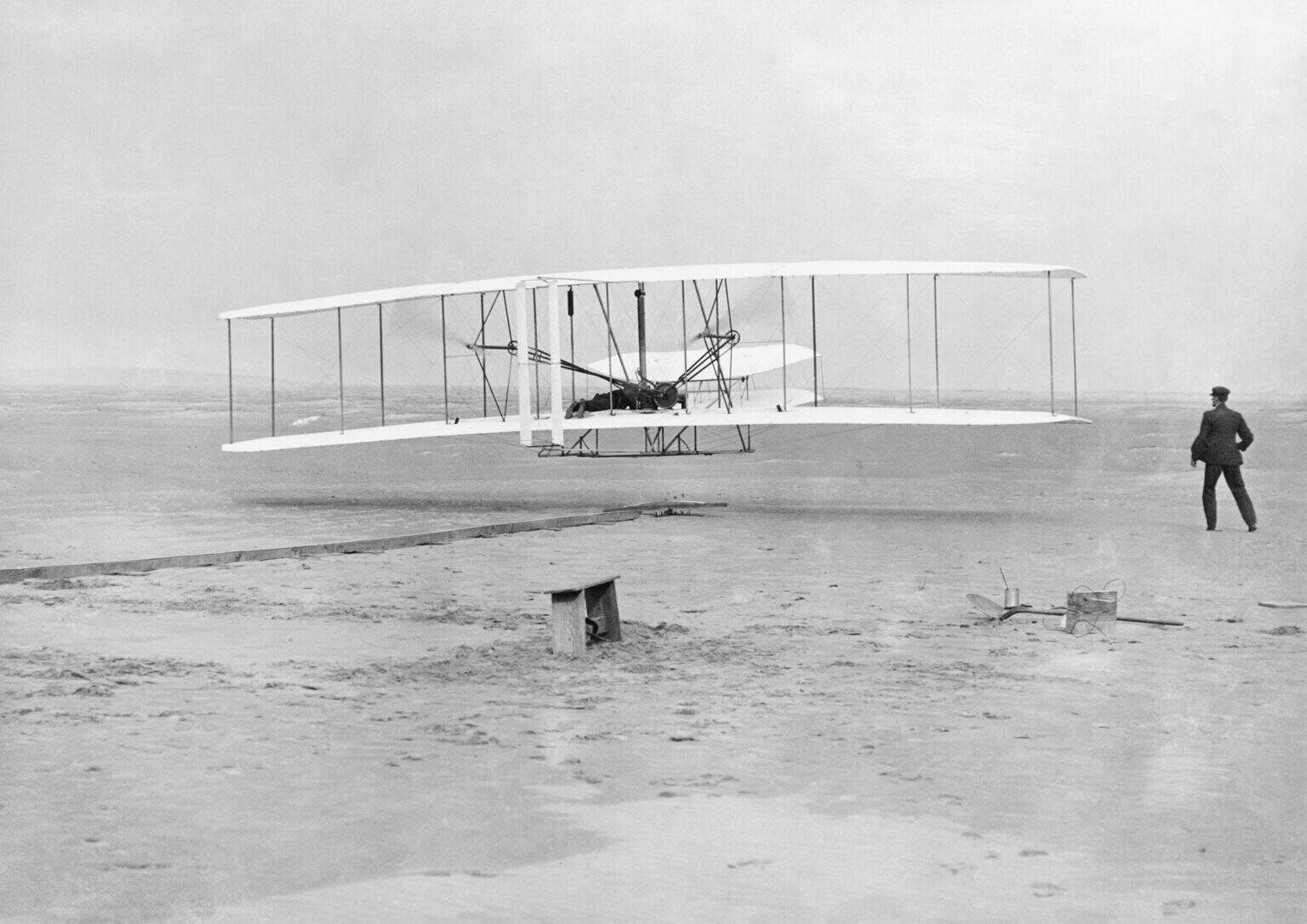
The most famous photograph in aviation was taken by a man from the local lifesaving station, working a camera that someone else had set up in advance. It shows a fragile biplane a few feet above the sand, with a man lying flat on its lower wing.
The pilot is Orville Wright. The time is 10:35 in the morning on December 17, 1903, and the flight in the picture will last 12 seconds.
Those 12 seconds are the part everyone knows. What followed is stranger: a telegram that got the numbers wrong, five years in which hardly anyone believed it, and a fight over the credit that lasted until 1948 and ended with a museum signing a contract. Here is what actually happened on the dunes, and after.
What Happened on the Wright Brothers’ First Flight?
On December 17, 1903, Orville Wright flew the Wright Flyer for 12 seconds and 120 feet (37 m), the first sustained flight of a manned, powered, controlled heavier-than-air machine. The brothers flew three more times that morning, taking turns, and Wilbur’s fourth flight covered 852 feet (260 m) in 59 seconds.
Minutes after that last landing, a gust flipped the airplane over and wrecked it. The Wright Flyer never flew again, and its entire flying career added up to 98 seconds in the air, which still makes it the opening entry on any list of famous firsts in aviation.
The first flight at a glance
Date and time: December 17, 1903, 10:35 a.m. Place: the dunes at what is now Kill Devil Hills, North Carolina, about 4 miles south of Kitty Hawk. Pilot: Orville Wright. First flight: 12 seconds, 120 feet. Best flight: Wilbur, 852 feet in 59 seconds. Witnesses: five. Aircraft: wrecked by wind the same morning, never flown again.
The Four Flights of December 17, 1903
The first attempt actually came three days earlier. On December 14 the brothers tossed a coin, Wilbur won, and they launched the Flyer down the slope of Big Kill Devil Hill. He pulled up too sharply, stalled, and came down after 105 feet (32 m) in about three and a half seconds, damaging the Flyer.
Repairs took until the 17th, so it was Orville’s turn. That morning the wind was freezing and averaging more than 20 mph (32 km/h), gusting to 27 mph (43 km/h), so they laid their 60-foot (18 m) wooden launching rail on level ground pointing straight into it. The wind, not a hill, would provide the airspeed.
| Flight | Pilot | Distance over the ground | Time aloft |
|---|---|---|---|
| 1 | Orville | 120 feet (37 m) | 12 seconds |
| 2 | Wilbur | 175 feet (53 m) | 12 seconds |
| 3 | Orville | 200 feet (61 m) | 15 seconds |
| 4 | Wilbur | 852 feet (260 m) | 59 seconds |
None of the flights climbed much higher than about 10 feet (3 m), and all of them went essentially straight, because turns were not attempted. Every landing was bumpy and unplanned, and the fourth broke the supports of the front elevator.
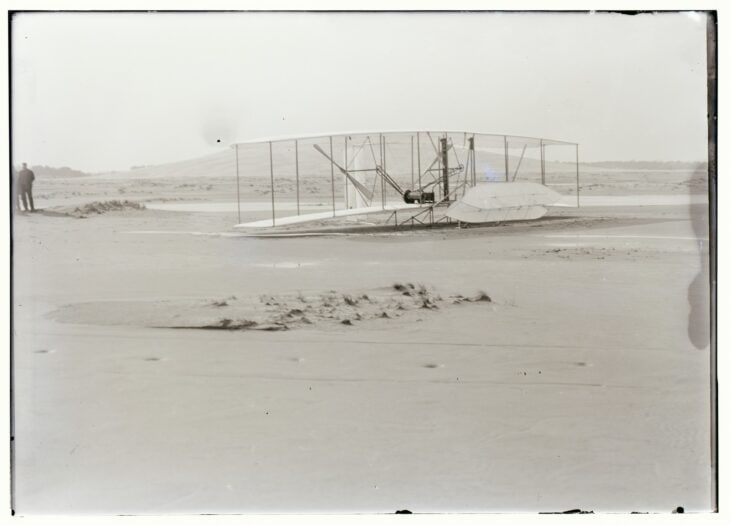

The brothers hoped to fix it and try a 4-mile (6 km) flight to Kitty Hawk village. Then a heavy gust caught the Flyer on the ground and tumbled it end over end while the men tried to hold it down, damaging it beyond any quick repair.
Shorter than a jumbo jet
Orville’s first flight of 120 feet was shorter than the wingspan of a Boeing 747. Wilbur’s 852-foot fourth flight, later that same morning, covered much more ground, and because he was flying into a strong headwind, the Flyer moved through roughly half a mile of air to do it.
Where Was the First Flight? Not Quite Kitty Hawk
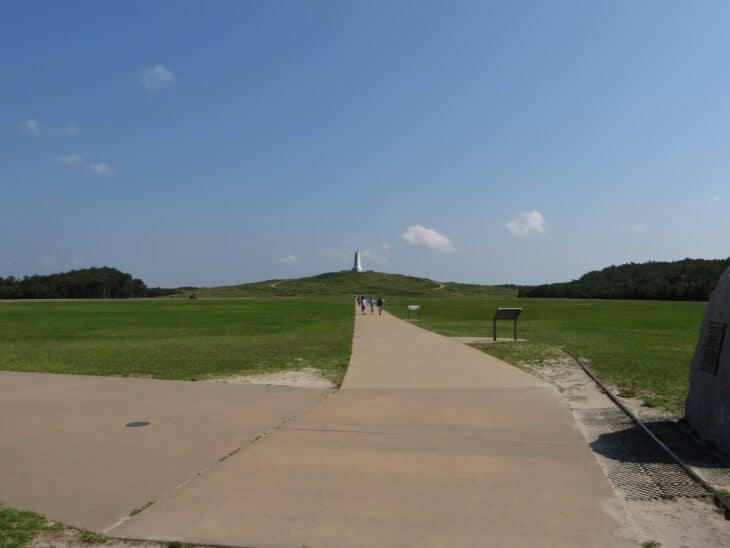
The flights are almost always placed at Kitty Hawk, the nearest village. The brothers’ camp and the dunes they flew from were about 4 miles (6 km) to the south, on land that is now the town of Kill Devil Hills.
The Wrights had chosen the Outer Banks back in 1900, after the engineer Octave Chanute suggested the mid-Atlantic coast for its regular breezes and soft sand. Wilbur checked US Weather Bureau data and wrote to the meteorologist stationed at Kitty Hawk before committing. The remoteness was a bonus: it kept reporters away.
Today the site is the Wright Brothers National Memorial, run by the National Park Service. Its visitor center displays the Flyer’s original broken engine crankcase, and it is one of the stops worth making on any list of aviation museums in North Carolina.
.jpg)
Why the Wrights Flew and Langley Did Not
The Wrights were not the ones with government money in 1903. Samuel Langley, Secretary of the Smithsonian Institution, was: his Aerodrome project had received $50,000 from the US Army in 1898.
Langley’s full-size Aerodrome had a 53-horsepower engine, about four times the power of the Wrights’. It was launched by catapult from a houseboat on the Potomac River on October 7, 1903, and fell straight into the water. On December 8 it collapsed on launch and fell in again, nine days before the Wrights flew.
The Wrights’ engine, by contrast, was a 12-horsepower four-cylinder built from scratch in about six weeks by their shop mechanic, Charlie Taylor, because the brothers could not find a suitable car engine. It weighed 180 pounds (82 kg) and drove two propellers through bicycle-style chains, one of them crossed so the propellers spun in opposite directions.
Power was never the Wrights’ real advantage. Control was. They had spent three seasons flying gliders at Kitty Hawk, and out of them came the real breakthrough: a three-axis control system that let the pilot steer the airplane and keep it balanced.
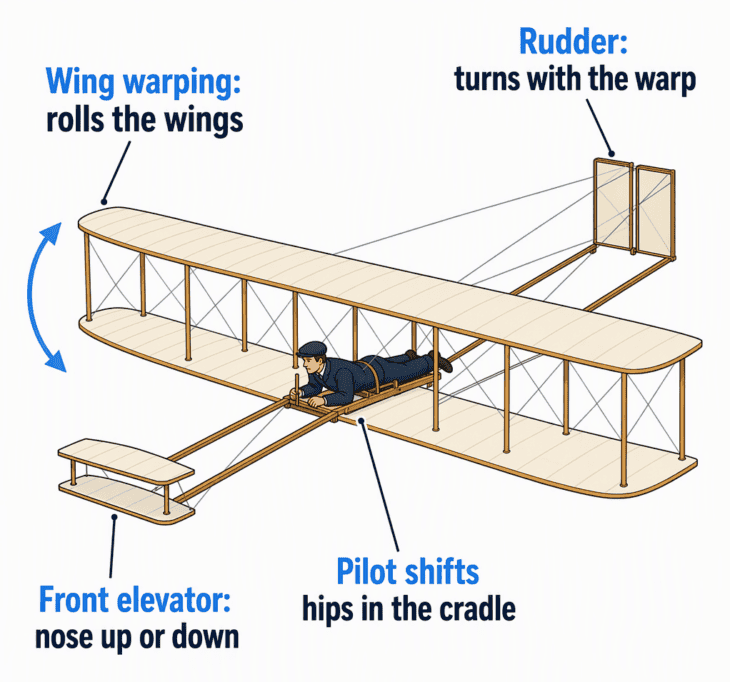
The pilot lay on his stomach and steered by sliding his hips in a cradle, which pulled wires that twisted the wingtips to roll the airplane and turned the rudder at the same time. His left hand worked the front elevator to raise or lower the nose.
That idea of coordinated roll and yaw is still how virtually every fixed-wing airplane is flown, even though ailerons long ago replaced the twisting wings. The Flyer itself was so unstable that a later engineering analysis by F.E.C. Culick and Henry Jex found it almost unmanageable by anyone but the Wrights, who had trained themselves on their gliders.
Why Almost Nobody Believed It for Five Years
The brothers telegraphed their father in Dayton: “Success four flights Thursday morning all against twenty-one mile per hour wind started from level with engine power alone average speed through air thirty-one miles longest 57 seconds inform press home Christmas.”
The message arrived with two transmission errors. The 59-second flight had become 57 seconds, and it was signed “Orevelle Wright.”
The press did not take the hint. The Dayton Journal declined to run the story because the flights seemed too short to matter, while a telegraph operator leaked the message to a Virginia newspaper that published a wildly inaccurate account, which other papers then reprinted.
It got worse in 1904. The Wrights moved their testing to Huffman Prairie, a cow pasture near Dayton, and invited reporters to watch, but engine trouble and light winds produced almost nothing. Local papers ignored them for the next year and a half, even as the flights grew from seconds to more than half an hour.
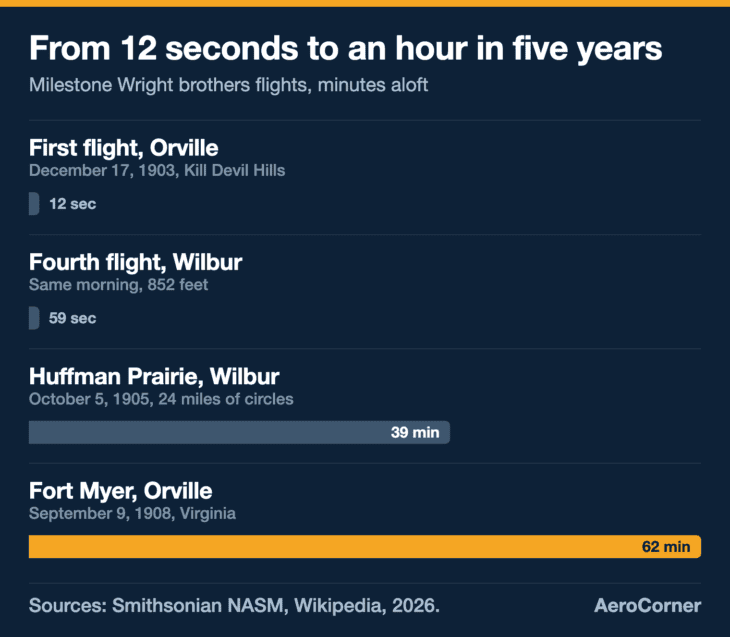
On October 5, 1905, Wilbur flew 24 miles (39 km) in 39 minutes, circling the pasture. Scientific American still doubted the “alleged experiments,” and in 1906 the Paris edition of the Herald headlined its story on the brothers “Flyers or liars?”
The doubt ended on August 8, 1908, at a racetrack near Le Mans, France. Wilbur’s first public flight there lasted only 1 minute 45 seconds, but his smooth banking turns stunned the onlookers, French aviators among them, after some French papers had called him a bluffer.
A month later, on September 9, Orville flew for 62 minutes at Fort Myer, Virginia.
Was Kitty Hawk Really the First Flight?
Several rivals have been put forward, and two come up most often. Gustave Whitehead, a German immigrant in Connecticut, was described in an August 1901 Bridgeport Herald article as flying about half a mile, and in 2013 an editorial in Jane’s All the World’s Aircraft backed his claim.
The photograph the Herald‘s drawing was supposedly based on is believed never to have existed, and a researcher showed that the photo the Jane’s editorial relied on did not depict his machine in flight. Jane’s owner later distanced itself from the editorial, and the Royal Aeronautical Society concluded that all available evidence fails to support Whitehead’s claim.
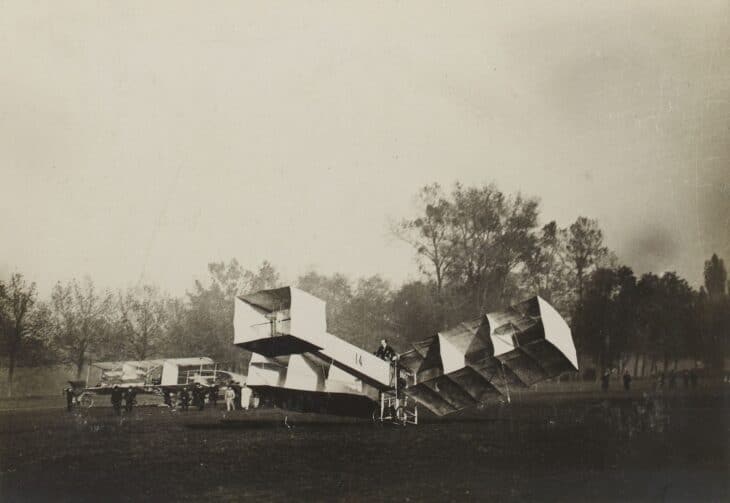
The other rival is the Brazilian pioneer Alberto Santos-Dumont, whose supporters argue that his 14-bis was the first true airplane. It flew near Paris in October and November 1906, the best flight covering 220 meters (over 700 feet), in front of a crowd, official observers and a film camera, none of which the Wrights had in 1903.

Myth: the 1903 Wright Flyer needed a catapult
One argument for Santos-Dumont is that the Wrights’ airplane relied on a catapult. In 1903 it did not: it ran along a 60-foot rail on a wheeled dolly that stayed on the ground, and lifted off into the wind. The Wrights used a catapult to help launch most flights of their 1904 and 1905 airplanes, after Kitty Hawk.
The one rival with official backing, for decades, was Langley. That is where the contract comes in.
The Smithsonian Feud and the $1 Contract
In 1914, at the Smithsonian’s instigation, Glenn Curtiss took Langley’s failed Aerodrome to Keuka Lake in New York. Curtiss had just lost a patent fight with the Wrights, and a flying Aerodrome could help undo their patent.
He fitted pontoons, made other changes, and hopped it off the water for about 5 seconds at a time. The Smithsonian went on to describe Langley’s machine as the “first aeroplane capable of sustained free flight with a man.”
Orville refused to accept it. Wilbur had died of typhoid in 1912, so Orville fought on alone, and in 1928 he did something drastic.
1910
The Smithsonian says no. The Wrights offer the Flyer for display. The Institution declines, though it would take other Wright artifacts.
1914
The Aerodrome flies, after a fashion. Curtiss tests a modified Langley Aerodrome at Keuka Lake. Critics call the changes alterations, not a restoration.
January 28, 1928
The Flyer leaves America. Orville ships it to the Science Museum in London, where it is shown in “the place of honour.”
World War II
Hidden from the Blitz. The Flyer is stored underground near Corsham, about 100 miles (160 km) from London. Not, as often claimed, in the London Underground.
1942
The Smithsonian backs down. Its annual report lists Curtiss’s modifications to the Aerodrome and states that the Wrights were the first to make sustained flights.
1943
Orville relents. After an exchange of letters with the Smithsonian’s new secretary, Charles Abbot, he agrees to bring the Flyer home once a replica can be built for London.
January 30, 1948
Orville dies at 76. He does not live to see the Flyer return.
November 23, 1948
The contract. Orville’s executors sell the Flyer to the United States, represented by the Smithsonian, for $1, with conditions attached.
December 17, 1948
Home at last. The Flyer goes on display in Washington, 45 years to the day after it flew.
The 1948 agreement says the Smithsonian may never display or publish a statement claiming that any aircraft earlier than the Wright airplane of 1903 “was capable of carrying a man under its own power in controlled flight.” If it does, the Wright estate can take the Flyer back.
The clause was aimed at Langley’s Aerodrome, but it reads like a gag order on every rival claim. Whitehead’s supporters have treated it that way since one of their researchers learned of it in 1975 and obtained a copy with help from Connecticut Senator Lowell Weicker.
Defenders of the Smithsonian point out that it sat in the public probate record in Ohio all along.
The Smithsonian’s senior aeronautics curator, Tom Crouch, answered the charge in 2013. He said he hoped that, if persuasive evidence of an earlier flight ever appeared, he and his colleagues “would have the courage and the honesty to admit the new evidence and risk the loss of the Wright Flyer.”
What Happened to the Wright Brothers and the Flyer?
Wilbur, the older brother, died first, on May 30, 1912, at 45. Orville lived until January 30, 1948, long enough to see airplanes break the sound barrier. John T. Daniels, the lifesaving station crewman who took the famous photograph, died the day after Orville.
The Flyer nearly did not survive either. It sat in crates behind a shed in Dayton for nine years and spent eleven days under mud and water in the Great Dayton Flood of 1913.
According to a 1948 account by Charlie Taylor, Wilbur told a colleague in early 1912 that they would most likely burn it, as they had burned their 1904 machine. The colleague, exhibition team manager Roy Knabenshue, talked him out of it.
It is now on display at the National Air and Space Museum in Washington, wearing fabric from a 1985 restoration. Pieces of the original have flown much farther than 852 feet: Neil Armstrong carried Flyer wood and fabric to the Moon on Apollo 11 in 1969.
A small swatch of its wing fabric went to Mars on the Ingenuity helicopter, wrapped around a cable under its solar panel. On April 19, 2021, Ingenuity made the first powered flight on another planet, and its first airfield there was named Wright Brothers Field.
So look at that photograph again. The airplane in it would fly for 98 seconds in its whole life, the newspapers would mostly miss it, and the credit would take 45 years and a $1 contract to settle. Yet just over a decade after it flew, in 1914, the first airline passenger was buying a ticket.
Sources and references used for research and fact-checking.
- Smithsonian National Air and Space Museum, 1903 Wright Flyer (collection object A19610048000)
- Smithsonian National Air and Space Museum, Telegraph Key, Wright 1903 Flight
- Smithsonian National Air and Space Museum, The Wright Brothers Made History at Kitty Hawk
- National Park Service, Wright Brothers National Memorial, 1903: The First Flight
- NASA, 120 Years Ago: The First Powered Flight at Kitty Hawk
- Wikipedia, Wright Flyer
- Wikipedia, Wright brothers
- Wright Brothers Aeroplane Company (wright-brothers.org), The Smithsonian Contract
- Wikipedia, Gustave Whitehead
- Wikipedia, Santos-Dumont 14-bis
- Wikipedia, Langley Aerodrome
- collectSPACE, Ingenuity Mars helicopter carries piece of Wright brothers' first airplane
Get the Newsletter
The latest aviation news and stories sent to your inbox.
About the Author

Tim is the owner and lead editor of AeroCorner since 2019, overseeing aviation content covering aircraft, airlines, airports, and the broader aviation industry. Through years of researching, writing, editing, and publishing aviation-focused content, he has developed extensive practical knowledge of commercial aviation and air travel. Based in Asia and a frequent traveler himself, Tim also brings firsthand passenger experience to AeroCorner’s coverage. Outside of publishing, he has also explored aviation firsthand through hands-on flight training in New Zealand.