

Table of Contents
The cabin door thumps shut and the announcement arrives on cue: please switch all personal devices to airplane mode. Somewhere around row 23, a phone stays exactly as it was, buried in a coat pocket, fully live.
The flight lands three hours later, on time and entirely uneventful. That is not luck. It happens on more or less every commercial flight in the world, every day, and has done for decades.
So the rule is not doing what the announcement implies. Airplane mode exists for reasons that have far more to do with the ground beneath you than the cockpit ahead of you, and understanding the difference explains why the rule has outlived the fear that created it.
What Is the Point of Airplane Mode?
Airplane mode exists mainly to stop your phone from overwhelming the mobile network on the ground. A handset at cruising altitude can see dozens of cell towers at once, which is precisely the situation those networks were designed never to encounter.
The aviation side is real but much smaller. A transmitting phone can push an audible buzz into the pilots’ headsets, and in unlucky combinations it can nudge older avionics. Neither has ever brought down an airliner. Both are still worth switching off.
At a glance
Airplane mode kills your phone’s cellular transmitter. The primary reason is protecting the terrestrial mobile network, which cannot cope with a handset that is in range of dozens of towers at 500 mph. The secondary reason is keeping radio noise out of the cockpit audio. The idea that a phone will crash the aircraft has never been supported by evidence.
The Rule Was Written to Protect Cell Towers, Not Aircraft
The oldest and hardest rule on this subject is not an aviation rule at all. It belongs to the Federal Communications Commission, and it is short: “Cellular telephones installed in or carried aboard airplanes, balloons or any other type of aircraft must not be operated while such aircraft are airborne.”
That is 47 CFR 22.925, and Part 22 covers the old 800 MHz Cellular Radiotelephone Service. The FCC wrote it to protect its own licensees on the ground from a problem the networks could not engineer around.
A mobile network is built on the assumption that a phone is low, slow, and close to one tower. Antennas are tilted downward, each cell covers a few miles, and the system hands your call from one tower to the next as you drive.
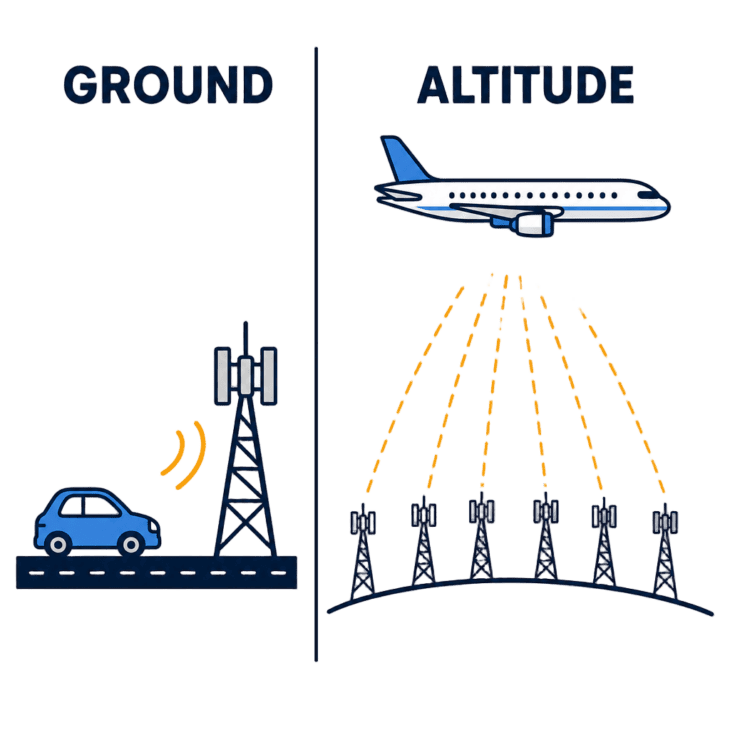
Put that same phone at 35,000 feet (10,700 m) and the geometry breaks. There is nothing between the handset and the horizon, so it is suddenly in line of sight of a large slice of a state’s worth of towers.
Worse, it is moving at around 500 mph (800 km/h). Every tower that hears it has to log it, track it, and hand it off within seconds, burning capacity that was meant for the people driving underneath.
One phone is a rounding error. A few hundred aircraft over a metropolitan area, each carrying 180 live handsets, is a network engineering problem, and it was cheaper to ban the behaviour in 1991 than to redesign the entire cellular system around it.
There is a selfish reason to comply too. A phone that cannot find a usable tower does not give up quietly, it ramps its transmitter to full power and keeps searching, which is why a forgotten phone often lands with a startlingly dead battery.
What a Live Phone Actually Does to the Cockpit
The aviation half of the rule is separate and much softer. Under 14 CFR 91.21 the FAA does not ban portable electronics outright, it pushes the decision to the airline: the operator must determine that a device will not interfere with the aircraft before allowing it.
That is why the policy differs between carriers, and why it changed all at once in 2013. An FAA rulemaking committee spent that year testing the question and concluded most airliners tolerate passenger device emissions fine.
On 31 October 2013 the FAA cleared airlines to allow gate-to-gate device use in airplane mode. Reading, working, and watching films below 10,000 feet became legal overnight. Voice calls did not.
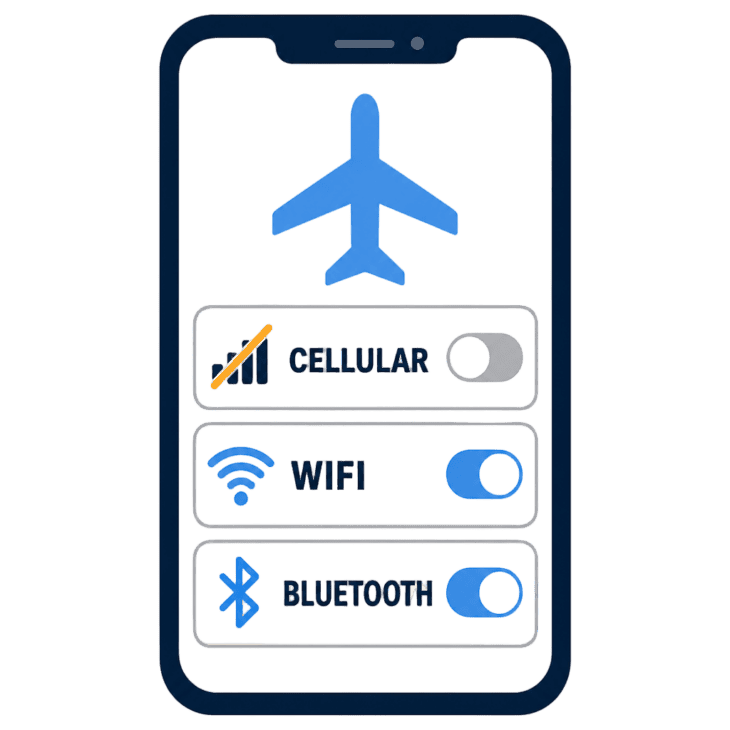
What crews do genuinely notice is noise. A phone hunting for a signal can bleed into cockpit audio as a rhythmic buzz or click, the same sound a phone makes in a desk speaker just before it rings.
The danger there is not a fried instrument. It is a pilot missing two words of an air traffic control clearance during a busy approach, which is a small annoyance with a bad tail risk.
Researchers have also flagged intermodulation, where two ordinary signals combine to produce a third at a frequency neither transmits on, potentially landing near a navigation band. It is a plausible mechanism rather than a documented cause of any accident.
The experiment nobody authorised
A Carnegie Mellon team measured the radio environment aboard 37 commercial flights in the northeastern United States in late 2003 and found one to four cellphone calls made in the air on a typical flight. Their results were published in IEEE Spectrum in 2006. The compliance rate has never been anywhere near total, and the accident record still shows no airliner lost to a passenger handset.
Modern airliners are also far tougher than the rule’s origins suggest. Avionics are shielded and certified against radio interference, on an airframe already built to absorb a direct lightning strike without the crew noticing much more than a flash.
The Myth: 5G Nearly Grounded the Fleet, So Phones Must Be Dangerous
Between 2021 and 2024 there was a genuine, serious fight over 5G and flight safety. It made headlines, it cancelled flights, and it is the single strongest piece of evidence people reach for when defending airplane mode. It is also about something else entirely.
The myth
The 5G interference crisis proved that passenger phones threaten aircraft systems. In fact not one part of that dispute involved a handset inside the cabin. The problem was high-power 5G base stations on the ground near runways, and it was fixed by re-equipping aircraft, not by switching off phones.
The conflict was one of frequency neighbours. US carriers deployed 5G in the C-band around 3.7 to 3.98 GHz, uncomfortably close to the 4.2 to 4.4 GHz slice reserved for radio altimeters, the instruments that measure an aircraft’s exact height above the runway during a low-visibility landing.
Regulators worried that some older altimeters listened too broadly and could be confused by a powerful transmitter nearby. The FAA imposed buffer zones around dozens of airports in January 2022, and airlines cancelled and rerouted flights while the two industries argued.
The fix was an airworthiness directive requiring US passenger and cargo aircraft to carry 5G-tolerant radio altimeters or approved filters by February 2024. Retrofit the aircraft, and the problem goes away.
Note what is absent from that story. The threat came from ground transmitters running hundreds of watts through directional antennas, not from a handset radiating a fraction of a watt from inside a metal tube. The two are not the same problem, and the layered way aviation handles risk treated them accordingly.
The Rule Is Quietly Dissolving
Europe has already engineered its way around the original objection. In November 2022 the European Commission updated its spectrum decision to let airlines run 5G onboard, and gave member states until 30 June 2023 to make the frequencies available.
The trick is a picocell, a very small base station installed in the cabin. Your phone connects to that box a few feet away at minimal power, and the traffic leaves the aircraft over the same satellite link that delivers inflight Wi-Fi.
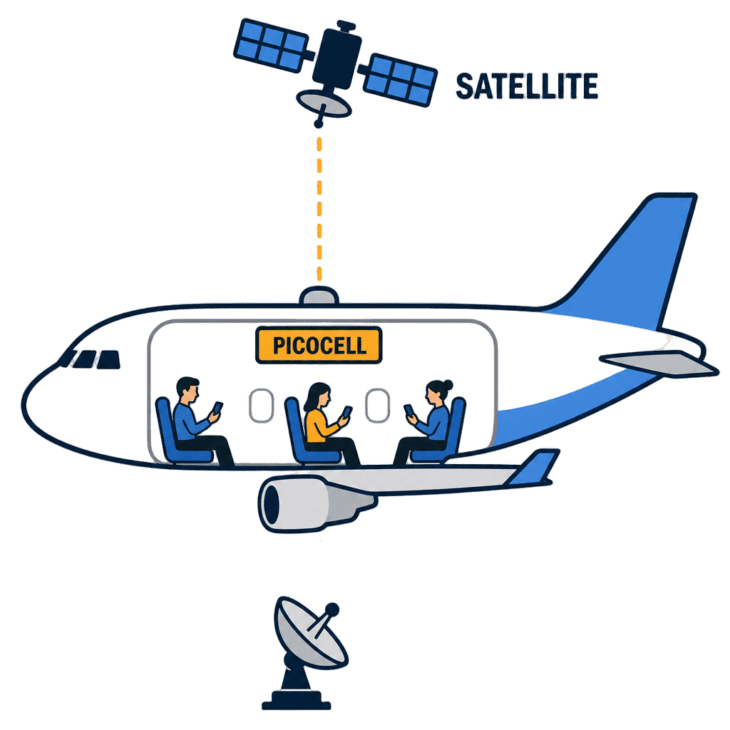
Because the phone never reaches for a ground tower, the entire reason for 47 CFR 22.925 evaporates. More than 30 airlines worldwide now sell some form of onboard mobile service, and a growing number of them include voice.
The United States went the other way, and not for technical reasons. The FCC opened a proceeding in 2013 to allow inflight mobile service, collected more than 1,400 filings, and ran into fierce opposition from pilot and flight attendant unions plus a public that hated the idea of a neighbour taking calls at 35,000 feet.
On 24 November 2020 the commission formally terminated the proceeding, concluding that the record was insufficient to strike a reasonable balance between competing interests. That is regulator language for a social problem, not a safety one.
The last assumption is eroding too. Direct-to-satellite phone services, such as the T-Mobile and Starlink product that launched commercially in July 2025, are built precisely so an ordinary handset can talk to something far overhead with no tower involved.
So the next time the announcement comes, you can switch the toggle knowing what it is really for. It is protecting a cell network you left behind on the ground, keeping a faint buzz out of two headsets up front, and saving your battery for the taxi queue at the other end.
The aircraft was never the fragile part of that arrangement. It was the tower.
Sources and references used for research and fact-checking.
- Cornell Law School Legal Information Institute, 47 CFR 22.925 - Prohibition on airborne operation of cellular telephones
- Federal Aviation Administration, AC 91.21-1D: Use of Portable Electronic Devices Aboard Aircraft
- IEEE Spectrum, Unsafe at Any Airspeed?
- Federal Aviation Administration, 5G and Aviation Safety
- European Commission, 5G on planes, Wi-Fi on the road: Commission decision opens up new opportunities for innovation
- Federal Communications Commission, FCC Terminates Onboard Aircraft Proceeding
Get the Newsletter
The latest aviation news and stories sent to your inbox.
About the Author

Tim is the owner and lead editor of AeroCorner since 2019, overseeing aviation content covering aircraft, airlines, airports, and the broader aviation industry. Through years of researching, writing, editing, and publishing aviation-focused content, he has developed extensive practical knowledge of commercial aviation and air travel. Based in Asia and a frequent traveler himself, Tim also brings firsthand passenger experience to AeroCorner’s coverage. Outside of publishing, he has also explored aviation firsthand through hands-on flight training in New Zealand.