

Table of Contents
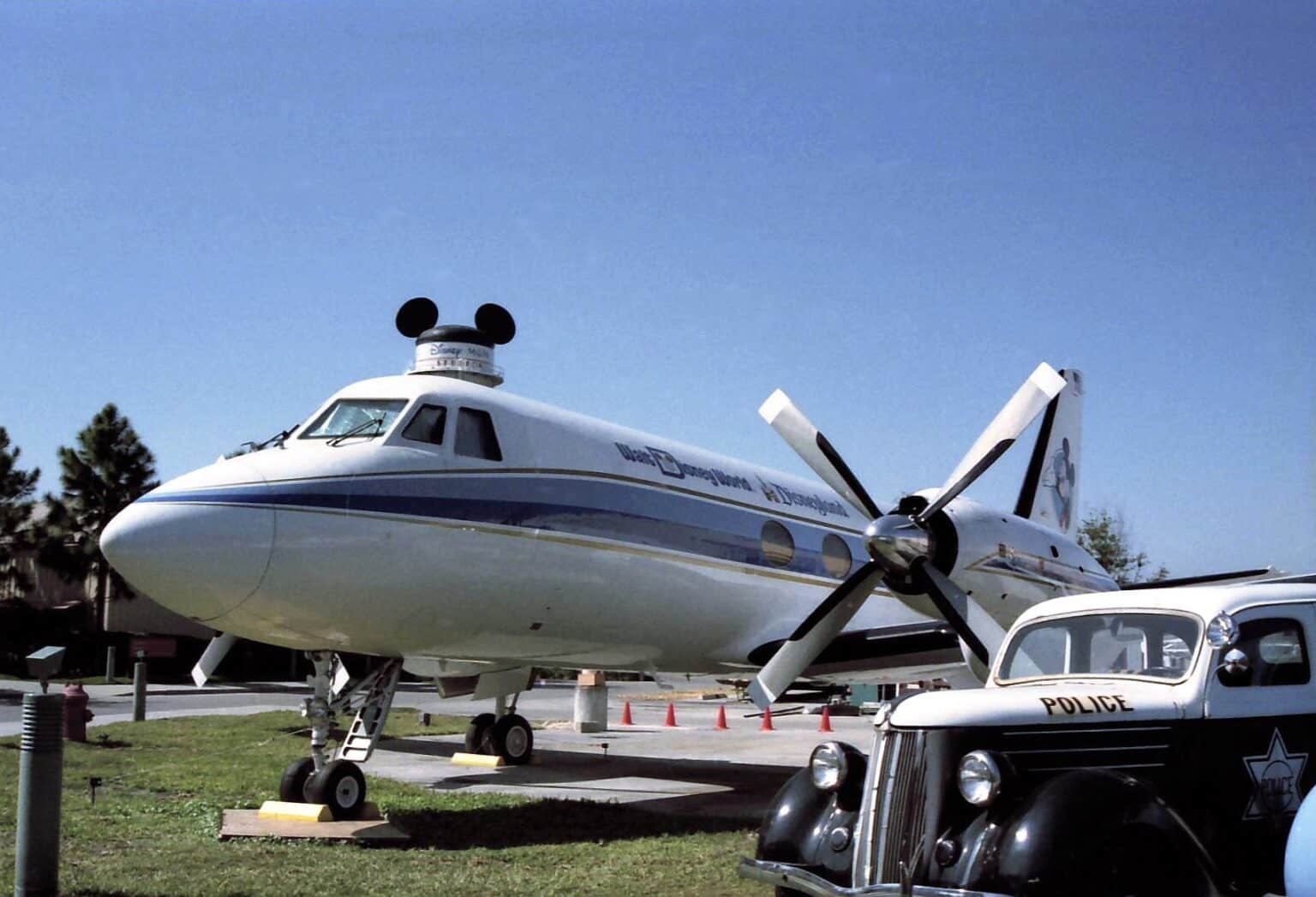
The Walt Disney private jet everyone remembers was not a jet at all. It was a Grumman Gulfstream I, a twin-turboprop business plane that Disney’s company used to survey Central Florida while it quietly bought up the land for Walt Disney World.
Pilots and controllers knew it as “Mickey Mouse,” or just “The Mouse.” It flew for 28 years, landed for the last time on a road inside Walt Disney World in 1992, and now sits at the Palm Springs Air Museum, a few miles from Walt’s old vacation home.
With Walt’s 125th birthday on December 5, 2026, this guide checks the plane’s story against the Walt Disney Archives, the Smithsonian and the FAA register. Two details most retellings get wrong are below: the famous November 1963 Florida flight, and the tail number Walt actually flew under.
Quick facts about Walt Disney’s private plane
Walt Disney’s Complete Private Plane Fleet
The Walt Disney Archives lists three company planes from Walt’s lifetime: two Beechcrafts and the Gulfstream. All three flew as company planes for Walt Disney Productions.
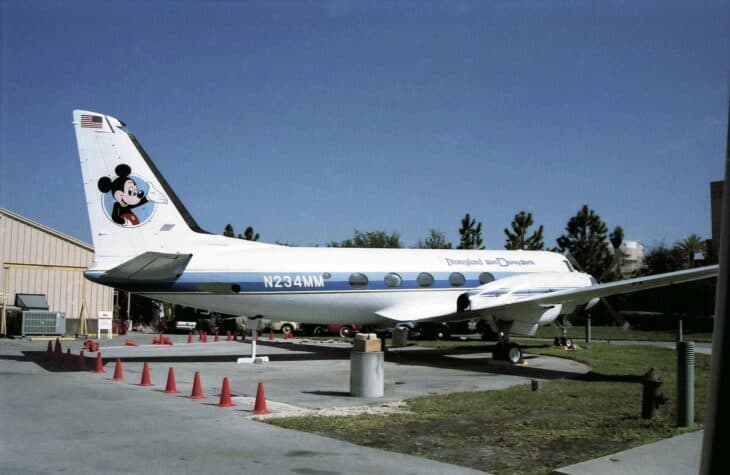

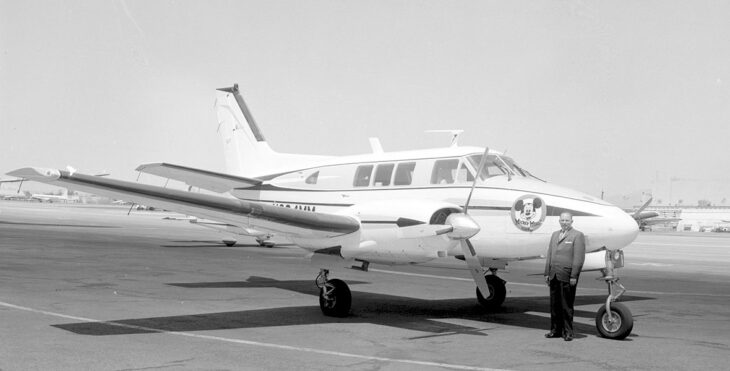

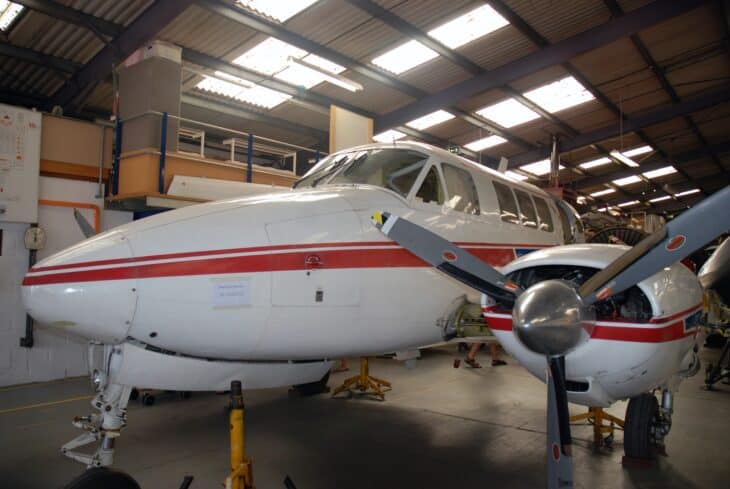

The two Beechcraft entries carry less certainty than the Gulfstream. The Disney Archives gives their service years, but secondhand accounts disagree on the Queen Air’s model and tail number, so both versions are shown.
The Origin Story: From a Weekend Plane to “The Mouse”
The studio bought its first plane so Walt could get to Palm Springs on weekends. Within a year it was flying Imagineers across the country.
February 1963
The Queen Air enters service. Walt Disney Productions’ first company plane is a smaller twin-propeller Beechcraft.
November 22, 1963
The Central Florida decision. Walt and his team fly over the Florida coast and then inland to Orlando. They learn of President Kennedy’s assassination when they land in New Orleans to refuel.
December 6, 1963
The Gulfstream is certified. The FAA file gives this airworthiness date for Grumman G-159 serial 121, delivered unpainted as N732G.
Early 1964
The Gulfstream goes to work. Its first big job is shuttling Imagineers between Burbank and New York for the 1964 to 1965 World’s Fair.
1964
The Pirates flight. Walt flies from Palm Springs to Puerto Rico and, over El Morro in San Juan, finds the look for Pirates of the Caribbean.
1965
A King Air replaces the Queen Air. The new turboprop takes the N234MM tail number.
December 1966
Walt Disney dies. The company keeps the Gulfstream to fly executives and guests.
1967
N732G becomes N234MM. The King Air is sold and its Mickey Mouse tail number moves to the Gulfstream.
1985
A new look and a new base. Repainted white with a blue stripe and a waving Mickey on the tail, the plane moves to Florida for goodwill tours.
October 8, 1992
The last landing. Disney pilot Manny Regateiro lands it on World Drive, beside what was then Disney-MGM Studios.
September 2014
The tour ends. The Studio Backlot Tour, where the plane had been on display, closes for good.
September 2022
West again. Restored outside, the plane appears at D23 Expo 2022 in Anaheim, then moves to Palm Springs.
December 5, 2022
The exhibit opens. The Palm Springs Air Museum unveils it on Walt’s birthday and announces an interior restoration.
Inside “The Mouse”: Walt Disney’s Gulfstream I
The Grumman Gulfstream I was one of the first airplanes built from scratch for business travel. It went on sale in 1959, and Grumman built 202 of them, according to the Smithsonian’s Air & Space Quarterly.
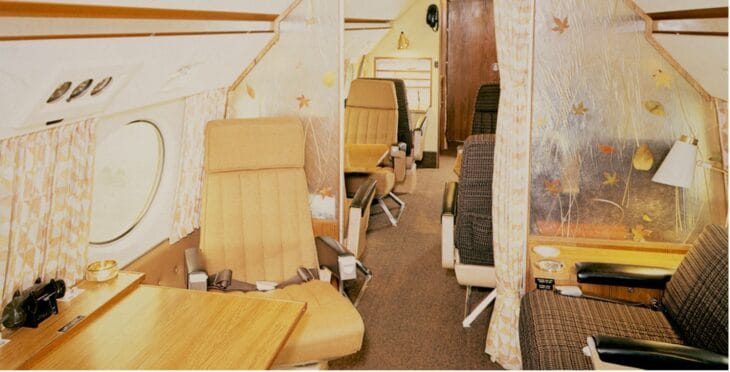
Walt and his wife Lillian had a hand in the cabin design, the Walt Disney Company says. It seated up to 15 passengers and had a galley kitchen, two restrooms, two couches and a desk.
Walt also had an altimeter, an airspeed gauge and a clock fitted to the bulkhead by his seat, Disney archivist Edward Ovalle told the Smithsonian. He was not a licensed pilot, but he would sometimes take the controls in flight.
Performance
Airframe
Career
The performance and airframe figures are the Smithsonian’s. The career totals come from Flying magazine’s January 1993 report on the retirement, which also put the distance flown at some five million miles (8 million km).
Why fly private at all? Ovalle’s answer was privacy. On the Gulfstream, Walt could talk about films and attractions that had not been announced without a stranger in the next seat overhearing.
It worked hard. Disney historian Jim Korkis told Yesterland it became “the highest utilization Gulfstream in worldwide corporate service,” with near-constant runs to New York for the World’s Fair and later to Florida.
Walt never flew The Mouse as N234MM
The plane is sold today as Mickey Mouse One, tail number N234MM. But the Smithsonian and the Walt Disney Company both date that tail number to 1967, after Walt’s death. While he flew in it, the Gulfstream was N732G, and Korkis says crews called it George. The Mickey Mouse tail number belonged first to the Beechcrafts.
The Florida Project: What the Plane Really Did
Riders on the Studio Backlot Tour were told this was the plane Walt used to scout Florida. That is true only in part.
The decisive flight came on November 22, 1963, when Walt and his team flew over the coast, ruled out an oceanfront site and circled the swamps around Orlando. The FAA file shows the Gulfstream was not certified until December 6, 1963.
Accounts differ on what Walt flew that day. Korkis says it was “a different plane,” the Queen Air, while the Walt Disney Company’s 2022 release says the 1963 Florida trip used a demonstration Gulfstream. Neither account puts Walt’s own Gulfstream on that flight.
What the Gulfstream did do was the follow-up. After it arrived in early 1964, Walt made several trips to Florida in it, Disney says, and the Disney Archives says it was used to survey the property during the land acquisition.
That acquisition was the secret part. The 27,000 acres, mostly swampland, were bought from hundreds of landowners before word got out about Orlando, EAA’s account says. Disney World opened in 1971.
The correction
The Gulfstream on display in Palm Springs is the real plane Walt Disney used, serial 121. It surveyed the Florida land after the decision was made. It did not fly the November 22, 1963 trip on which Walt chose Central Florida, because it had not yet been delivered.
After Walt: Movies, Mickey and a Road Landing
The company kept flying the Gulfstream after Walt’s death. It even had small film roles, in The Computer Wore Tennis Shoes (1969) and Now You See Him, Now You Don’t (1972), both starring a young Kurt Russell.
Over its career it carried Julie Andrews, Annette Funicello, Richard Nixon, Jimmy Carter and Ronald Reagan, according to the Smithsonian.
In 1985 it was repainted white with a blue stripe and a waving Mickey on the tail. From then on it mostly flew goodwill tours and character visits to children’s hospitals.
Age caught up with it. A Florida trip took about seven hours, roughly two hours longer than an airliner, according to Disney archivist Dave Smith’s account quoted by MousePlanet.
On October 8, 1992, Disney pilot Manny Regateiro landed it on World Drive, a road just west of Disney-MGM Studios, Flying magazine reported. A crane then lifted it into the park.
Where Walt Disney’s Plane Is Now
For years the plane sat on the Studio Backlot Tour, in sight of the tram. Sources differ on when it left: the tour closed in September 2014, while the Smithsonian says the plane was part of backlot tours until 2016.
By 2021 it was parked behind a fence backstage at Disney’s Animal Kingdom, KTVU reported. Its outside was then restored to the original white, orange and black scheme for D23 Expo 2022 in Anaheim.
EAA reports it was taken apart, carried on four tractor-trailers and put back together in 14 hours for the show. In September 2022 it moved to the Palm Springs Air Museum, on long-term loan from the Walt Disney Archives.
Palm Springs fits. Walt kept a home at nearby Smoke Tree Ranch, and the museum sits next to an airport he used often, the Smithsonian notes.
The cabin is the unfinished part. In January 2024 visitors could see only the outside, and by May 2026 D23 members had toured the restored interior, WDWNT reported, while the Archives still called the work ongoing. Check with the museum before you go if boarding matters to you.
On paper the plane is still Disney’s. The FAA register’s November 26, 2026 release lists N234MM, Gulfstream serial 121, as valid and registered to Walt Disney World Co., Lake Buena Vista, Florida, through August 2027.
Walt Disney’s Most Famous Flights
The Flight That Found Pirates of the Caribbean
In 1964 Walt flew more than 3,300 miles (5,300 km) from Palm Springs to Puerto Rico to scout settings for a boat ride. Over the Castillo de San Felipe del Morro in Old San Juan, he found it, the Smithsonian says. Pirates of the Caribbean opened at Disneyland in 1967.
277,282 Miles for the World’s Fair
The Gulfstream flew 277,282 miles (446,200 km) between Burbank and New York for the 1964 to 1965 World’s Fair, Disney says. That is where “it’s a small world” made its debut before moving to Disneyland.
Eight Days for That Darn Cat
Other parts of the company used it too. In the fall of 1965 it flew 8,300 miles (13,400 km) in 26 flying hours on a sales trip for That Darn Cat, MousePlanet reports.
The News in New Orleans
The best-known Disney flight is the November 22, 1963 Florida survey, even though it predates the Gulfstream. Korkis says the team learned of President Kennedy’s assassination when they stopped to refuel in New Orleans on the way home to Burbank.
How Walt Disney’s Plane Compares With Other Hollywood Planes
Walt’s Gulfstream I belongs to the first generation of business aircraft. Its successor, the Gulfstream II jet, was the one Frank Sinatra’s private jet fleet added in 1967, the year The Mouse took its famous tail number.
Other icons went bigger. Elvis Presley’s private jet was a converted Convair 880 airliner, and Hugh Hefner’s private jet was a black DC-9.
Walt’s was smaller and more practical, a flying office for animators and Imagineers. Elvis’s planes sit at Graceland, and Walt’s sits in Palm Springs, both preserved in places the two men knew well.
FAQ
Sources and references used for research and fact-checking.
- Smithsonian National Air and Space Museum, Air & Space Quarterly (Winter 2024), Mickey Mouse One
- The Walt Disney Company, Disney Announces Restoration and Recreation of the Interior of Walt Disney's Plane to Its 1960s Design
- D23 Disney A to Z (Walt Disney Archives), Aircraft, Walt Disney's
- Federal Aviation Administration, Aircraft Inquiry: N234MM (releasable aircraft database, November 26, 2026 release)
- Yesterland, Is That Really Walt's Airplane?
- MousePlanet, Up, Up and Away with Walt Disney
- EAA, Walt's Gulfstream
- Flying magazine, via dix-project.net, Mickey Mouse Hangs It Up (Flying, January 1993)
- Wikipedia, Studio Backlot Tour
- KTVU, Video: Walt Disney's personal plane spotted at Animal Kingdom
- Aviation International News, Walt Disney's Gulfstream I To Become Museum Piece
- Time Out, See Walt Disney's legendary Mickey Mouse One private jet in Palm Springs now
- WDWNT, Walt Disney's 1960s-era company plane interior restored, shared by Walt Disney Archives
- Visit Palm Springs, See "The Mouse" at the Palm Springs Air Museum
- Wikipedia, Walt Disney
Get the Newsletter
The latest aviation news and stories sent to your inbox.
About the Author

Tim is the owner and lead editor of AeroCorner since 2019, overseeing aviation content covering aircraft, airlines, airports, and the broader aviation industry. Through years of researching, writing, editing, and publishing aviation-focused content, he has developed extensive practical knowledge of commercial aviation and air travel. Based in Asia and a frequent traveler himself, Tim also brings firsthand passenger experience to AeroCorner’s coverage. Outside of publishing, he has also explored aviation firsthand through hands-on flight training in New Zealand.