

Table of Contents
Pick United Basic Economy if everything you bring fits under the seat, your plans will not change, and you do not care about miles. Pick United Economy if you need a carry-on bag, want to choose your seat, or might change the trip: on a domestic round trip, one checked bag costs $90, more than the $84 that Basic Economy typically saves.
Both fares put you in the same seat with the same snacks. What changes is the rules around it: bags, seats, changes, boarding and, since April 2026, miles.
We compared them as of November 2026, using United’s own newsroom and fare rules as reported by NerdWallet, Thrifty Traveler and AwardWallet. If you are also weighing extra legroom, our United Economy Plus vs Economy comparison covers that seat.
| Criterion | Basic Economy | Economy | Edge |
|---|---|---|---|
| Typical price | About $42 less one way | The standard fare | Basic Economy |
| Full-size carry-on, domestic | Not allowed; personal item only, 9 x 10 x 17 in | Included | Economy |
| Seat selection | Paid, from about $10 a flight; otherwise assigned | Free at booking | Economy |
| Changes | Not allowed after 24 hours; cancel for a credit minus a fee | No change fee on most flights | Economy |
| Miles per $1, no card / United card | 0 / 3 | 3 / 6 | Economy |
| Boarding | Group 6, last | Groups 3 to 5 | Economy |
| Economy Plus and upgrades | Economy Plus only at check-in; no Premier upgrades | Economy Plus any time; Premier upgrades apply | Economy |
| Long-haul international | Carry-on included on transatlantic, transpacific and South America flights; still no changes | Carry-on, free seat choice, changes | Economy |
| First checked bag, domestic | $45 prepaid | $45 prepaid | Even |
| Seat, legroom and snacks | Same seat | Same seat | Even |
How we compared
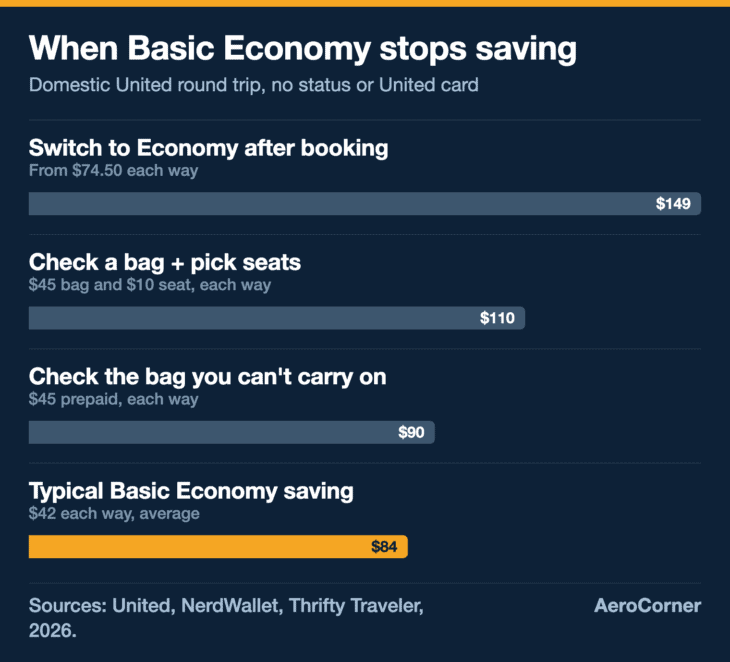
Rules are for United-operated domestic flights and a general MileagePlus member with no United card, as of November 2026. The typical saving is NerdWallet’s average gap between Basic Economy and Economy on flights from Chicago O’Hare to 10 US cities, doubled for a round trip ($42 x 2 = $84). Add-on costs use United’s $45 prepaid first-bag fee, seat fees from about $10 a flight per Thrifty Traveler, and the switch-to-Economy price from $74.50 per direction per NerdWallet, each doubled for a nonstop round trip. Fares and fees vary by route and date.
Carry-on bags: the rule that decides most bookings
United Basic Economy on a domestic flight includes one personal item and no full-size carry-on. The personal item must fit under the seat in front of you, no bigger than 9 by 10 by 17 inches (23 x 25 x 43 cm), which is a purse, laptop bag or small backpack.
United Economy includes both a personal item and an overhead carry-on. That is the single biggest practical difference, and Thrifty Traveler calls United’s version the strictest Basic Economy carry-on rule among the big US airlines, since Delta and American allow carry-ons on their basic fares.
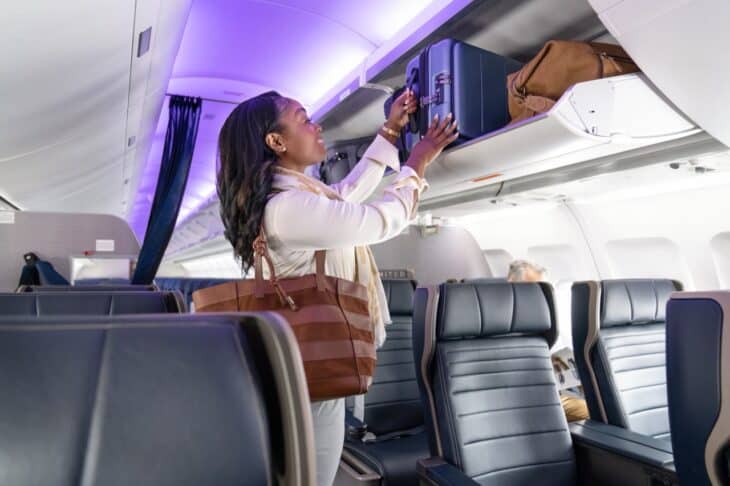
There are exceptions. MileagePlus Premier members, Star Alliance Gold members and primary holders of a qualifying United credit card get a carry-on in Basic Economy, as do some companions on their reservation, and Basic Economy passengers on transatlantic, transpacific and South America flights get one too.
Checked bags cost the same in both fares. Since April 3, 2026, the first bag on a domestic United ticket is $45 prepaid and the second $55, plus $5 more each for bags checked less than 24 hours before departure.
Edge: Economy. A carry-on is included, and in Basic Economy anything bigger than a personal item becomes a $45 checked bag.
Price: how much cheaper Basic Economy really is
A NerdWallet analysis of flights from Chicago O’Hare to 10 destinations found Basic Economy saved about $42 on average against regular Economy. That is about $84 on a round trip, though the gap moves with route, date and demand: Thrifty Traveler generally sees $90 to $100 or more.
The saving disappears fast once you add back what Economy includes. A traveler with a roll-aboard who books Basic Economy must check it, which is $90 for a round trip at the prepaid price, already $6 more than the typical saving.
Add seats at about $10 per flight, and the add-ons reach $110 on a nonstop round trip. Seat fees are charged per flight, so a connection doubles them.
The $84 rule of thumb
On a domestic round trip, Basic Economy typically saves about $84. Checking one bag both ways costs $90 at United’s prepaid rate. If you need a roll-aboard and have no United card or status, buy Economy unless the fare gap is clearly bigger than $90.
Edge: Basic Economy. It is cheaper at the fare level, as long as you add nothing back.
Seat selection and sitting together
United Economy lets you choose a standard seat for free when you book. Basic Economy does not: United assigns a seat before boarding, and families are not seated together unless they pay for seat selection in advance.
Unlike some airlines, United sells Basic Economy passengers a seat from the moment they book. Thrifty Traveler typically sees $10 to $20 a seat per flight, with back-of-cabin middle seats the cheapest, and found a window from $13 on a Houston to Washington Dulles flight.
Edge: Economy. The seat choice is free, and in Basic Economy it is a per-flight fee.
Changes and cancellations
Both fares can be canceled for a full refund within 24 hours of booking. After that, United Economy has no change fee on most flights, so you pay only any fare difference.
Basic Economy cannot be changed. Cancel it and you get only part of its value back as a travel credit: Thrifty Traveler reports a $99 fee on a domestic round trip and $199 on an international one.
There is a way out after booking. United sometimes offers a switch to Economy on the trip details page, which restores free changes, a carry-on and seat choice for the whole reservation, from $74.50 per direction on domestic flights and $149.50 on international ones, according to NerdWallet.
That works out to at least $149 on a domestic round trip, far more than the typical $84 fare gap. If you are unsure about the trip, it is cheaper to buy Economy at the start.
Edge: Economy. It can be changed without a fee, while Basic Economy can only be canceled for a reduced credit.
Miles and status since April 2026
This is the change most older guides miss. United’s February 19, 2026 announcement said that “general members now must hold a United card to earn miles when traveling on a Basic Economy ticket.”
For tickets issued on or after April 2, 2026, a general member with no United card earns 0 miles per dollar in Basic Economy and 3 in Economy. With a United card the rates are 3 and 6, and Premier members earn 2 to 6 miles per dollar in Basic Economy against 5 to 9 in Economy, according to AwardWallet’s tables.
Basic Economy also does not count toward Premier qualifying flights for elite status. If you are chasing status or earning miles toward an award, compare programs in our guide to the best airline loyalty programs.
Edge: Economy. It earns miles at every level, and for a general member without a card Basic Economy earns none.
Boarding
United boards in six groups. Economy passengers board in groups 3 to 5, and Basic Economy boards last, in group 6.
Boarding last matters less when you have no carry-on to stow. Premier members, Star Alliance Gold members and qualifying United cardholders keep their earlier boarding even on a Basic Economy ticket.
Edge: Economy. Groups 3 to 5 board before group 6.
Economy Plus, upgrades and the seat itself
On board, the two fares are identical: the same standard Economy seat, the same legroom and the same free snacks and soft drinks. On a United Boeing 737 MAX 8, a Basic Economy passenger and the Economy passenger beside them are in the same row.
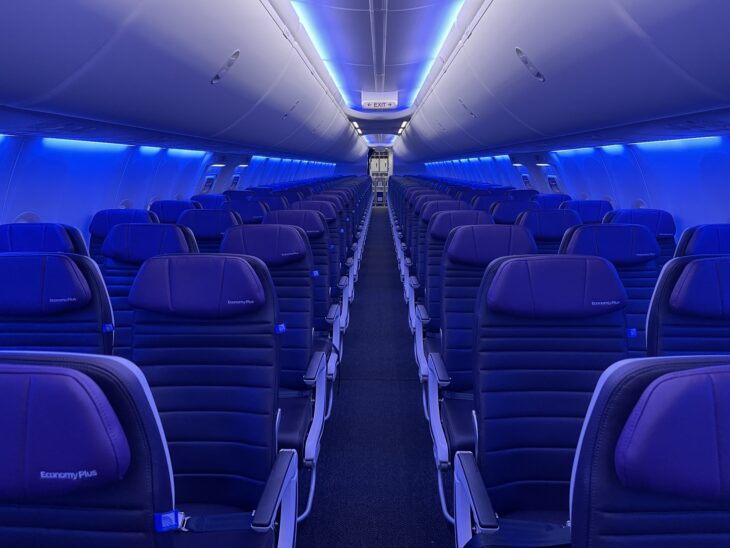

The difference is the way out of that seat. Economy passengers can buy Economy Plus extra legroom when they book, and Premier members get it free and go on the upgrade list.
Basic Economy passengers can buy Economy Plus only at check-in, and NerdWallet notes that elites do not get it free on a Basic Economy ticket. Complimentary Premier upgrades do not apply either.
Edge: Economy. The seat is the same, but only Economy keeps Economy Plus and upgrades open from the start.
International flights: where the gap narrows
Basic Economy is sold almost everywhere United flies, including ultra-long-haul routes such as Singapore and Sydney, according to Thrifty Traveler. On long international flights, though, the bag rule that dominates the domestic decision mostly falls away.
Basic Economy passengers on transatlantic, transpacific and South America flights get a full-size carry-on. NerdWallet adds that transpacific Basic Economy fares include a free checked bag too.
What stays is everything else: no changes, paid seats, last boarding and reduced or zero miles. On a long flight, being assigned a middle seat at the gate costs more comfort than it does on a one-hour hop.
The fare gap grows as well. Thrifty Traveler puts the step up to Economy at about $200 for a round trip to Europe, and the switch to Economy after booking starts at $149.50 per direction on international routes.
Edge: Economy. Basic Economy is easier to live with on long international routes, but it still cannot be changed and still earns fewer miles.
Myth: Basic Economy gets you a worse seat
It does not. Basic Economy and Economy passengers sit in the same standard seats with the same legroom and the same snacks. What you give up is the right to choose that seat for free, a carry-on bag, changes, and, since April 2026, miles if you have no United card or status. Paying for a seat in Basic Economy also does not add a carry-on.
Who should pick which
| If you… | Pick | Because |
|---|---|---|
| Fly domestic with only a backpack, and your plans are fixed | Basic Economy | You keep the saving and lose nothing you would use |
| Need a roll-aboard and have no United card or status | Economy | One bag both ways costs $90, more than the typical $84 saving |
| Hold a United card or Premier status | Basic Economy, if plans are fixed | You keep a carry-on and early boarding, and still earn some miles |
| Travel with children or want to sit together | Economy, or Basic plus paid seats | Basic Economy seats families together only if you pay per flight |
| Might change or cancel | Economy | Basic Economy cannot be changed, and switching later costs from $149 a round trip |
| Want miles or elite credit | Economy | A general member with no card earns 0 miles on Basic Economy |
| Fly across the Atlantic or Pacific | Either, carefully | Basic Economy gets a carry-on on those routes, but still no changes |
Basic Economy is not shrinking. United’s third-quarter 2026 results reported Basic Economy revenue up 16% on a year earlier, and the airline now sells the same stripped-down idea in its premium cabins, as our report on United’s new base fares in First and Business explains.
FAQ
Sources and references used for research and fact-checking.
- United Airlines, United Gives MileagePlus Credit Cardholders More Miles, Exclusive Flight Discounts
- United Airlines, United Delivers Record 17% Revenue Growth in Q3, and Expects Record Q4 Revenue Growth
- NerdWallet, United Basic Economy: What You Need to Know
- NerdWallet, How to Add Economy Benefits to a United Basic Economy Ticket
- NerdWallet, United Airlines Basic Economy vs. Economy vs. Economy Plus
- AwardWallet, United MileagePlus Mileage Earning Changes 2026
- Thrifty Traveler, The Complete Guide to United Basic Economy
- The Points Guy, United Airlines new basic business and Premium Plus fares
- Fortune, United raises checked bag fees by $10
Get the Newsletter
The latest aviation news and stories sent to your inbox.
About the Author

Tim is the owner and lead editor of AeroCorner since 2019, overseeing aviation content covering aircraft, airlines, airports, and the broader aviation industry. Through years of researching, writing, editing, and publishing aviation-focused content, he has developed extensive practical knowledge of commercial aviation and air travel. Based in Asia and a frequent traveler himself, Tim also brings firsthand passenger experience to AeroCorner’s coverage. Outside of publishing, he has also explored aviation firsthand through hands-on flight training in New Zealand.