

Table of Contents
In late December 2023, lawyers for Taylor Swift sent a cease-and-desist letter to Jack Sweeney, a University of Central Florida student whose automated accounts posted her private jet’s flights. The letter called the tracking “a life-or-death matter.” We found no report of a lawsuit, and the tracking never stopped.
Sweeney was not hacking anything, and he was not really reading an FAA database either. Federal rules require the jet to broadcast its own identity, position, altitude and speed, unencrypted, to anyone with a cheap receiver. Every privacy tool the FAA offers works around that broadcast, and none of them turns it off.
This account is built from the federal ADS-B rules, 14 CFR 91.225 and 91.227, the FAA’s own pages on its LADD and PIA privacy programs, Section 803 of the FAA Reauthorization Act of 2024, and the FAA aircraft registry as of October 2026.

Jan. 1, 2020
The broadcast becomes mandatory. The FAA’s ADS-B Out rule takes effect for most controlled airspace, including everything above 10,000 feet over the 48 contiguous states, where a business jet spends nearly all of its flight.
July 2022
The emissions ranking. Marketing agency Yard says Swift’s jet flew 170 times between Jan. 1 and July 29, 2022. Her spokesperson replies that the jet “is loaned out regularly to other individuals.”
Late Dec. 2023
The letter. Attorneys from the law firm Venable tell Sweeney his accounts give anyone intent on harming Swift “a roadmap to carry out their plans.”
Feb. 6, 2024
The letter goes public. The Washington Post reports it. The same day, the FAA issues a registration certificate for Swift’s older Falcon 900 to a Missouri company, Triangle Real Estate LLC.
May 16, 2024
Congress acts. The FAA Reauthorization Act of 2024 is enacted. Its Section 803 orders the FAA to withhold a private owner’s registration data from broad display on request.
Oct. 2024
Meta removes the accounts. Instagram and Threads accounts tracking Swift, Mark Zuckerberg and others are banned, citing privacy concerns and the risk of physical harm.
Mar. 28, 2025
The registry goes dark on request. The FAA starts accepting electronic requests to withhold an owner’s name and address from all FAA websites.
Feb. 2026
A new tail number. Swift’s Falcon 7X, serial number 27, moves to a new registration mark, and N621MM is reserved on Feb. 10 by Island Jet Inc. of Nashville.
Oct. 14, 2026
Still tracked. A tracker account on Bluesky posts the jet’s 5-hour-14-minute flight from Morristown, New Jersey, to Burbank, California, under its new registration.
What happened
Swift’s jet became a public subject in July 2022, when the marketing agency Yard ranked celebrity jets by estimated emissions and put hers first, with 170 flights between January 1 and July 29, 2022.
Her spokesperson pushed back on the attribution, not the flights. “Taylor’s jet is loaned out regularly to other individuals,” the statement said. “To attribute most or all of these trips to her is blatantly incorrect.”
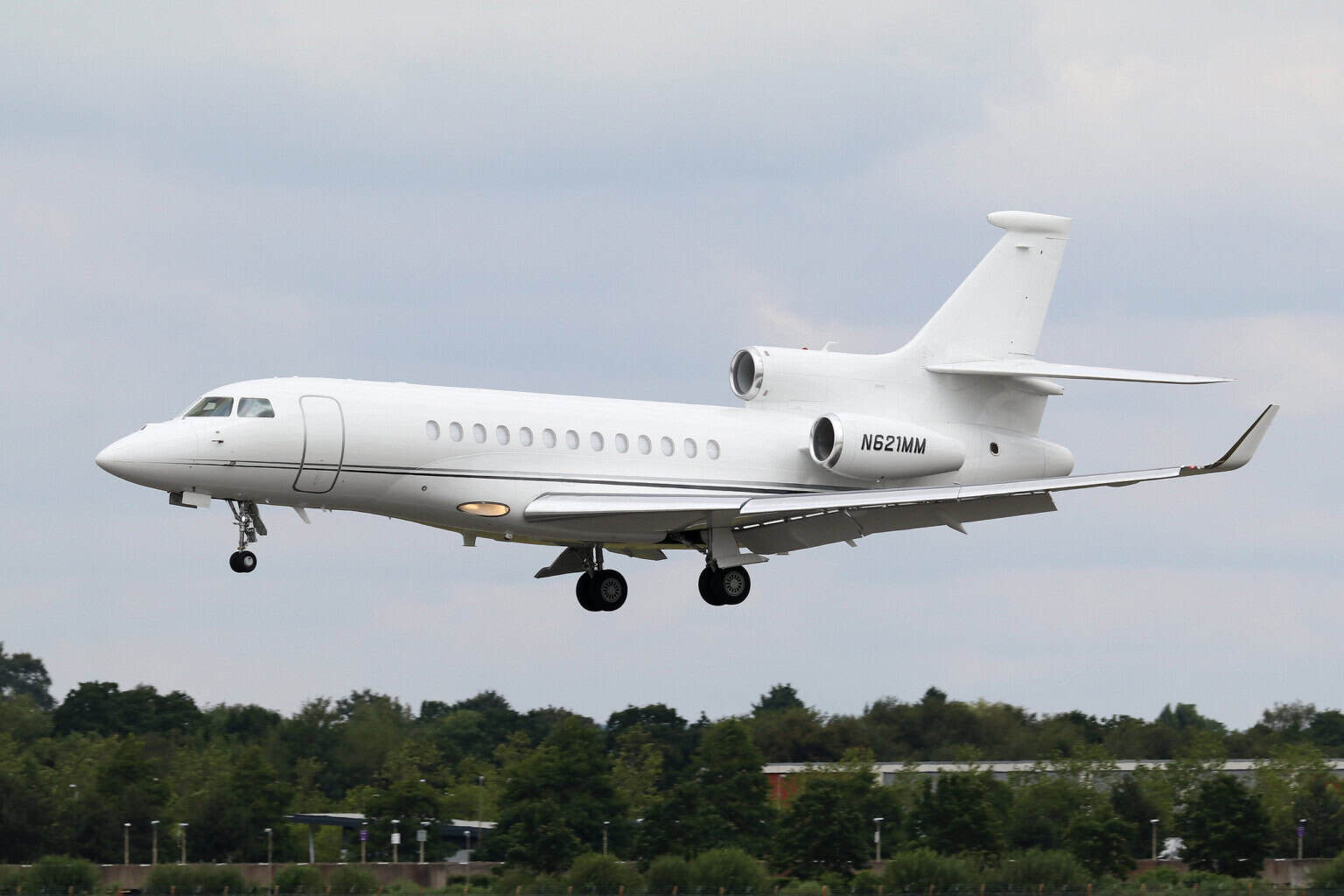
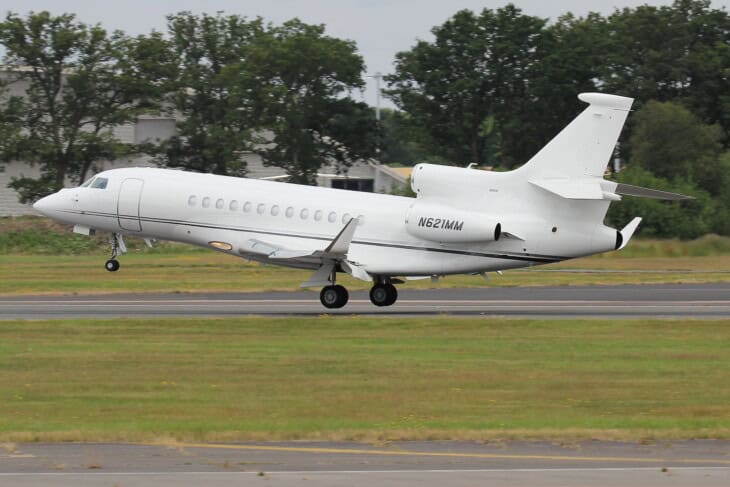
The jet at the center of it was a Dassault Falcon 7X, a three-engine, long-range business jet. Fortune reported in December 2024 that it was officially owned by Island Jet Inc., a Nashville holding company. Our guide to Taylor Swift’s private jets covers the fleet itself.
Sweeney had built accounts that posted flights automatically, with a map and a fuel and carbon estimate, for Swift, Elon Musk and dozens of others. Twitter suspended his account following Elon Musk’s private jets in December 2022, after it had passed 526,000 followers.
In late December 2023, attorneys from the law firm Venable wrote to him. “While this may be a game for you or an avenue that you hope will earn you wealth or fame, it is a life-or-death matter” for Swift, the letter said.
It accused him of “stalking and harassing behavior,” and warned that Swift would have “no choice but to pursue any and all legal remedies available to her.” It demanded that he “immediately stop providing information about our client’s location to the public.”
The Washington Post broke the story on February 6, 2024. A Swift spokesperson said “the timing of stalkers suggests a connection” and added: “His posts tell you exactly when and where she would be.” Sweeney answered: “I believe in transparency and public information.”
We found no court filing and no report of one. The pressure came instead from platforms, the registry and Congress.
What the record shows
The FAA registry shows Swift’s older jet changing hands as the letter went public. Her Falcon 900, serial number 95, flew as N898TS, and the FAA issued its new registration certificate to Triangle Real Estate LLC of Saint Peters, Missouri, on February 6, 2024.

The airframe now flies under a different tail number for its new owner. The mark N898TS itself was reserved on June 4, 2024, by S.A.T.A. LLC, a Nashville company, which keeps it off any other aircraft.
The Falcon 7X, serial number 27, built in 2009, is still on the US register. But its public record no longer names an owner. Where the name and address used to be, the FAA’s page now reads: “The Registered owner has requested to keep this data private under Title 49 of the United States Code Section 44114.”
That section is where Congress put Section 803 of the FAA Reauthorization Act of 2024. It tells the FAA, on request of a private owner or operator, to withhold “the registration number and other similar identifiable data or information” from “any broad dissemination or display.”
In February 2026 the 7X also left the tail number every fan page still prints. Its record now carries a different mark, with the same serial number, certificate date and expiration date, and N621MM sits in the FAA’s reserved-number file, held since February 10, 2026, by Island Jet Inc. of Nashville.
We are not printing the new registration. The tracker accounts found it anyway: on October 14, 2026, one of them on Bluesky posted the jet’s 5-hour-14-minute flight from Morristown, New Jersey, to Burbank, California, under the new mark.
What most accounts get wrong
The trackers were not hacking anything, and the data was not really the FAA’s. The Associated Press wrote that Sweeney’s accounts merely repackaged public data provided by the FAA, but the positions come from the jet itself, which federal rules require to broadcast its identity and location to any receiver in range. The FAA’s own privacy program, LADD, only filters the FAA’s data feed, and the FAA says it does not affect the broadcast. And the tail number nearly every page still gives for her jet, N621MM, has not been on any aircraft on the active US register since February 2026.
How a jet tracker actually works
Since January 1, 2020, 14 CFR 91.225 has required ADS-B Out in Class A, B and C airspace and in Class E airspace at and above 10,000 feet over the 48 contiguous states. A business jet at cruise altitude is inside that airspace almost the whole time.
The same rule says an equipped aircraft must “operate this equipment in the transmit mode at all times,” with exceptions only for sensitive government missions or when air traffic control directs otherwise. A celebrity’s privacy is not on the list.
The next rule, 14 CFR 91.227, sets the minimum message. It includes latitude and longitude, barometric and geometric altitude, velocity, the flight identification and the aircraft’s assigned ICAO 24-bit address, and the position must go out no later than 2.0 seconds after it is measured.
That 24-bit address is the key. “ADS-B Out operates by transmitting the aircraft’s unique ICAO aircraft address, making identification by any individual with an ADS-B receiver possible,” the FAA says on its own privacy page. The registry then ties each address to a registration, and each registration to an owner.
Catching the signal takes, in The Points Guy’s words, “small, inexpensive equipment like an antenna and a” Raspberry Pi. Volunteers called feeders pool what their receivers hear into networks such as ADS-B Exchange, which The Points Guy reported in 2022 displays the data unfiltered, legally, because it travels over public radio frequencies.

.jpg)
Sweeney’s bots follow chosen aircraft through ADS-B and post each flight automatically. As Business Insider put it in 2023, the federal block programs “can be skirted via ADS-B Exchange.” The accounts post when a jet lands, not who stepped off it.
Sweeney conceded that limit himself in December 2024. “We know it’s her plane, but we don’t know if she’s on it or who’s on it,” he told Fortune.
What LADD, PIA and the registry can and cannot hide
The FAA offers owners two tools, and they solve different problems. Neither stops the broadcast, because the broadcast is what keeps the airplane visible to controllers and to other aircraft.
LADD, Limiting Aircraft Data Displayed, formerly called BARR, filters an aircraft out of the FAA’s own System Wide Information Management (SWIM) feed. Flight-tracking sites that subscribe to that feed sign a Data Access User Agreement that binds them to hide every LADD aircraft.
That is why Swift’s jet could vanish from a commercial flight tracker and still appear on a hobbyist map. The FAA says it plainly: “The LADD program does not impact the ADS-B broadcast data.”
PIA, the Privacy ICAO Address program, goes after the broadcast’s weak point instead. The owner gets an alternate, temporary 24-bit address that “will not be assigned to the owner” in the registry, and flies with a third-party call sign rather than the tail number.
It has hard limits. It is only for US-registered aircraft with 1090 MHz ADS-B, and only inside US-managed airspace: the FAA’s own examples allow New York to Los Angeles and rule out New York to London. Any flight leaving that airspace must broadcast the registered address.
The FAA also concedes that a PIA aircraft can still be “received by off-the-shelf receivers.” What changes is that the address no longer leads straight to a name. Owners can request a new PIA every 20 days.
The third layer is the registry itself. Since March 28, 2025, owners have been able to ask the FAA, through its CARES online system, to withhold their name and address from all FAA websites. The 7X’s record now shows a withheld owner.
Put together, the layers raise the cost of tracking without ending it. The jet still transmits, the receivers still hear it, and a new tail number is one more fact for a tracker to work out, not a disappearance.
What changed
The law changed, though not because of one singer. Section 803 of the 2024 Act, enacted on May 16, 2024, made registry privacy a right in law, and it applies “notwithstanding any other provision of law,” including the Freedom of Information Act. The FAA has said it is weighing whether to withhold private owners’ data by default.
The platforms changed too. In October 2024 Meta banned Sweeney’s Instagram and Threads accounts tracking Swift, Mark Zuckerberg and others, citing privacy concerns and the risk of physical harm. Sweeney said the accounts broke no platform rule.
The physics did not change. As long as 14 CFR 91.225 requires ADS-B Out in the airspace where jets cruise, any private jet flying there tells every receiver in range where it is, and the trackers keep finding new ways to put a name on it.
FAQ
Sources and references used for research and fact-checking.
- Electronic Code of Federal Regulations, 14 CFR 91.225, Automatic Dependent Surveillance-Broadcast (ADS-B) Out equipment and use
- Electronic Code of Federal Regulations, 14 CFR 91.227, ADS-B Out equipment performance requirements
- Federal Aviation Administration, ADS-B Privacy (Privacy ICAO Address program)
- Federal Aviation Administration, Limiting Aircraft Data Displayed (LADD)
- Federal Aviation Administration, FAA Moves to Protect Aircraft Owners' Private Information (March 28, 2025)
- Federal Register, Request for comment on removal of aircraft registration information from public dissemination (Docket FAA-2025-0638)
- Federal Aviation Administration, Aircraft registry: N-Number inquiry and ReleasableAircraft database (October 2026 release), Dassault Falcon 7X serial 27, Falcon 900 serial 95, reserved marks N621MM and N898TS
- The Associated Press via NBC Miami, Taylor Swift sends cease and desist to student tracking her jets: 'It is a life-or-death matter'
- WRAL, Taylor Swift threatens legal action against Florida student who tracks her jet
- FOX 29, Taylor Swift responds to critics after jet tops worst private plane CO2 emissions list
- Fortune, Taylor Swift's French-made private jet took 98 flights this year
- Straight Arrow News, Meta shuts down Jack Sweeney's private jet tracking accounts
- The Associated Press via WSET, Twitter suspends account that tracked owner Elon Musk's jet
- The Points Guy, How flight tracking works
- Business Insider via Yahoo News, Student who tracks Elon Musk's jet blasts sale of flight-tracking site he uses to keep tabs on aircraft
Get the Newsletter
The latest aviation news and stories sent to your inbox.
About the Author

Tim is the owner and lead editor of AeroCorner since 2019, overseeing aviation content covering aircraft, airlines, airports, and the broader aviation industry. Through years of researching, writing, editing, and publishing aviation-focused content, he has developed extensive practical knowledge of commercial aviation and air travel. Based in Asia and a frequent traveler himself, Tim also brings firsthand passenger experience to AeroCorner’s coverage. Outside of publishing, he has also explored aviation firsthand through hands-on flight training in New Zealand.