

Table of Contents
The tow release goes off with a bang somewhere behind the pilot’s head, and the tug peels away to the left. The propeller noise fades out over about three seconds. What is left is a faint hiss of air over the canopy and not much else.
The glider is now 2,000 feet up with nothing pushing it forward. And it is already going down. From the instant the rope lets go it is descending through the air around it, and it never stops, not once, not at any speed the pilot can choose.
Yet glider pilots routinely stay airborne for hours, climb into the flight levels, and cross more than a thousand miles of continent in a day. The trick is not that they stop falling. It is that they find air going up faster than they are going down.
How Do Gliders Fly Without an Engine?
A glider flies by trading height for distance. Gravity pulls it forward and down along a very shallow slope, the wing converts that motion into the lift that keeps any aircraft flying, and the whole machine slides downhill through the air like a sled on a gentle incline.
In perfectly still air, that is the end of the story. Launch high, glide, land. A training flight released from a 2,000-foot aerotow lasts roughly ten minutes and covers about eight miles.
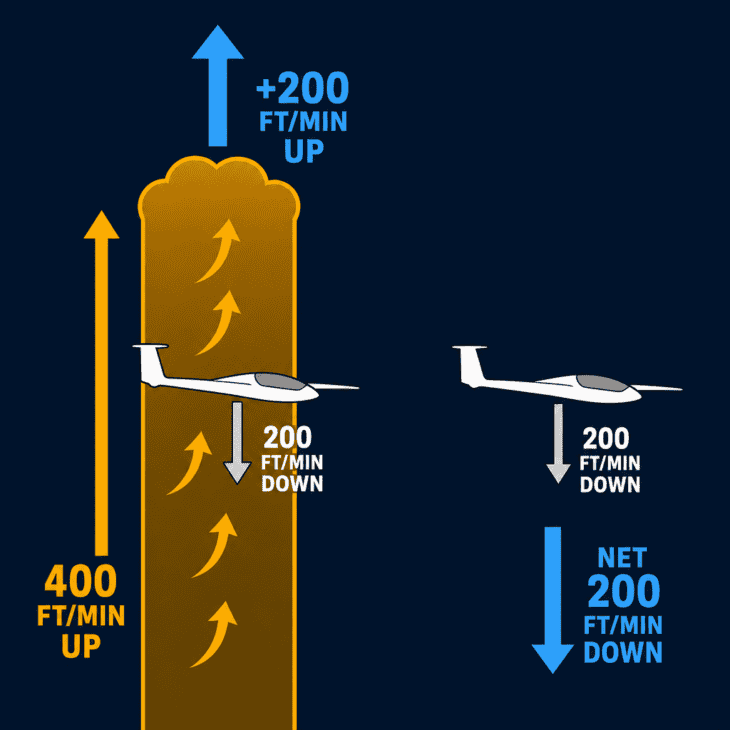
Soaring is what happens when the air itself is rising. If the glider sinks through the air at 200 feet per minute, and that whole body of air is climbing at 400 feet per minute, the glider gains 200 feet per minute against the ground. It is still falling. The floor is just coming up faster.
How a glider actually stays up
A glider is always descending relative to the air around it. It gains altitude only by flying inside a mass of air that is rising faster than the glider is sinking through it. Everything else in soaring is about finding that air, and losing as little height as possible on the way to it.
Getting airborne in the first place still takes an outside push. Most American clubs use an aerotow behind a light aircraft and release somewhere between 2,000 and 3,000 feet.
The other common method is a ground winch that reels in a long steel or synthetic cable and slingshots the glider skyward in about 30 seconds. Release height lands near 35 percent of the cable length, so a 3,300-foot (1,000 m) cable buys roughly 1,150 feet.
Glide Ratio Is the One Number That Matters
Every glider’s performance compresses into a single figure: the glide ratio, meaning how far it travels forward for each unit of height it gives up. A 50:1 sailplane covers 50 miles for every mile of altitude it loses.
That is a far better number than anything with an engine bolted to it. A Boeing 747-400 glides at roughly 17:1. The German open-class sailplane eta manages 70:1, at a best glide speed of 67 mph (108 km/h).
| Aircraft | Best glide ratio | Wing aspect ratio | Minimum sink |
|---|---|---|---|
| eta (open class sailplane) | 70:1 | 51.3 | 79 ft/min |
| Schleicher ASW 27 (15-metre racing class) | 48:1 | 25 | 114 ft/min |
| Schweizer SGS 2-33 (club trainer) | 22:1 | 11.9 | 187 ft/min |
| Boeing 747-400 | about 17:1 | about 7.9 | not applicable |
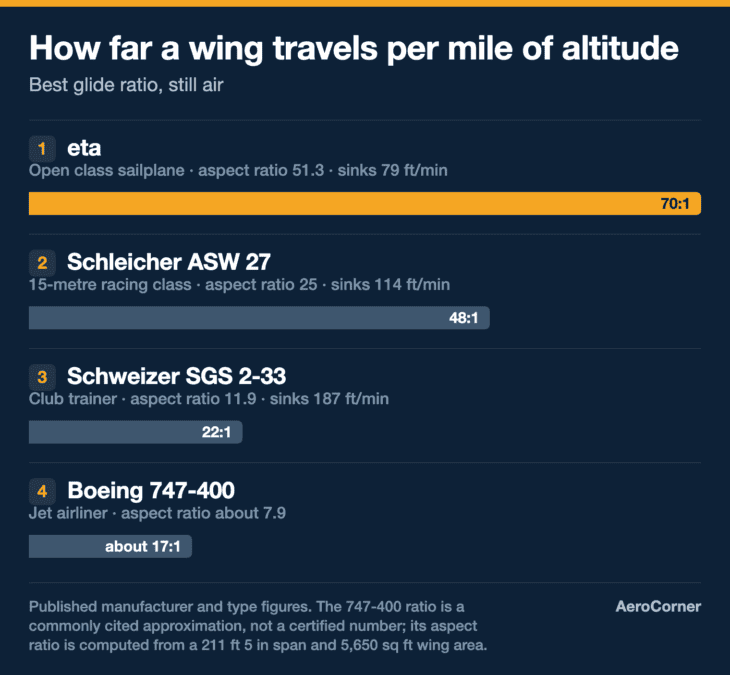
Those ratios translate directly into range. From 5,000 feet in still air, a 22:1 club trainer can reach a point about 21 miles away. A 70:1 sailplane from the same height can reach 66 miles.
There is a catch that shapes every minute of a cross-country flight. Best glide ratio only happens at one airspeed. Fly faster than that and you sink faster, fly slower and you also sink faster, so the pilot is constantly choosing a speed to match the conditions ahead.
The Three Kinds of Rising Air
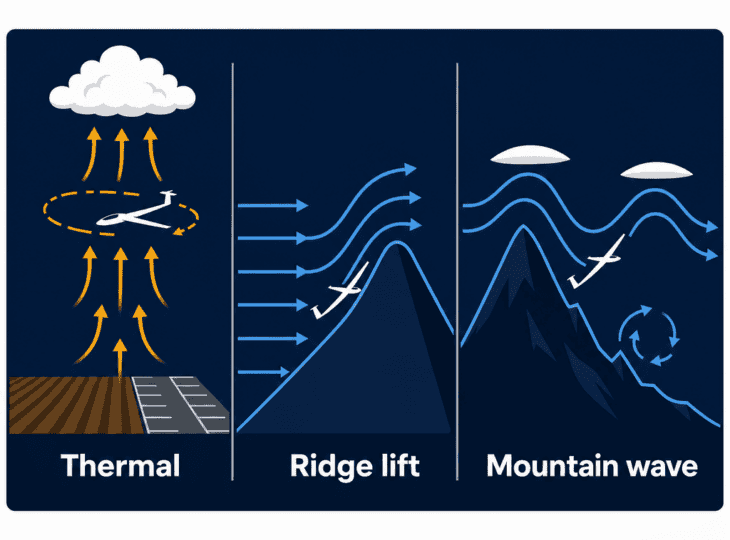
Soaring pilots hunt three separate atmospheric phenomena. Each one has its own weather, its own terrain, and its own ceiling, and a good pilot will use two or three of them in a single flight.
Thermals: the workhorse
The sun heats the ground unevenly. A plowed field, an asphalt parking lot or a bare rocky slope warms faster than the grass and trees around it, and eventually the warm air sitting on top of it breaks loose and rises as a column or a bubble.
Typical thermals give a glider a climb of 2 to 5 knots, roughly 200 to 500 feet per minute, so the pilot banks into a tight circle and stays inside the column all the way up. This is the most-used lift in the sport because it works over flat country as well as hills.
Cumulus clouds are simply the visible tops of thermals, formed where the rising air has cooled enough for its moisture to condense. A sky full of scattered puffy cumulus is, to a glider pilot, a map of where the lift is.
Ridge lift: the escalator
When wind meets a hill or a long ridge broadside, it has nowhere to go but over the top, and the air against the windward face is deflected upward. A glider flying back and forth along that face is riding a permanent escalator.
It needs wind of at least about 10 knots, ideally 15 to 20, striking the ridge within roughly 45 degrees of perpendicular. The lift band is shallow and rarely extends much more than 2,000 feet (600 m) above the terrain.
The compensation is reliability. Ridge lift runs all day and works under overcast skies, on the days when thermals never get going at all.
Mountain wave: the exotic one
When strong wind crosses a mountain range, the air does not go over the top and settle down again. It oscillates downwind in a standing wave, the way water does over a submerged rock, and the rising side of that wave can extend astonishingly high.
Smooth lens-shaped lenticular clouds parked motionless over and behind the peaks are the giveaway that wave is running. Underneath sits the rotor, a band of violent tumbling turbulence that pilots have to climb through to reach the glassy-smooth lift above it.
The highest a glider has ever flown
On 2 September 2018, Jim Payne and Tim Gardner rode an Andes mountain wave in the pressurised Perlan 2 sailplane to an FAI-ratified 74,334 feet (22,657 m) over El Calafate, Argentina, wearing pressure suits. That is higher than the 73,737 feet a U-2 spy plane officially reached in 1989, achieved in an aircraft with no engine at all.
Airbus, which backed the project, reported a peak of 76,124 feet on that same flight. The two numbers differ because they measure different things: the FAI record is based on GPS altitude, while the higher figure is pressure altitude, the height an aircraft’s barometric instruments compute from ambient air pressure.
Why the Wings Are So Absurdly Long
Stand next to a competition sailplane and the proportions look wrong. The eta carries 101 ft 5 in (30.9 m) of wingspan on a fuselage barely wider than the pilot’s shoulders.
The measure of that shape is aspect ratio: span squared divided by wing area, which is roughly a way of saying how long and thin the wing is. A 747-400’s wing works out to about 7.9. The eta’s is 51.3.
The reason is induced drag, the drag a wing creates purely as a byproduct of making lift, most of it generated by the vortex spilling off each wingtip. Spread the same lift across a longer, narrower wing and there is measurably less of it to overcome.
Everything else on the airframe follows from the same obsession. Seamless composite skins with almost no rivets, a fuselage pinched to the smallest cross-section a human will fit in, retractable landing gear on an aircraft that may well land in a farmer’s field, and wing surfaces polished to give away as little energy as possible.
The payoff is in the sink rate. At its best the eta descends at just 79 feet per minute, under a foot and a half per second. A Schweizer 2-33 club trainer sinks at 187 feet per minute, more than twice as fast, which is exactly why beginners fly them and record chasers do not.
The Myth: Gliders Are Held Up by the Wind
The misconception
Gliders do not stay airborne because wind blows underneath them and holds them up, the way it holds up a kite. Horizontal wind does not support a free-flying aircraft at all. Only air moving vertically upward, faster than the glider is sinking through it, produces a climb.
The confusion is understandable, because a glider tracking along a ridge does look exactly like a kite on a string. But a glider flying in a steady 40-knot horizontal wind sinks at precisely the same rate as one in dead calm air.
Once it is airborne and untethered, the aircraft simply moves with the air mass around it. There is no headwind or tailwind in the glider’s own frame of reference, only the air it is embedded in.
Wind matters only where something turns it upward: a ridge that deflects it, a mountain that sets it oscillating, or solar heating that breaks it into rising columns. Wind changes where a glider ends up over the ground. It does not change how fast the glider falls through the air.
The second common misconception is that gliding is a ten-minute novelty ride. On 21 January 2003, Klaus Ohlmann and Karl Rabeder flew a Schempp-Hirth Nimbus 4DM 1,869 miles (3,008 km) across Argentine wave systems in a single flight, and that mark still heads the FAI distance table. It is farther than Los Angeles to Chicago.
You Can Solo a Glider Before You Can Drive
The regulatory bar is lower than most people assume. Under 14 CFR 61.83, a student pilot may solo a glider at 14, two years before the minimum age to solo an airplane and, in most states, before they can hold a full driver’s license.
A full private pilot certificate with a glider rating requires at least 10 hours of flight time in gliders and 20 flights, including 2 hours of solo time across at least 10 launches and landings, under 14 CFR 61.109(f).
Someone who already holds 40 hours in a powered aircraft needs only 3 hours in a glider and 10 solo flights. Compare that with the 40-hour minimum for a powered private certificate, on an aircraft that burns no fuel and is usually maintained by a club full of volunteers.
Next time you see a sailplane working a ridge on a summer afternoon, watch what the pilot is actually doing. Those tight banked circles are not showmanship. They are a search pattern, holding the aircraft inside a column of rising air perhaps a few hundred feet across.
There is no throttle to reach for and no second chance at altitude. Every foot of height is either something the tow plane gave them or something they found in the air, and all of it is draining away the entire time.
That is why glider pilots read clouds the way sailors read water.
Sources and references used for research and fact-checking.
- Federal Aviation Administration, Glider Flying Handbook (FAA-H-8083-13B)
- Cornell Law School Legal Information Institute, 14 CFR 61.109 - Aeronautical experience
- Wikipedia, Gliding
- Airbus, Airbus Perlan Mission II glider soars to 76,000 feet to break own altitude record
- Fedération Aéronautique Internationale, Airbus Perlan Mission II soars to the highest altitude ever reached on a glider
- Wikipedia, Schleicher ASW 27
Get the Newsletter
The latest aviation news and stories sent to your inbox.
About the Author

Tim is the owner and lead editor of AeroCorner since 2019, overseeing aviation content covering aircraft, airlines, airports, and the broader aviation industry. Through years of researching, writing, editing, and publishing aviation-focused content, he has developed extensive practical knowledge of commercial aviation and air travel. Based in Asia and a frequent traveler himself, Tim also brings firsthand passenger experience to AeroCorner’s coverage. Outside of publishing, he has also explored aviation firsthand through hands-on flight training in New Zealand.