

Table of Contents
A fighter jet looks hard to draw until you notice it is mostly a long oval, a triangle and a fin. Once you see those shapes, the wings and canopy stop being scary.
This list has 25 fighter jet drawing ideas, ordered from easiest to hardest. Ideas 1 to 8 use basic shapes and suit beginners and kids, 9 to 18 add scenes and detail, and 19 to 25 cover style, shading and challenges.
Every jet here is a generic design with no markings, so you can invent your own paint scheme. You only need a pencil, an eraser and a black pen. Ready to move on? Try our easy airplane drawing ideas or helicopter drawing ideas, or print these fighter jet coloring pages to color instead.
01. Simple Fighter Jet From Basic Shapes
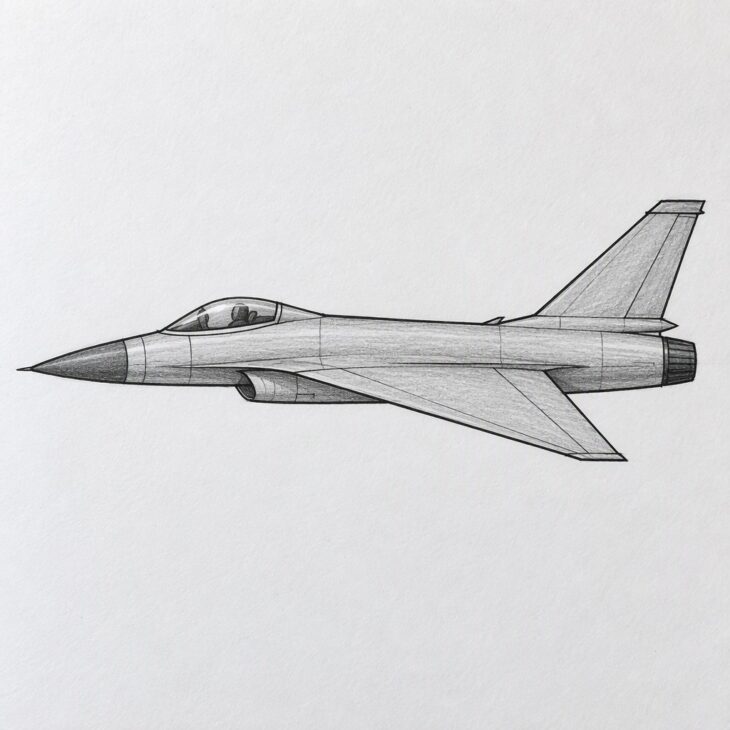
What it is A side-view jet made of five parts: a long oval body, a pointed nose, a bubble canopy, a tail fin and one triangle wing. It takes about three minutes and suits ages 5 and up.
Why it works Splitting the jet into basic shapes removes the fear of drawing one. Every later idea on this list is a variation of this shape.
How to get it Draw a long, thin oval in pencil and sharpen one end into a nose. Add a half circle on top for the canopy and a triangle under the middle for the wing. Put a swept fin at the back, then trace in pen and erase the pencil. Repeat it three times until the shapes feel automatic.
02. Cartoon Fighter Jet With a Smiling Face
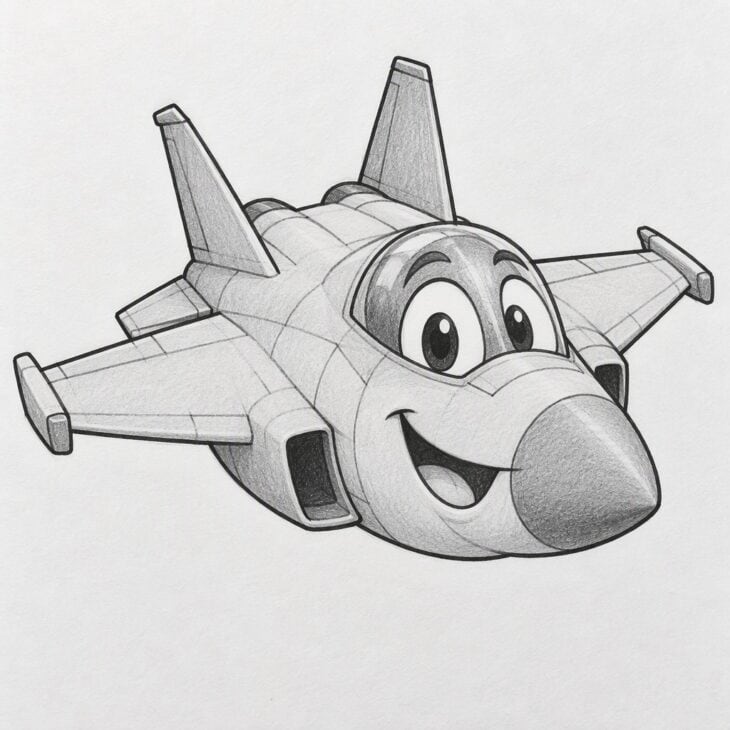
What it is A chubby cartoon jet with an oversized canopy, two big eyes, a curved smile on the nose cone and short stubby wings. Kids often add speed lines and a name on the tail.
Why it works Characters are easier to draw than machines because nothing has to be accurate. A smile covers up crooked lines.
How to get it Start with a fat bean shape for the body and a big circle for the canopy. Add two round eyes and a smile on the nose. Draw two small wings and a tail fin, then three speed lines behind. Color it with markers in any bright color.
03. Fighter Jet Front View
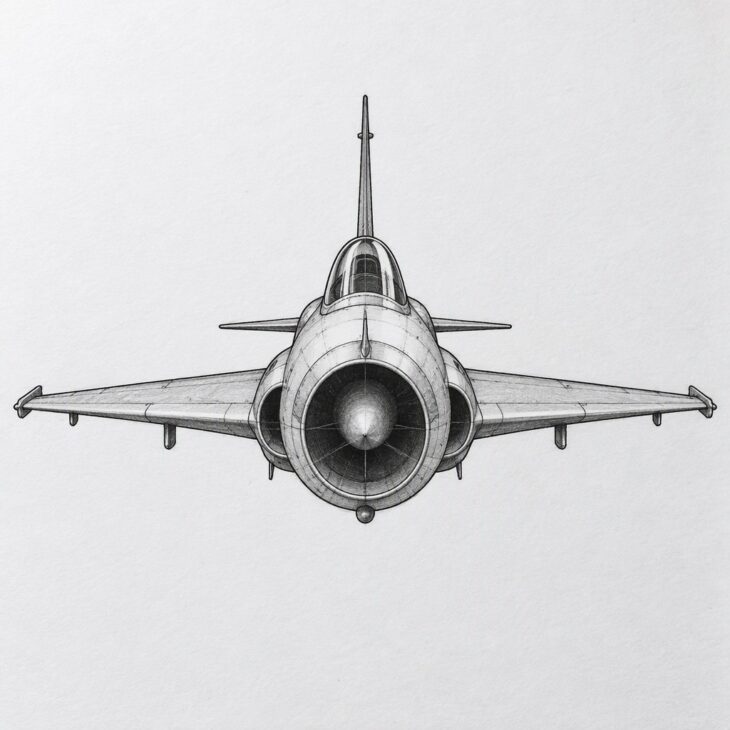
What it is A head-on view with a round air intake in the middle, a narrow canopy above it, two wings stretching out evenly and twin tail fins behind. It suits ages 8 and up.
Why it works A front view teaches symmetry, because the left side must mirror the right. It also looks dramatic with very little detail.
How to get it Draw a vertical center line first and keep it faint. Sketch the intake circle and canopy on the line, then draw each wing as a mirrored thin triangle. Add two tail fins that lean slightly outward. Fold the page in half against a window to check the mirror.
04. Fighter Jet Top View
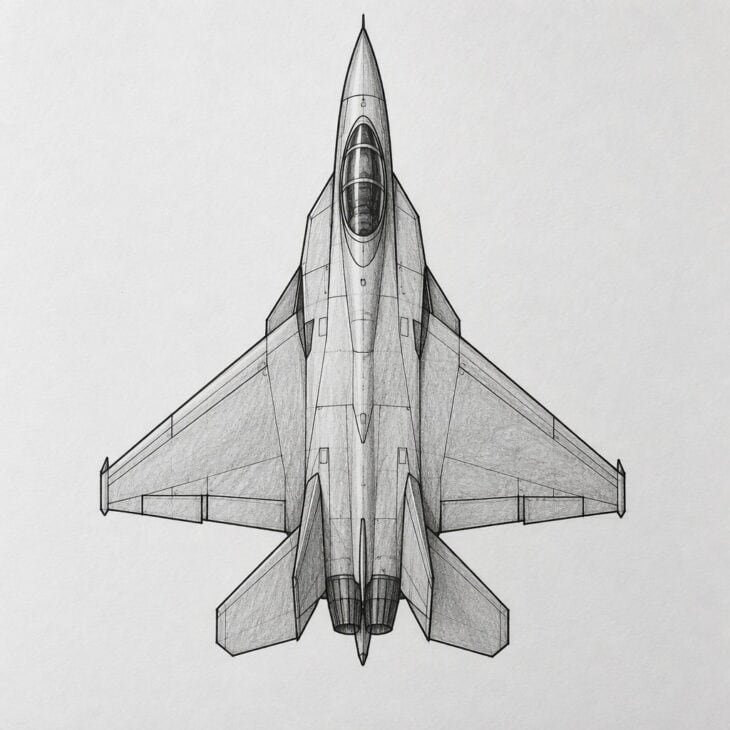
What it is A flat top-down view with a dart-shaped body, swept-back wings and two small rear stabilizers. The wing shape is the star of the drawing.
Why it works This view is the best way to learn how different wings look. You draw straight lines and angles, with no curves to fight.
How to get it Draw a long thin diamond down the middle for the body. Add a swept wing on each side that starts mid-body and ends in a clipped tip. Add two short rear stabilizers and a small oval canopy. Use a ruler for the wing edges to keep them crisp.
05. Delta Wing Jet
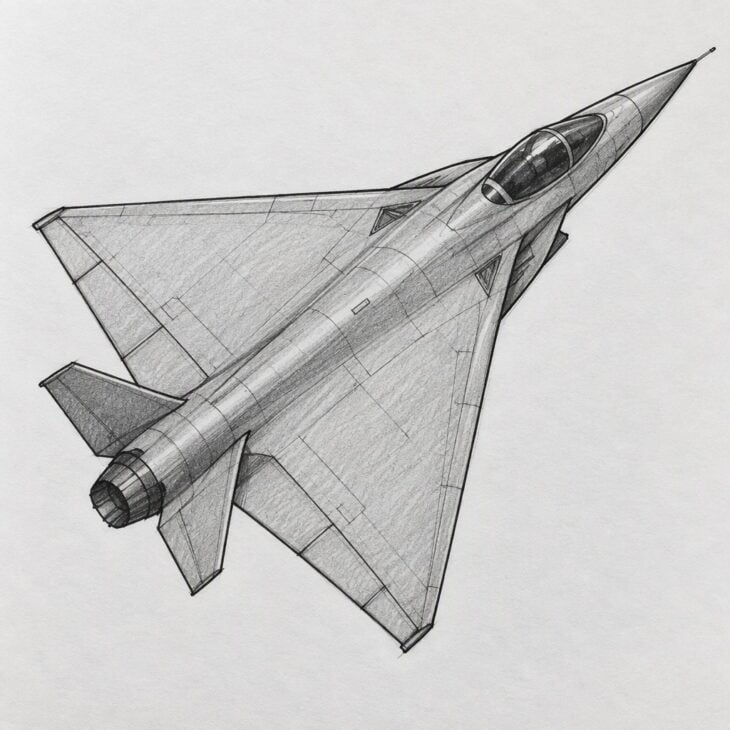
What it is A jet with a single large triangular wing that runs almost the full length of the body, plus a short nose and twin tail fins. The shape is simple and looks fast.
Why it works A delta wing is mostly one triangle, so it is a quick win for beginners. The result looks far more advanced than it is.
How to get it Draw a big isosceles triangle pointing right as the wing. Add a narrow nose forward of the tip and a small canopy bump. Put two short tail fins at the back corners. Shade the underside of the wing lightly to give it depth. For a bigger project, a finished drawing makes good aviation wall art.
06. Jet Taking Off From a Runway
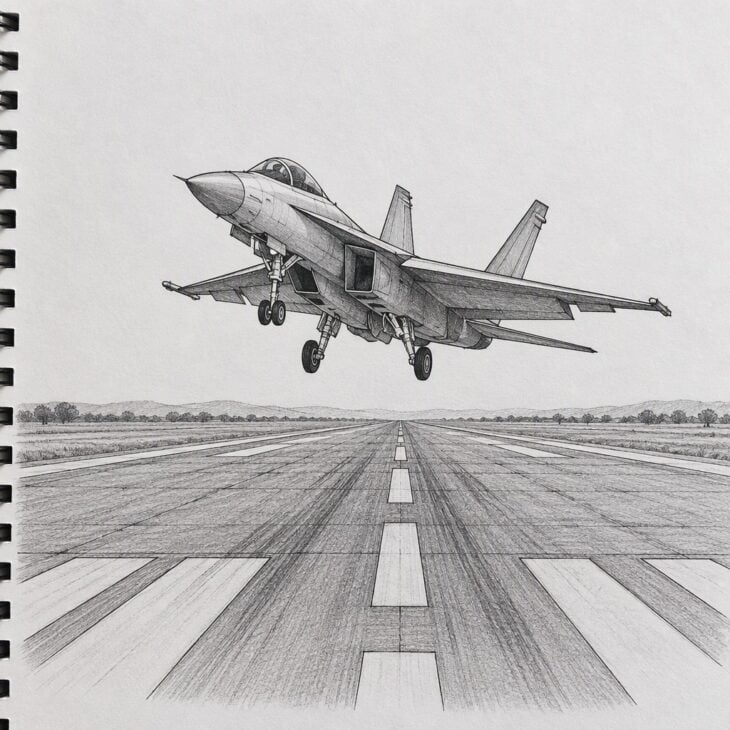
What it is A jet with its nose raised just above a runway, wheels still down. Dashed center lines run to a point on the horizon.
Why it works The runway teaches basic perspective. Lines that meet at one point make any scene look deep.
How to get it Mark a vanishing point on the horizon and draw two lines from it to the bottom corners for the runway edges. Add dashes along the middle that get smaller toward the point. Draw the jet at a slight upward tilt above the runway. Finish with two small wheels and a few grass strokes on each side.
07. Jet Landing on an Aircraft Carrier
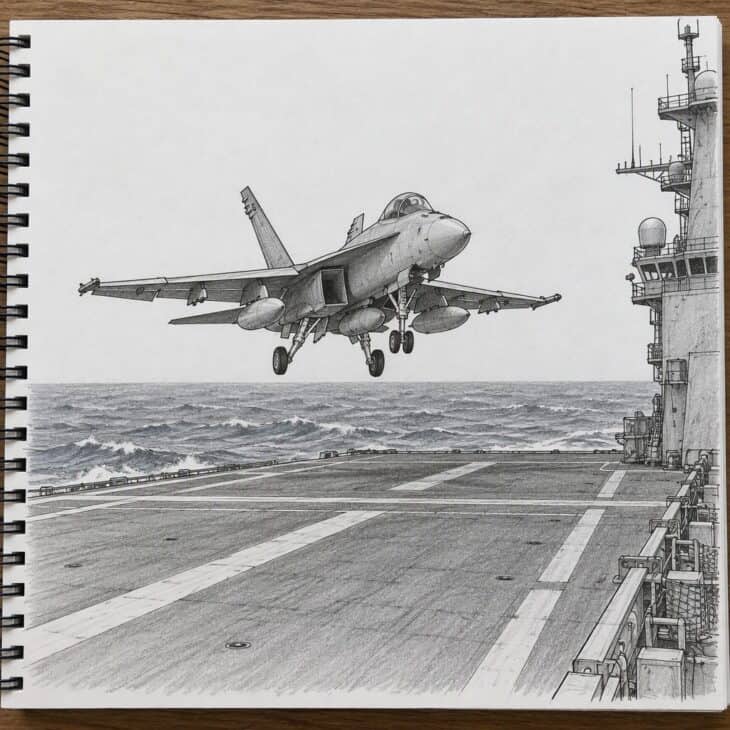
What it is A jet coming in to land on a flat gray ship deck, with its tail hook down and the sea below. The ship is a long flat rectangle with a small tower to one side.
Why it works The scene tells a story in three simple elements: jet, ship and ocean. Kids love the drama of a landing on a moving runway.
How to get it Draw the deck as a long flat parallelogram and add a small tower block on one side. Place the jet in the air behind it, nose slightly up, with a small hook under the tail. Add wavy lines for the sea and a few dashes for the ship wake. Shade the ship darker than the sky.
08. Two Jets in Formation
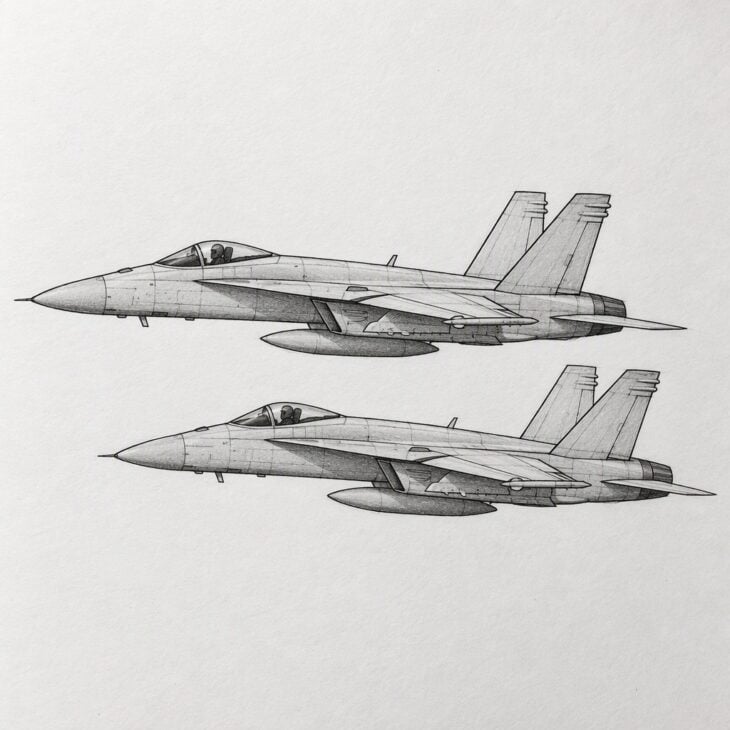
What it is Two jets flying wingtip to wingtip, one slightly ahead and higher. The back jet is drawn a little smaller and partly hidden.
Why it works Drawing two jets teaches overlap and scale. A smaller shape reads as farther away.
How to get it Draw the front jet first and fill in its details. Sketch the second jet behind it, 20 percent smaller, and stop its lines where the front jet covers them. Add a few cloud wisps between them. Erase hidden lines carefully so the overlap looks clean.
09. Jet Refueling in Mid-Air
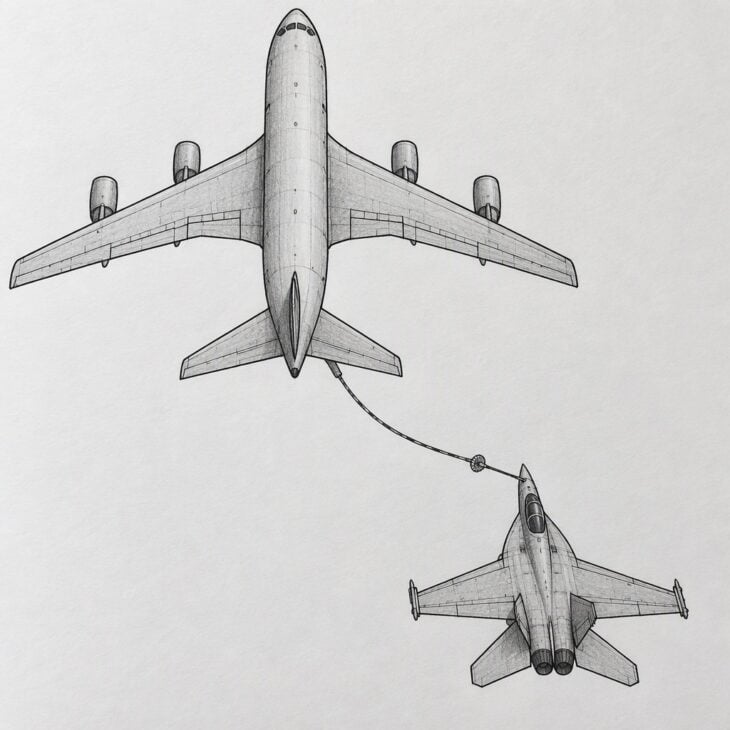
What it is A small fighter behind a large tanker, joined by a long hose with a cone at the end. The tanker is a simple wide shape with one big wing.
Why it works The hose gives the scene a clear focus and teaches how to link two shapes. It also shows scale, with a big tanker and a small jet.
How to get it Draw a wide cylinder body and a long wing for the tanker. Add a thin curved line trailing from its tail with a small cone at the end. Place a small jet just below and behind with a probe pointing at the cone. Keep the hose line slightly curved so it looks flexible.
10. Jet Pulling a Steep Climb
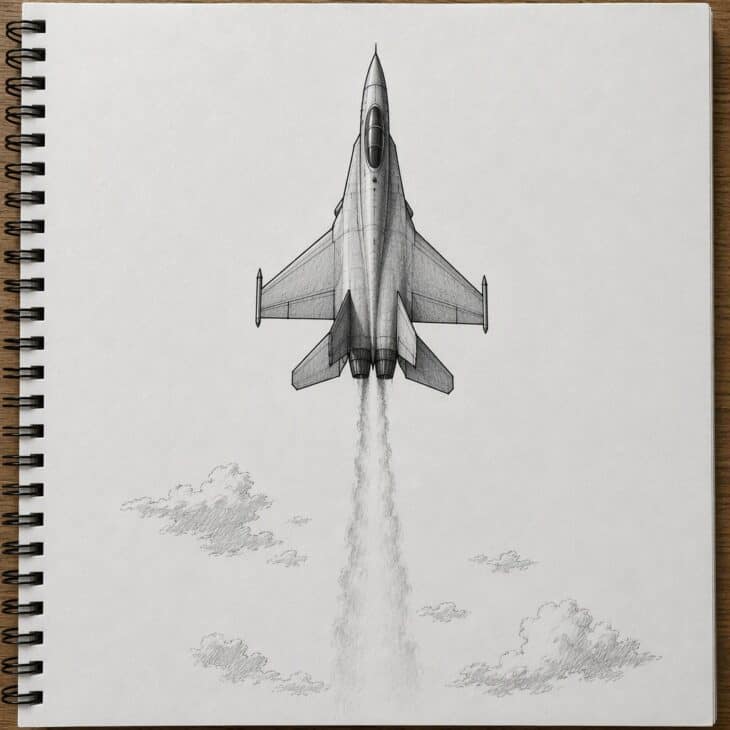
What it is A jet with its nose pointed almost straight up and a narrow trail beneath it. Small clouds sit at the bottom of the page.
Why it works A steep angle makes a drawing feel fast. The trail line also hides the tail, which is the hardest part to draw.
How to get it Draw the jet normally on a light pencil guide line tilted 70 degrees from flat. Add a wavy exhaust trail that fades with lighter strokes. Place a few small cloud shapes at the bottom. Shade the sky darker near the top to push the jet forward.
11. Fighter Jet Cockpit View
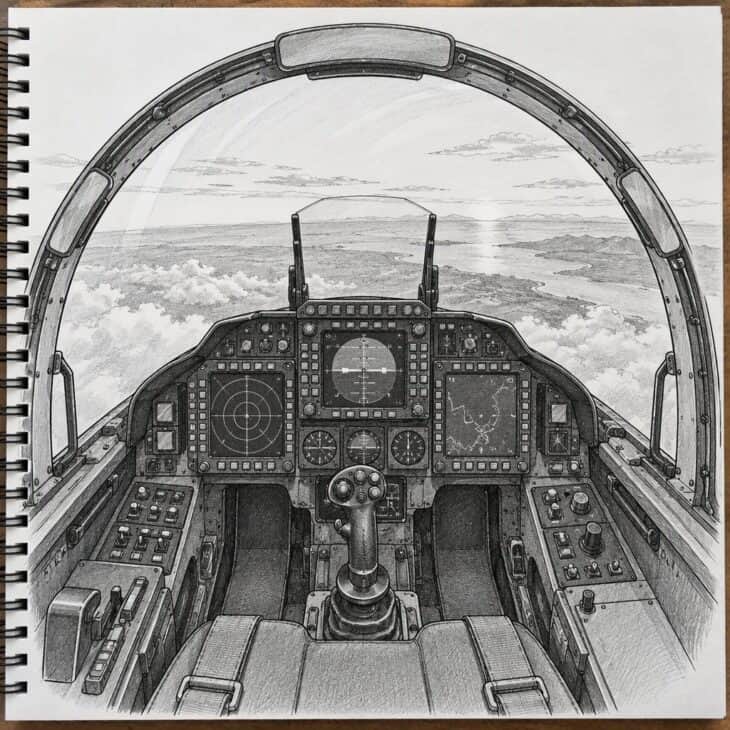
What it is A first-person view with a curved canopy frame, a dashboard of round dials and screens, a control stick between the knees and clouds beyond the glass.
Why it works Drawing from inside changes the point of view. The dials are fun to fill with small details.
How to get it Draw a large curved arch for the canopy frame and a flat dashboard along the bottom. Fill the dashboard with circles of different sizes for dials and two rectangles for screens. Add a stick in the center and a horizon line through the glass. Use a fine pen for the small dials.
12. Pilot in Helmet and Flight Suit
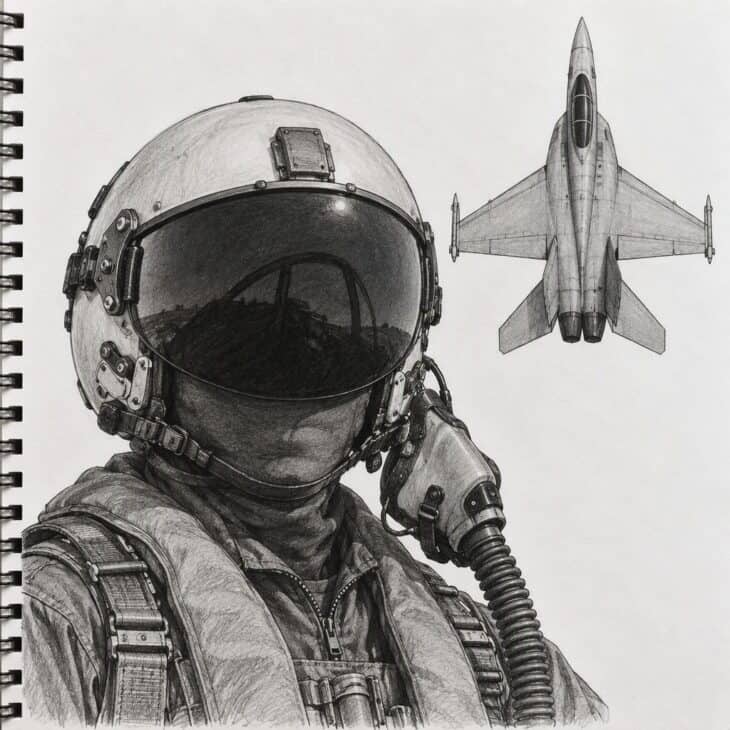
What it is A head-and-shoulders portrait of a pilot in a round helmet with a dark visor, an oxygen mask and a zipped suit collar. It suits ages 10 and up.
Why it works A visor means no eyes to draw, which is the part most people find hardest. The helmet shape also adds highlights to practice shading.
How to get it Draw a large circle for the helmet and a smaller one for the mask. Add a curved visor across the upper half and shade it dark. Draw a collar and shoulders below. Leave a white curved streak on the visor for a reflection. Fans of the movie can pair it with a Top Gun costume.
13. Jet Parked in a Hangar
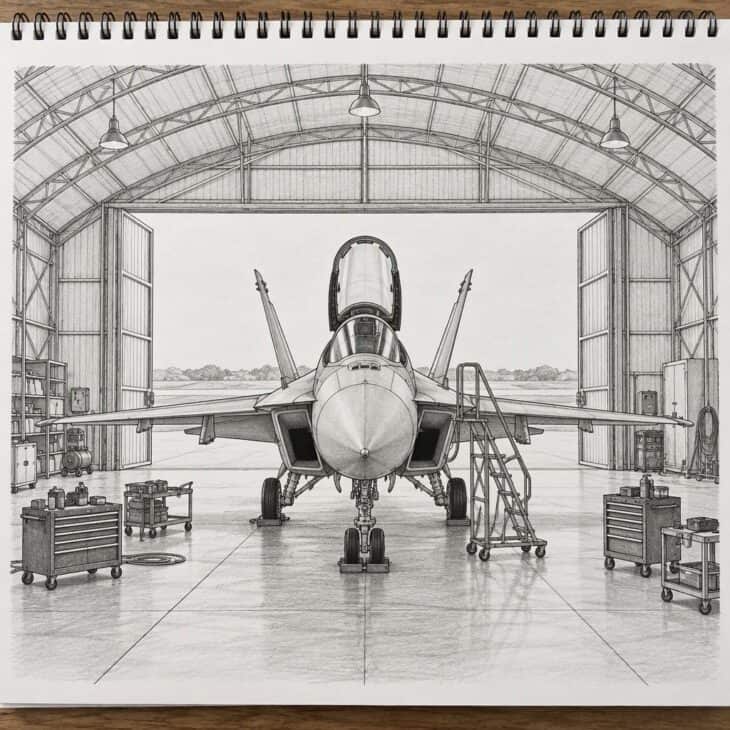
What it is A jet resting in a hangar with a curved roof, open doors, a rolling tool cart and a ladder against the side. The jet sits on three small wheels.
Why it works The roof, ladder and cart give the jet a sense of scale. It is a quiet scene that rewards patient line work.
How to get it Draw a big arch for the hangar opening and a floor line at the bottom. Place the jet in the middle and add a small ladder at the side. Add a cart with a few tools at the left. Use light shading under the jet to ground it.
14. Jets Over Mountains
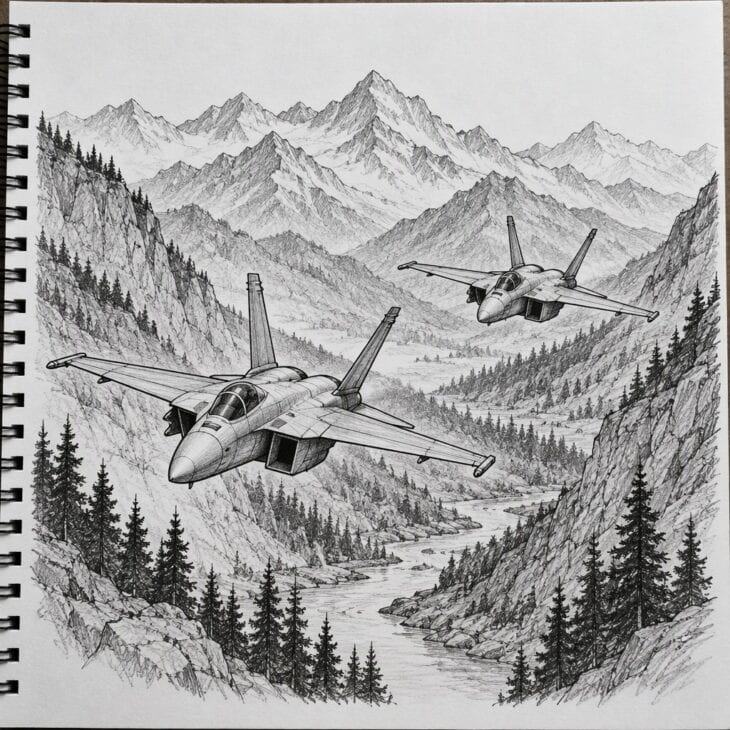
What it is Two jets crossing a valley with three layers of mountains behind them. Pine trees line the bottom.
Why it works Layers teach depth. Each ridge is lighter than the one in front, which makes the page feel huge.
How to get it Draw the farthest ridge first as a light zigzag. Add two ridges in front of it, each a bit darker and larger. Place the jets in the open space between them. Finish with small triangle pines along the bottom edge.
15. Jets Over the Ocean at Sunset
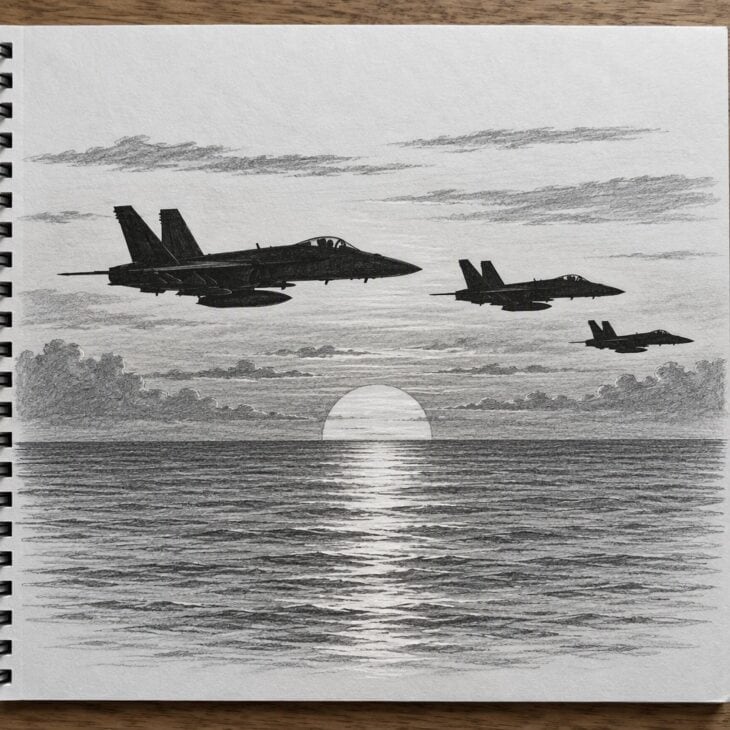
What it is Dark jet shapes against a low sun, with a bright half circle on the horizon and glittering lines on the water below.
Why it works A silhouette hides all the small details. A good outline does the job, which makes it the easiest dramatic drawing on the list.
How to get it Draw a horizon line and a half circle on it for the sun. Sketch two jet outlines above and fill them in solid black. Add short horizontal strokes on the water below the sun. Smudge a little pencil above the horizon for a glow.
16. Jet Breaking the Sound Barrier
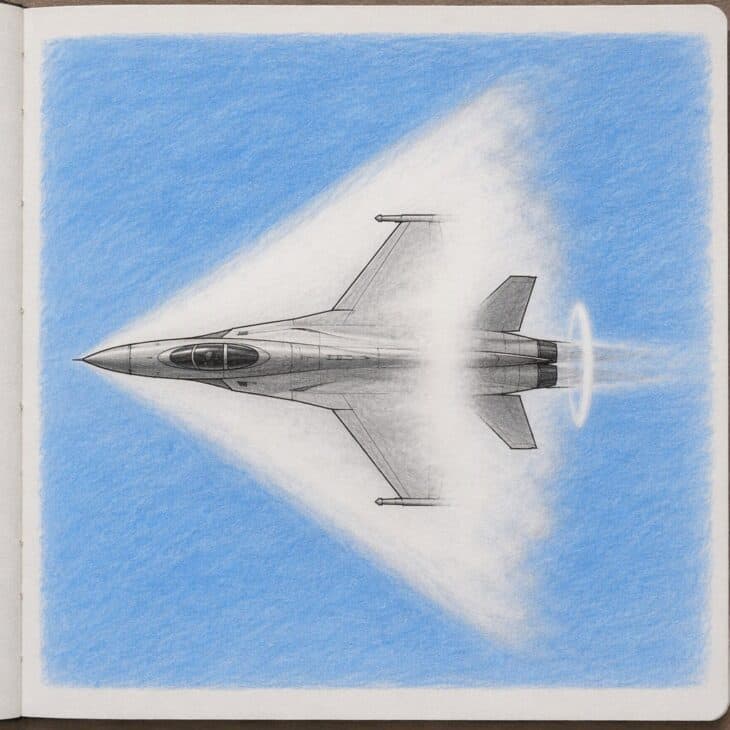
What it is A jet inside a soft cone of white vapor that forms around the body at high speed. Rings of mist circle the rear.
Why it works The vapor is easy to draw and looks impressive. It also shows kids that the air itself can be seen at high speed.
How to get it Draw the jet first in a simple side view. Sketch a wide cone shape around the back half and shade the sky around it. Leave the cone white by pressing harder on the blue pencil around it. Add two thin curved rings across the body.
17. Jet With Afterburner Flame
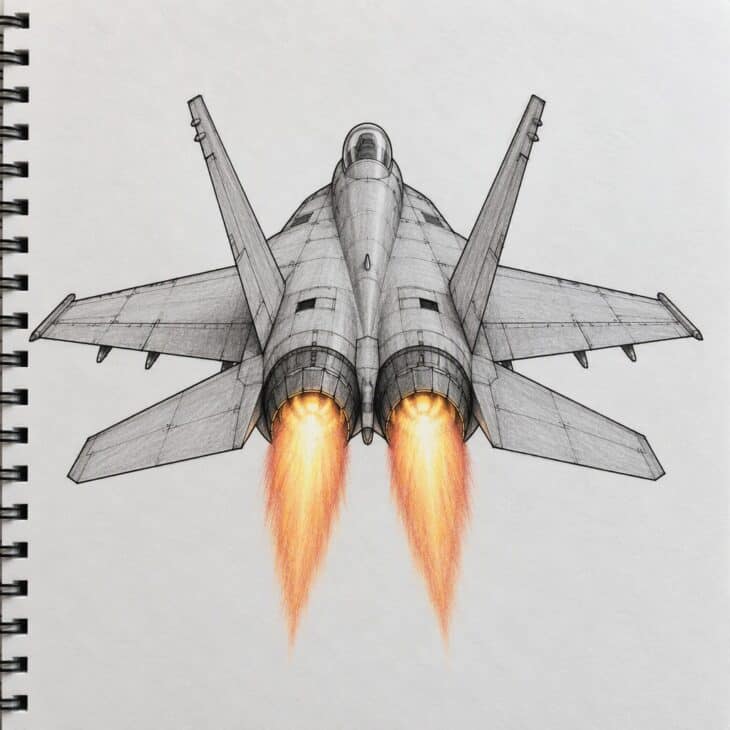
What it is A rear view of a jet with two round nozzles, each trailing a long orange flame with a bright center. The tail fins stand above.
Why it works Warm flames against a cool gray jet is the best color contrast on this list. The nozzles are just circles with rings.
How to get it Draw two circles side by side for the nozzles and add rings inside each one. Sketch a long teardrop flame from each circle. Color yellow in the center, orange next and a touch of red at the edges. Shade the jet in light gray so the flames stand out.
18. Jet With Weapon Pylons and Fuel Tanks
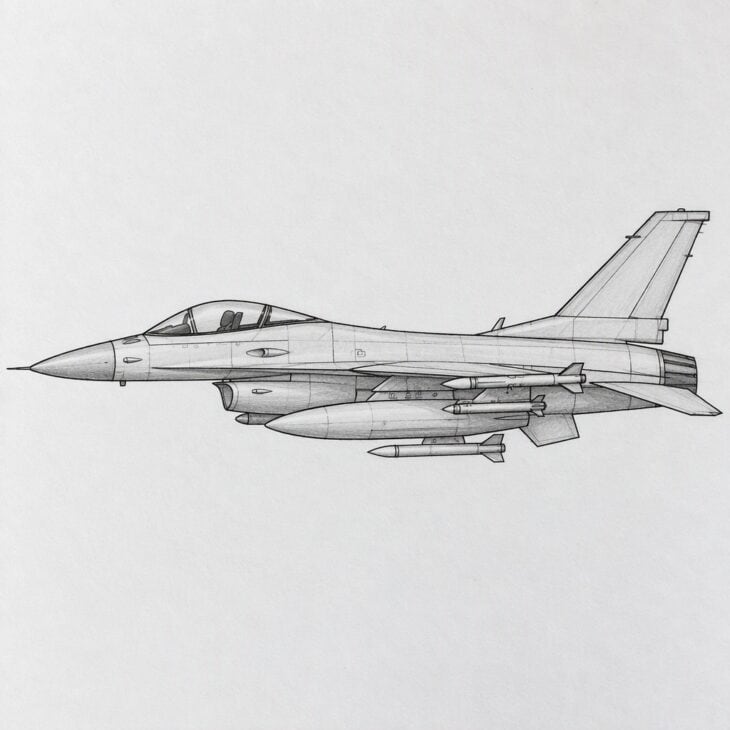
What it is A jet with pylons under each wing carrying slim fuel tanks and small missile shapes. It is a technical-style drawing.
Why it works The pylons add detail without making the drawing hard. Repeating shapes train your eye for rhythm.
How to get it Draw the jet in side view with a straight wing line. Hang short vertical pylons under the wing and add long pill shapes below them. Add a pointed nose and small fins on each missile. Keep the shapes evenly spaced.
19. Fighter Jet Mandala
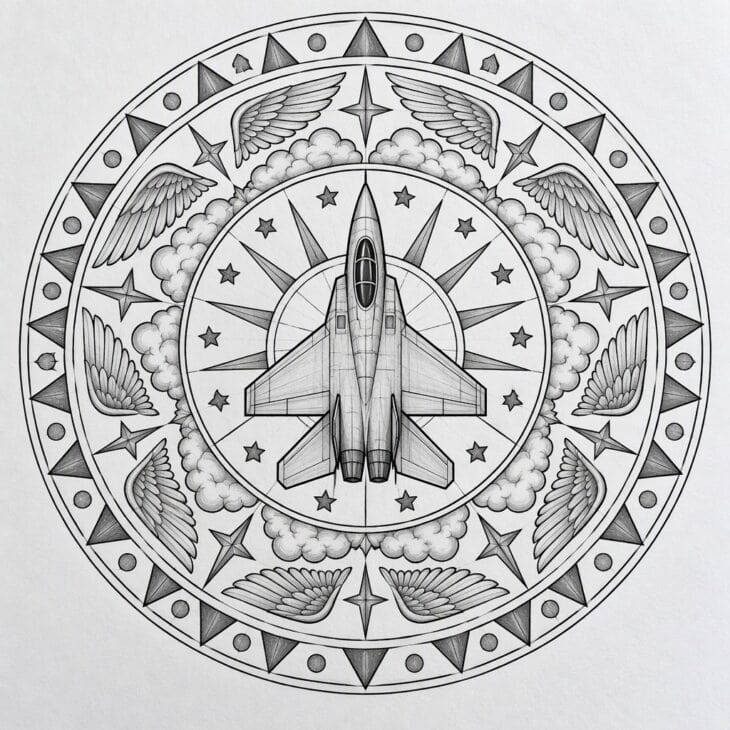
What it is A round design with a jet in the middle and concentric rings of stars, feathers and clouds. It suits ages 10 and adults.
Why it works A mandala turns drawing into a calm, repeating practice. It is a good change of pace from action scenes.
How to get it Draw a small circle in the center with a compass or a cup and place a simple jet in it. Add three rings around it and divide each into eight equal sections. Repeat one pattern in each section. Finish with fine pen lines and shade every second pattern.
20. Squadron of Jets From Above
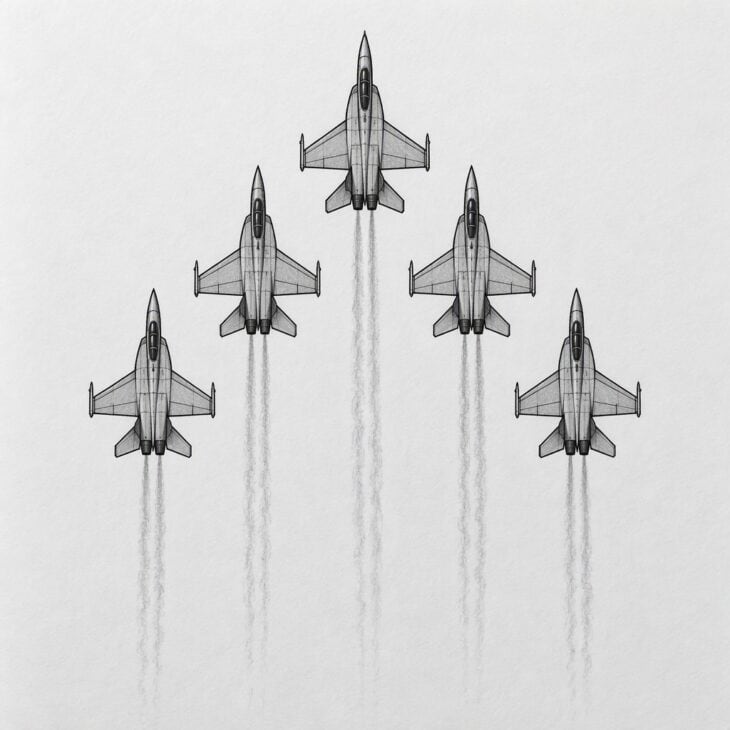
What it is A top-down view of six jets in a V, each slightly offset behind the one before. Thin trails run back from the wingtips.
Why it works Repeating the same shape six times builds speed and confidence. The formation fills the page without a background.
How to get it Draw the lead jet at the point of the V and draw a light V guideline. Copy the same jet five times along the lines, keeping them evenly spaced. Add short trails behind each one. Check that all jets point in the same direction.
21. Airshow Jets With Smoke Trails
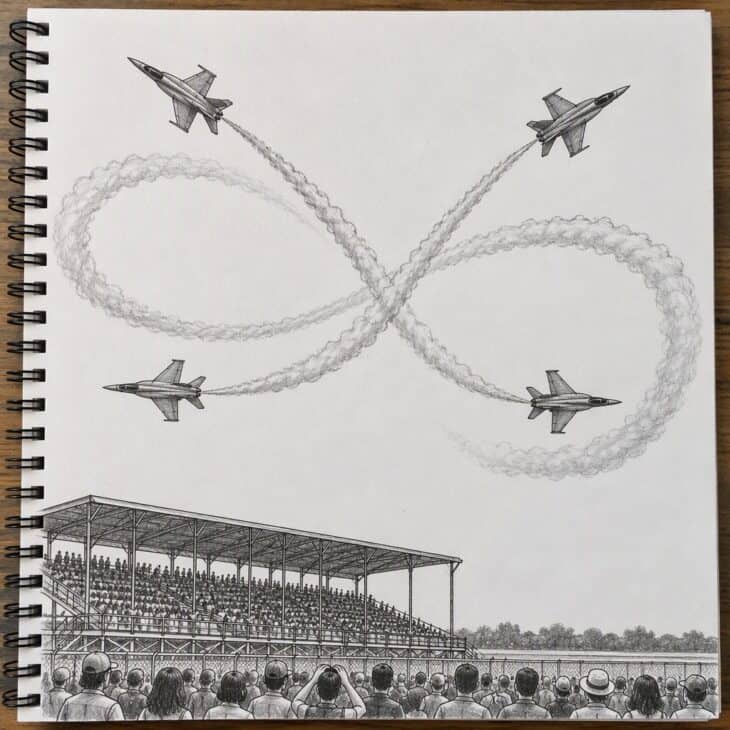
What it is Four jets crossing in the sky, each trailing a looping smoke ribbon, above a grandstand and a crowd of tiny spectators.
Why it works The ribbons give the page energy and let you play with curves. A crowd of tiny figures adds fun small details.
How to get it Draw the four jets small and spread them across the page. Link each to a long looping line and add a second line beside it to make the ribbon. Draw a low grandstand with dots for the crowd at the bottom. Color each ribbon a different shade.
22. Fighter Jet in a Dogfight Scene
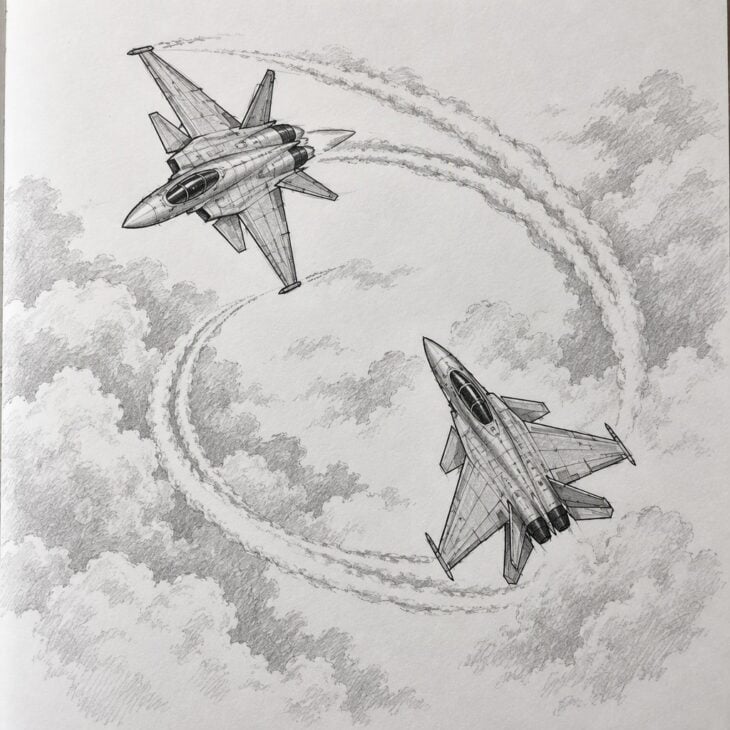
What it is Two jets banking hard in a tight loop, with curved vapor trails showing their paths. Clouds fill the background.
Why it works Banked wings are a good challenge in foreshortening. The trails make the motion easy to follow.
How to get it Draw the first jet from above at a steep bank so one wing looks shorter than the other. Draw the second one behind it on the opposite curve. Add two long curved trails behind them. Fill the sky with a few puffy clouds.
23. Futuristic Stealth Fighter Concept
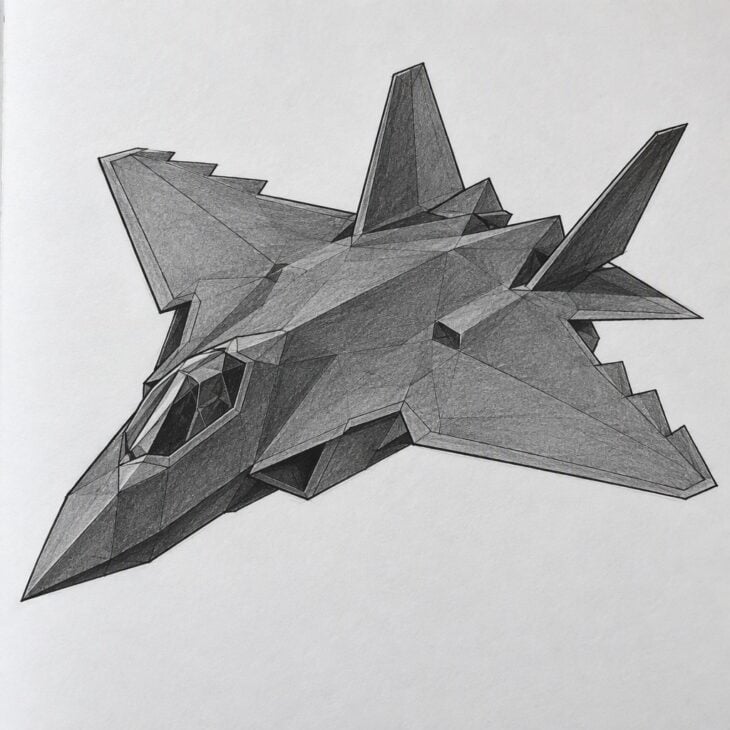
What it is An imagined jet with a flat, angular body, sawtooth edges and a faceted canopy. It is a made-up design, not a real aircraft.
Why it works Designing your own jet is the most creative idea here. Straight lines and sharp angles are easy to draw with a ruler.
How to get it Draw a flat arrowhead shape using a ruler. Add zigzag edges at the back and a faceted canopy of three small panels. Divide the body into flat shaded areas, some dark and some light. Invent a name and write it on the back of the page.
24. Realistic Shaded Fighter Jet
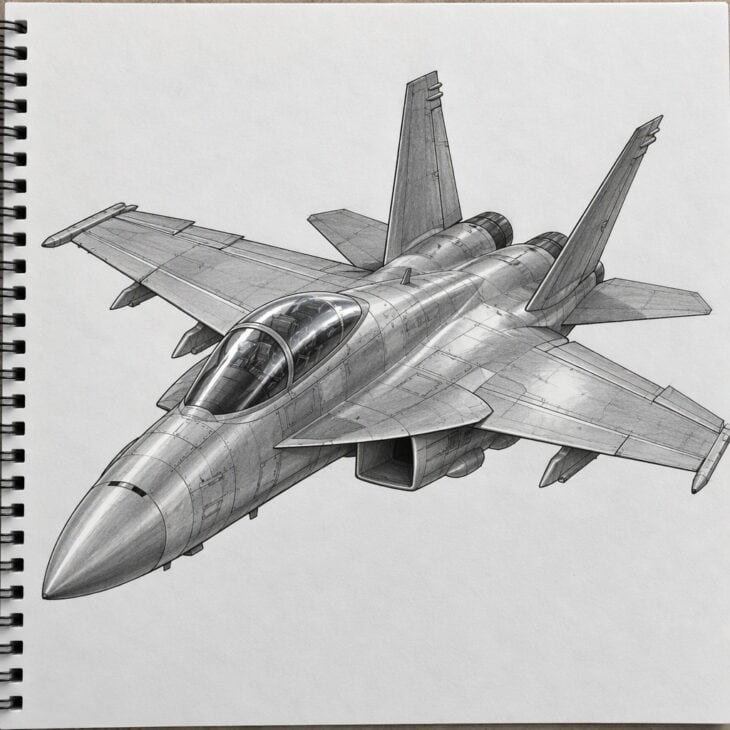
What it is A detailed three-quarter drawing with panel lines, a glossy canopy and soft gradients across the body. It is the hardest drawing on the list.
Why it works Realistic shading is the skill that separates sketches from finished artwork. The result belongs on a wall.
How to get it Block in the shape lightly with a 2H pencil and add panel lines with a ruler. Shade from light to dark with an HB and a 4B, keeping the strokes in one direction. Leave a bright streak on the canopy. Blend with a tissue and lift highlights with a kneaded eraser.
25. Fighter Jet Drawing Challenge
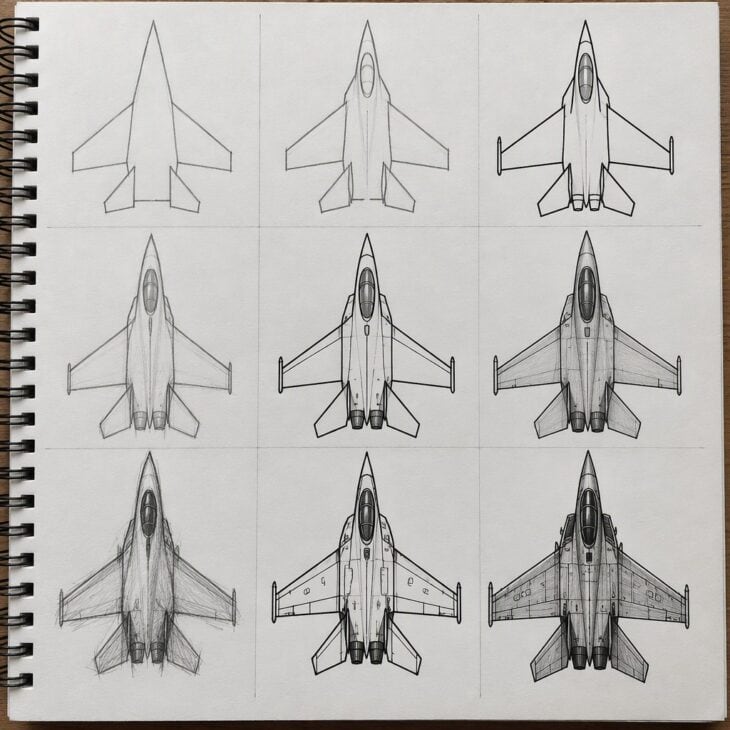
What it is A page divided into a three-by-three grid, with a different quick jet sketch in each box. The styles run from cartoon to realistic.
Why it works Small boxes remove the pressure to be perfect. Nine quick sketches teach more than one slow one.
How to get it Draw a three-by-three grid on a page. Give yourself two minutes per box and try a new angle or style in each. Number the boxes and pick your favorite at the end. Repeat the challenge a week later and compare. Folded paper jets are a fun next step: see these paper airplane designs.
Get the Newsletter
The latest aviation news and stories sent to your inbox.
About the Author

Hanna writes AeroCorner's aviation-lifestyle and decor guides, turning a love of flight into ideas for your home, celebrations, and gift lists.