

Table of Contents
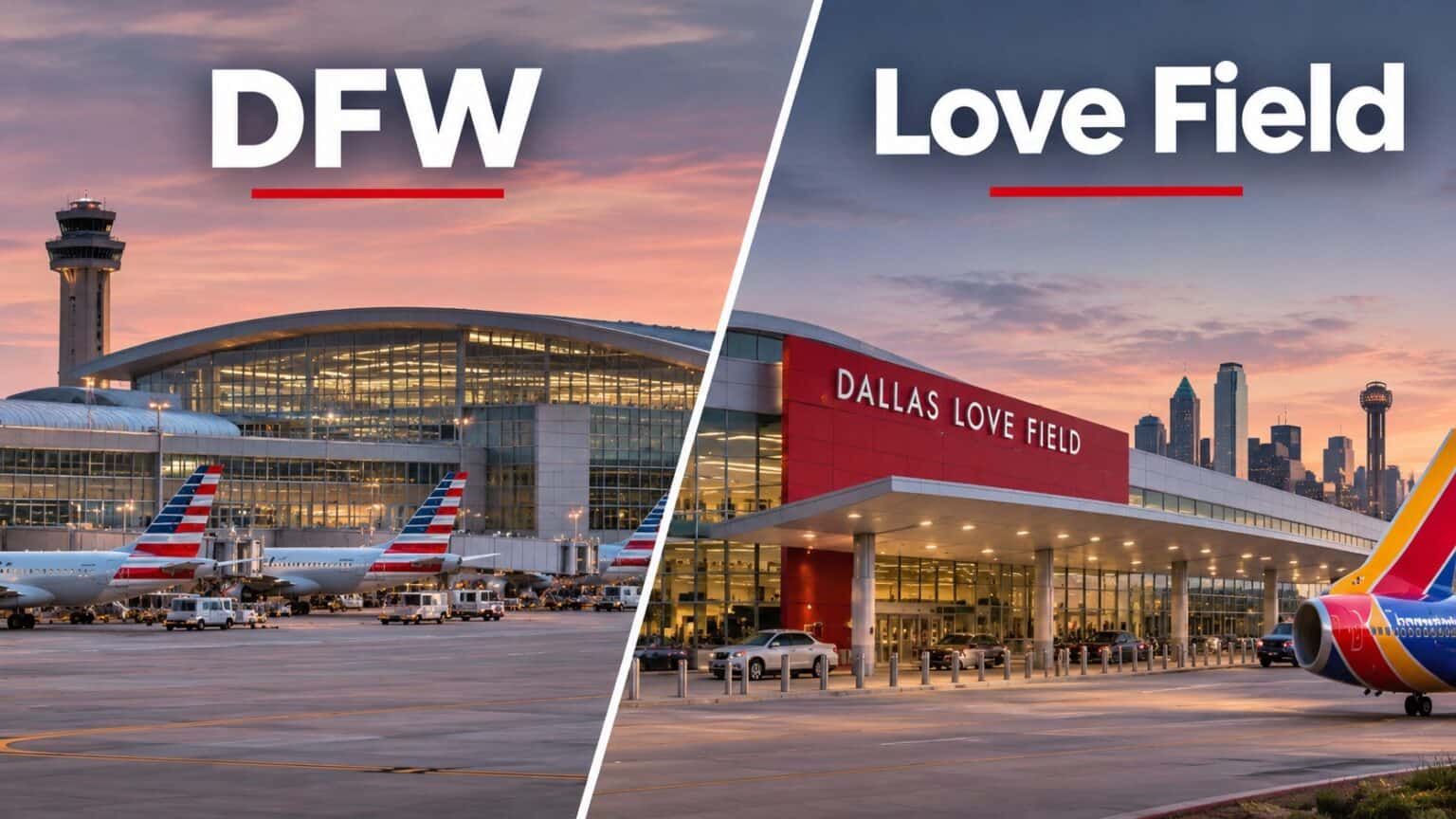
Pick Love Field for a domestic trip into Dallas itself, especially on Southwest: it sits about 6 miles from downtown, a cab costs $28 for one rider against $55 from DFW, its average fare ran about $103 lower in mid-2026, and it cancelled about half as many flights.
Pick DFW for anything international, for American Airlines or a long nonstop, or when you are headed to Fort Worth, Arlington or the mid-cities. It serves more than twice as many domestic destinations, and Love Field is barred from scheduled international flights.
Below, the two are compared on getting into town, where you can fly, delays, fares and the airports themselves, as of November 2026. The numbers come from the Bureau of Transportation Statistics (BTS), Dallas Area Rapid Transit (DART), the City of Dallas taxi rates, the Dallas Regional Chamber, J.D. Power and our own airport database.
| Criterion | DFW | Love Field (DAL) | Edge |
|---|---|---|---|
| Straight-line distance to downtown Dallas* | About 16.5 miles (26.5 km) | About 5.8 miles (9.4 km) | Love Field |
| Straight-line distance to downtown Fort Worth* | About 19.6 miles (31.5 km) | About 28.5 miles (45.9 km) | DFW |
| Taxi to downtown Dallas (flat rate, one rider) | $55 | $28 ($26 + $2 per passenger) | Love Field |
| Train to downtown Dallas | Orange Line from Terminal A, no change; $3 pass | Love Link bus, then Green or Orange Line; $3 pass | DFW |
| Domestic destinations, US airlines, Jan to Aug 2026** | 186 | 81 | DFW |
| International flights | 76 destinations | None scheduled (barred by law) | DFW |
| Main airline | American hub; 81% of domestic departures with Envoy and PSA | Southwest, 97.5% of domestic departures | DFW |
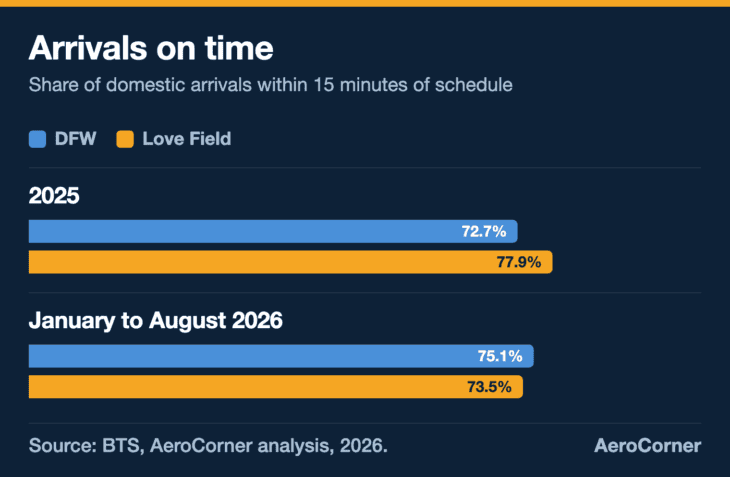
| Domestic arrivals on time, 2025 / Jan to Aug 2026** | 72.7% / 75.1% | 77.9% / 73.5% | Even |
| Departures cancelled, 2025 / Jan to Aug 2026** | 2.8% / 3.0% | 1.5% / 1.6% | Love Field |
| Average taxi-out, 2025** | 19.6 minutes | 13.2 minutes | Love Field |
| Average domestic fare, Q2 2026 | $496.05 | $393.35 | Love Field |
How we compared
On-time, cancellation, taxi-out, destination and airline-share figures are our own count from the BTS Reporting Carrier On-Time Performance files for January 2025 to August 2026, using the DOT definition: within 15 minutes of schedule, with cancelled and diverted flights counted as late. BTS covers only domestic flights by US airlines. Fares are the BTS average domestic itinerary fare for the second quarter of 2026, which includes taxes but not bag or seat fees. Taxi fares are the flat rates for trips between each airport and the Dallas Central Business District, the one-rider Love Field figure being $26 plus $2 per passenger. Distances were measured in a straight line to the center of downtown Dallas and downtown Fort Worth.
Getting into town
For Dallas, Love Field wins on distance by a wide margin. In a straight line it sits about 5.8 miles (9.4 km) from downtown, while DFW is about 16.5 miles (26.5 km) out, halfway between Dallas and Fort Worth.
The City of Dallas puts the drive from downtown to Love Field at 11 minutes. That gap shows up in the cab fare too: the regulated flat rate between DFW and the Dallas Central Business District is $55, against $26 plus $2 per passenger from Love Field.
So one traveler pays $28 from Love Field and $55 from DFW, a $27 saving. A group of four pays $34 from Love Field, still $21 less than the DFW rate.
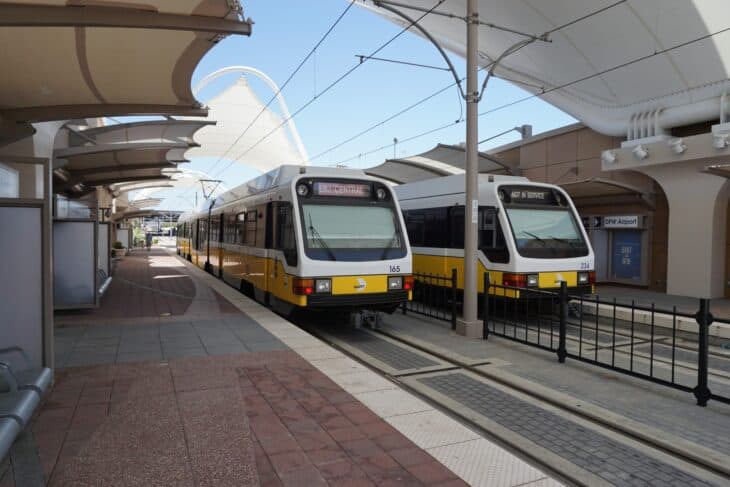
By train, DFW is simpler. DART’s Orange Line stops at Terminal A, and every Orange Line train serves downtown Dallas; DART says the run from the Pearl/Arts District station to the airport takes under an hour.

Love Field has no rail station of its own. DART’s Route 5 Love Link bus runs from the lower level outside baggage claim to Inwood/Love Field Station, where you change to a Green or Orange Line train into downtown.
Both trips fit on one DART Local pass, which covers buses and rail including the Silver Line. A 3-hour pass has cost $3 for adults since March 2025, and a day pass is $6.
Geography can flip the answer. For Fort Worth, DFW is about 19.6 miles (31.5 km) away against 28.5 miles (45.9 km) for Love Field, and TEXRail runs from DFW’s Terminal B straight to downtown Fort Worth.
Edge: Love Field. It is about 11 miles closer to downtown Dallas and half the cab fare, although DFW has the one-seat train ride and is the closer airport for Fort Worth.
Where you can fly
DFW is one of the largest connecting hubs in the world. Our DFW airport page counts about 1,145 flights a day to 275 destinations in 36 countries, and the longest nonstop runs to Melbourne at about 17 hours 40 minutes.
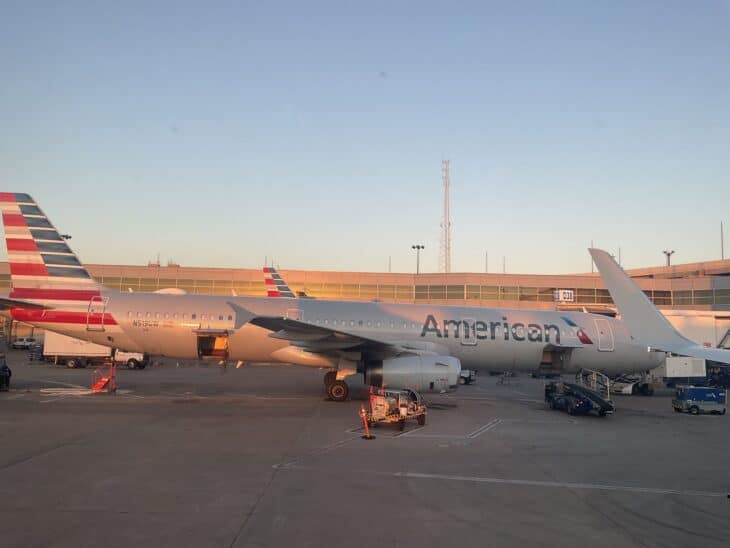

It handled 85,660,127 passengers in 2025, according to the Dallas Regional Chamber’s figures from the airport, 12.65 million of them international. It is American Airlines’ headquarters hub, and American with its regional affiliates Envoy and PSA flew 81% of the domestic departures BTS recorded there from January to August 2026.
DFW is not only American, though. Delta, United, Frontier and Alaska all flew domestic routes from it in 2026, so you can price several airlines on most trips.
Love Field is Southwest’s headquarters airport. Southwest flew 97.5% of its domestic departures from January to August 2026, Delta flew the rest, about five a day, and Alaska, which flew 101 departures there in 2025, recorded none this year.
Counting only scheduled US airlines, Love Field reached 81 domestic destinations against DFW’s 186. Our Love Field airport page lists 225, but most of those are private-jet trips by operators such as NetJets and Flexjet.
The bigger split is international. DFW serves 76 international destinations, the Chamber says, while the 2006 Wright Amendment Reform Act and the Five-Party Agreement bar scheduled international commercial flights at Love Field, which has no customs station for them.
The runways tell the same story. DFW’s longest runway is 13,448 feet (4,099 m), long enough for the widebodies on its long-haul routes, while Love Field’s longest is 8,812 feet (2,686 m), a length that suits Southwest’s all-Boeing 737 fleet. Both rank in our guide to the longest runways in the US.
Edge: DFW. It serves more than twice as many domestic destinations, several competing airlines, and every international route in the region.
Delays and cancellations
On punctuality, the two have traded places. On domestic flights by US airlines, 77.9% of Love Field’s arrivals were on time in 2025 against 72.7% at DFW, but from January to August 2026 DFW led with 75.1% against 73.5%.
Love Field cancels fewer flights. It scrubbed 1.5% of its domestic departures in 2025 and 1.6% from January to August 2026, against 2.8% and 3.0% at DFW, about one flight in 33.
The daily difference you will feel is on the ground. Love Field’s departures averaged 13.2 minutes from gate to takeoff in 2025, against 19.6 minutes at DFW, where jets taxi across one of the biggest airfields in the country.
Both airports share the same North Texas weather, so a thunderstorm can halt both at once, as one did when storms stopped flights into DFW and Love Field and cancelled more than 170 at American’s hub.
Edge: Love Field. On-time rates are close to even across the two years, but Love Field cancels about half as often and its taxi-outs are about 6 minutes shorter.
Airfares
Love Field is cheaper on average. In the second quarter of 2026, BTS put the average domestic itinerary fare from Love Field at $393.35, against $496.05 from DFW, a gap of $102.70 a ticket, or about $411 for a family of four.
That is not a like-for-like price. DFW’s average includes first-class seats and long transcontinental trips that Love Field barely serves, so the honest test is to price your own route from both airports on the same dates.
Fares rose at both airports through 2026, and BTS changed its fare survey in the third quarter of 2025, so compare quarters after that change only. The two home airlines are compared head to head in our American vs Southwest breakdown.
Edge: Love Field. Its average fare is about $103 lower, but check your exact route, because the averages cover different trips.
The terminals and the airport itself
Size is the main difference you will feel. DFW handled about five times Love Field’s 16,899,203 passengers in 2025, across five terminals, more than 160 gates and seven runways.
DFW is bigger than Manhattan
DFW’s footprint covers about 27 square miles (nearly 70 square kilometers), which the Dallas Regional Chamber notes is larger than Manhattan. Love Field, by law, may operate no more than 20 gates, a cap set in 2006 when its count was cut from 32.
Love Field is the easier airport to use. In J.D. Power’s 2026 North America Airport Satisfaction Study it placed third among large airports with 698 points, behind Tampa and Portland.
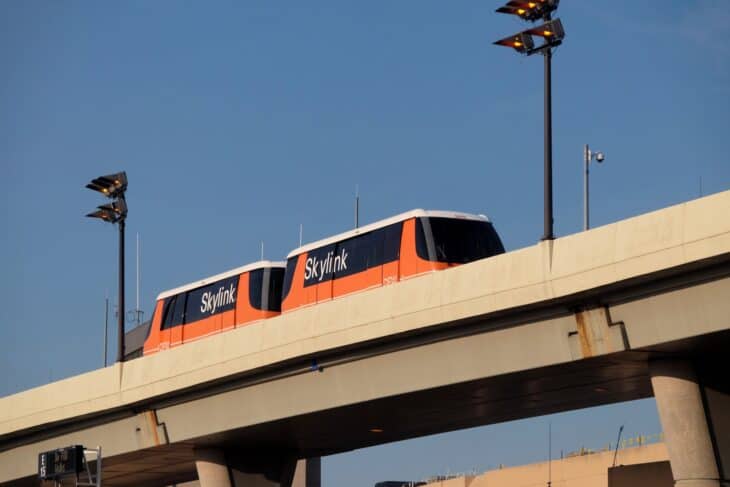
DFW makes up for its sprawl with the Skylink train between its terminals, and it has the long-haul airlines Love Field lacks. It is also adding a Terminal F with 31 gates, backed by American, whose first phase is due in 2027.

Love Field has its own $2.5 billion program on the way, with new ticketing and baggage claim, a pedestrian bridge, a ground transport center and a parking garage. Construction is due to start in 2027, so neither airport is free of building work for long.
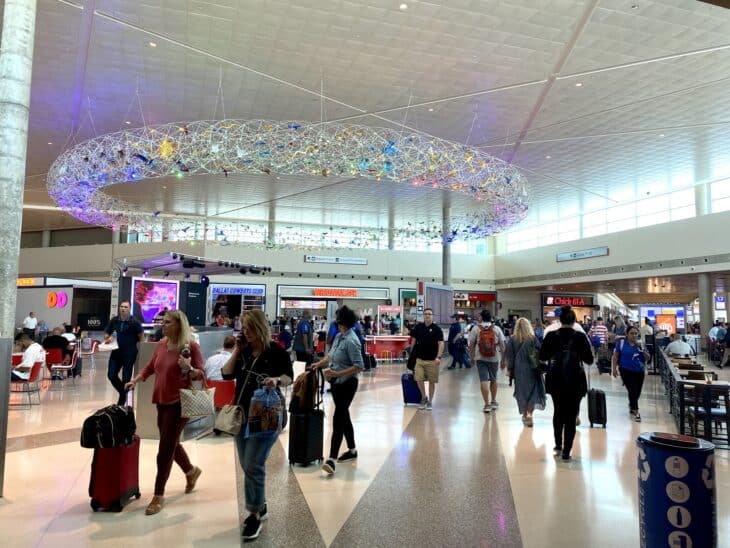

Edge: Love Field. It ranked near the top of its J.D. Power category in 2026 and is far quicker to cross, although DFW has far more airlines and routes.
Myth: Love Field can only fly to Texas and nearby states
That was true under the Wright Amendment, passed in 1979, which kept larger jets from Love Field inside Texas and four neighboring states. A 2006 reform law allowed through-ticketing at once and ended the flight restrictions completely on October 13, 2014. Love Field now reaches 81 domestic destinations. What the law still forbids is scheduled international service, so a trip abroad from Dallas starts at DFW.
Who should pick which
| If you… | Pick | Because |
|---|---|---|
| Fly Southwest, or any domestic trip with a hotel in Dallas, Uptown or Downtown | Love Field | About 6 miles away and a $28 cab |
| Fly to Europe, Asia, Mexico or anywhere abroad | DFW | Love Field cannot host scheduled international flights |
| Fly American or want a long nonstop | DFW | It is American’s headquarters hub |
| Stay in Fort Worth, Arlington or the mid-cities | DFW | It is the closer airport, and TEXRail runs to Fort Worth |
| Want to take the train with no change | DFW | The Orange Line runs from Terminal A to downtown |
| Want the fewest cancellations and the shortest taxi | Love Field | About half DFW’s cancellation rate in 2025 and 2026 |
| Want the lowest fare | Price both | Love Field averages $103 less, but on a different route mix |
For most domestic travelers headed into Dallas, Love Field is the easier airport. DFW earns its place as soon as a trip goes abroad, starts on American, or ends in Fort Worth. Chicago has the same split, covered in our Midway vs O’Hare comparison.
FAQ
Sources and references used for research and fact-checking.
- Bureau of Transportation Statistics, Reporting Carrier On-Time Performance (1987-present)
- DWU Consulting (BTS data), Dallas Love Field (DAL) airport data: average fares
- DWU Consulting (BTS data), Dallas/Fort Worth (DFW) airport data: average fares
- Dallas Regional Chamber, Dallas Regional Economic Development Guide 2026: Connectivity, DFW and Love Field
- zTrip, Dallas/Fort Worth meter rates
- Dallas Area Rapid Transit, DART to DFW Airport
- Dallas Area Rapid Transit, DART to Dallas Love Field
- Dallas Area Rapid Transit, DART to Airports
- DART Daily, Ask DART: What's changing with fares starting March 1
- Dallas Area Rapid Transit, DART Orange Line celebrates a decade of direct rail service to DFW Airport
- VisaVerge, Why Dallas Love Field lacks international flights
- Wikipedia, Wright Amendment
- The Points Guy, J.D. Power's best airports in North America for 2026
- AeroCorner, Thunderstorms halt flights into DFW and Love Field
- AeroCorner, Dallas-Fort Worth airport (KDFW)
- AeroCorner, Dallas Love Field airport (KDAL)
Get the Newsletter
The latest aviation news and stories sent to your inbox.
About the Author

Tim is the owner and lead editor of AeroCorner since 2019, overseeing aviation content covering aircraft, airlines, airports, and the broader aviation industry. Through years of researching, writing, editing, and publishing aviation-focused content, he has developed extensive practical knowledge of commercial aviation and air travel. Based in Asia and a frequent traveler himself, Tim also brings firsthand passenger experience to AeroCorner’s coverage. Outside of publishing, he has also explored aviation firsthand through hands-on flight training in New Zealand.