

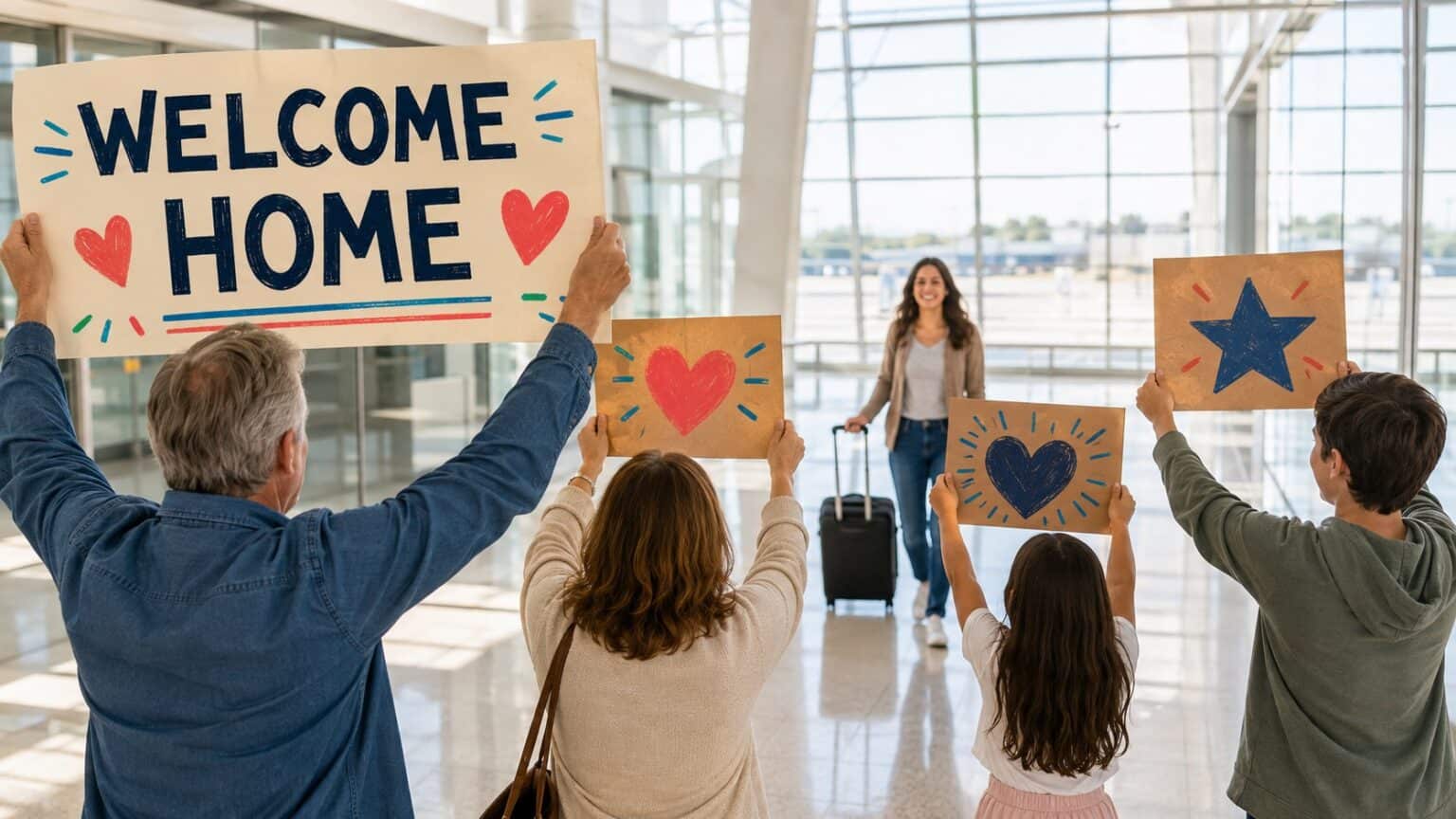
There is a wonderful split second in every airport reunion: the traveler clears the doors, scans a wall of strangers, and suddenly sees their name held above the crowd. A good sign makes that moment easier to find and much more fun to remember.
The best airport welcome signs are readable before they are clever. Big letters, strong contrast, and one clear idea will beat a beautifully decorated poster that turns into visual noise from thirty feet away. After that, you can make it funny, romantic, sentimental, or gloriously embarrassing.
Choose a design that fits the person and the reason they are arriving, then personalize the wording, colors, and small details. Most of these can be made in an evening with poster board and paint markers. A few are reusable enough to become the official family pickup sign.
01. The Giant First-Name Sign
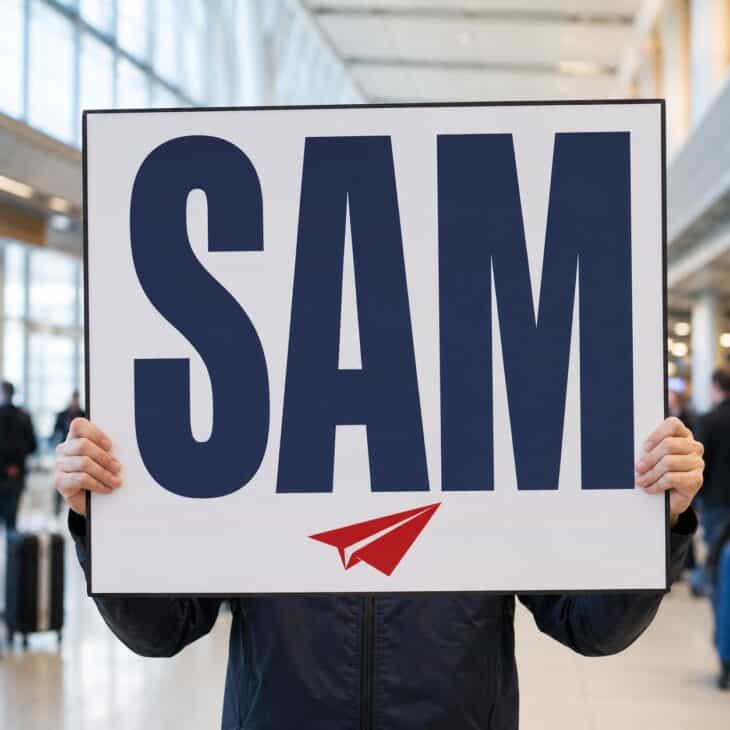
What it is A rigid white foam-board placard carrying one first name in tall, dark block letters, with almost no decoration. A single paper airplane, heart, or narrow color stripe can sit below the name, but the letters should take up most of the board.
Why it works The arriving traveler is looking for a person, not reading a paragraph. One familiar name can be recognized at a glance, and the clean design still feels special when the lettering is crisp and the colors suit them.
How to get it Buy a 20-by-30-inch sheet of white foam board and sketch the name lightly in pencil. Use a ruler and a broad paint marker to build condensed uppercase letters at least six inches tall. Fill the strokes twice so the color is solid, then erase the guide lines after the ink dries. Add one tiny symbol only if the board feels too bare. Stand near the exit with the sign above chest height, leaving your own face visible.
02. The Classic Welcome Home Banner
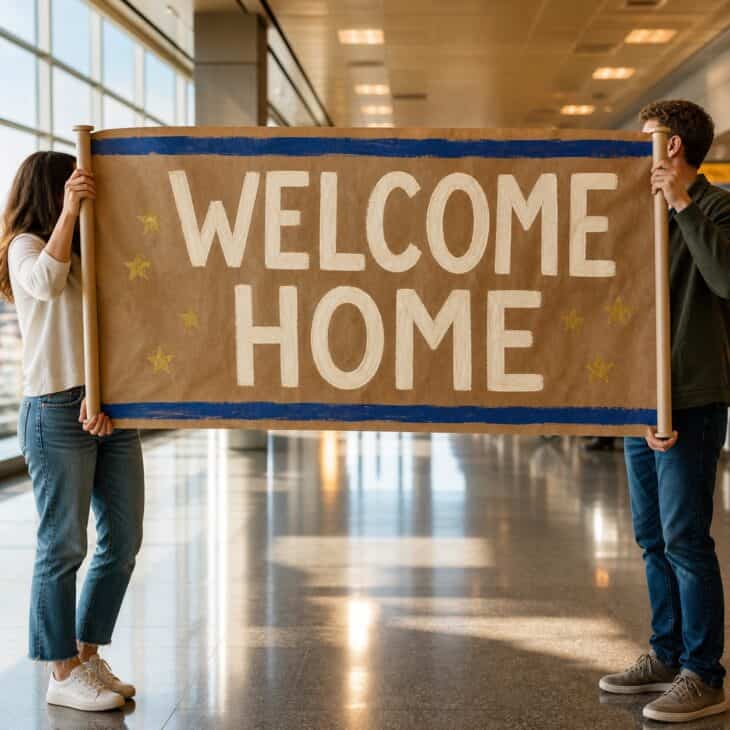
What it is A wide roll-paper banner with “Welcome Home” painted across the middle, usually finished with a border, stars, or a small airplane at each end. Kraft paper feels handmade and warm, while white paper with two strong colors looks brighter and more graphic.
Why it works It fits almost any return, from a weekend trip to a year abroad, and several people can hold it together. The width also makes it visible in a busy hall without requiring complicated wording.
How to get it Cut a piece of heavy paper about four feet wide and eighteen inches tall. Mark the center first, then space the words outward so the last letters do not crowd the edges. Paint with a broad flat brush or use vinyl letters for a cleaner finish. Tape a slim wooden dowel to each short end so the paper stays open. Roll it loosely for the drive, then unroll it only after you have found a clear waiting spot.
03. The We Missed You Sign
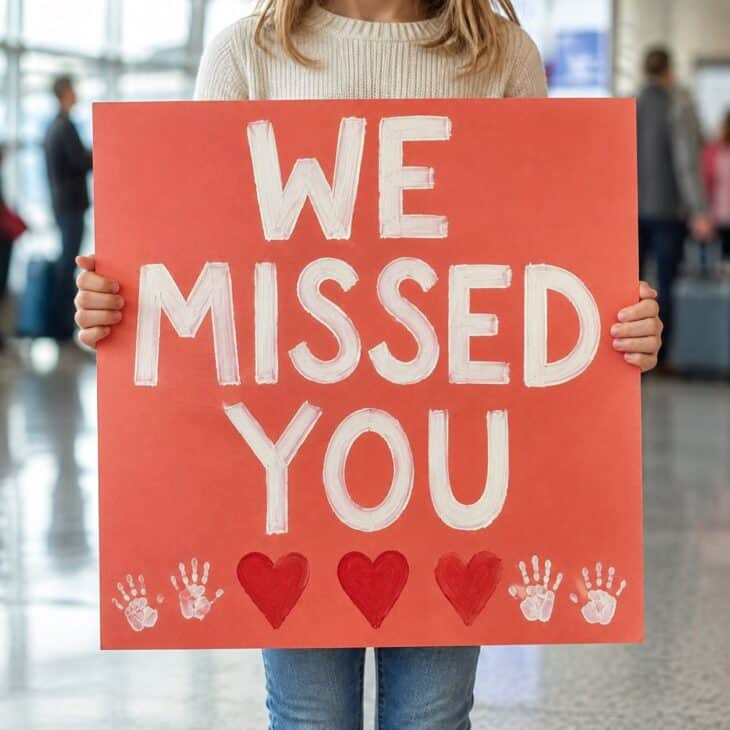
What it is A bright poster with “We Missed You” as the full message, softened with hearts, signatures, or handprints from everyone waiting. It works especially well on coral, cobalt, or sunflower-yellow board with high-contrast white or black lettering.
Why it works The wording is emotional without becoming a speech, and it suits a partner, parent, child, or close friend. Adding each person’s mark turns an ordinary poster into something the traveler may actually keep.
How to get it Write the main phrase first and reserve the bottom four inches for personal details. Give children washable paint for handprints, or ask each person to add a small heart and initials. Keep the marks around the edge so they do not reduce legibility. Let wet paint dry flat overnight before stacking anything on top. Bring a document tube if you want the poster to survive the return trip home.
04. The Plot Twist Sign

What it is A black sign with the line “Plot twist: you came back,” set in bold white capitals and one accent color. The design is intentionally spare, like a movie title card, with perhaps one tiny flight-path doodle in a corner.
Why it works The joke is affectionate but dry, so it suits a sibling or friend who would reject anything sentimental. It also gives the people walking beside your traveler a reason to smile before they know the story.
How to get it Use black foam board and white adhesive letters for the cleanest contrast. Put “Plot twist” on the first line in smaller type and make “You came back” twice as large below it. Add yellow, lime, or coral to just one phrase. Read the sign from the far side of the room before leaving home. If the joke needs explaining, simplify it until it lands in one glance.
05. The Chauffeur Name Placard
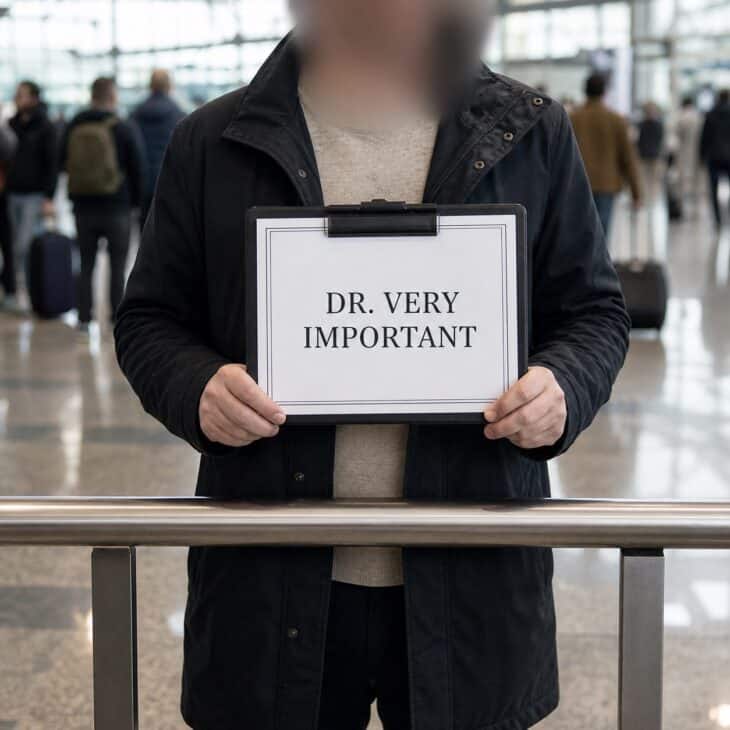
What it is A compact white card in a black clipboard, styled like a professional driver’s placard but carrying an exaggerated title such as “Dr. Very Important,” “Chief Vacation Officer,” or the traveler’s childhood nickname. A thin border and serif capitals complete the formal look.
Why it works The straight-faced presentation makes the joke. It is easy to carry, takes seconds to understand, and feels personal once the invented title points to something your traveler will recognize.
How to get it Design the card on a landscape letter-size page with a generous blank margin. Choose one readable serif font, add a thin black border, and print on heavyweight matte paper. Slide it into a plain black clipboard or document frame. Hold it with a completely serious expression when the traveler appears. Save the louder nickname for a friend who enjoys public teasing.
06. The Wi-Fi Password Joke
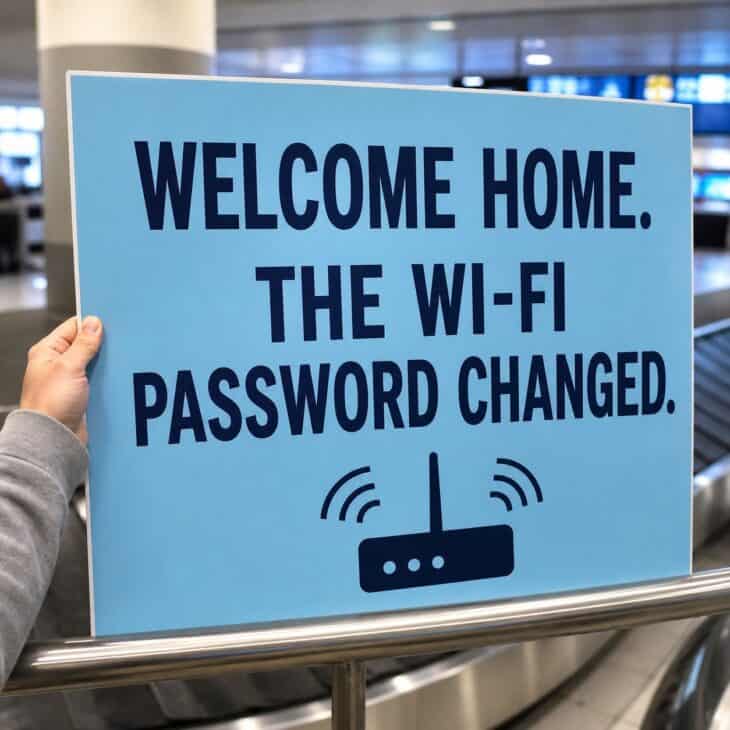
What it is A bright sign reading “Welcome home. The Wi-Fi password changed,” paired with a tiny router or signal icon. The text should sit on three clean lines, with “Wi-Fi password” emphasized in a second color.
Why it works It replaces the usual emotional message with a hilariously minor household problem. The joke is safe for almost any age and works particularly well for a student returning from college or a sibling coming back from a long trip.
How to get it Start with blue or yellow poster board and divide the copy into three centered lines. Use vinyl letters if your hand lettering tends to drift. Make the actual punch line at least four inches tall, then keep the router doodle very small. Do not put the real password anywhere on the sign. Pair it with the correct password written privately on a card if you want the joke to become useful later.
Make it readable before you make it clever
Hold your finished sign at the far end of a room and give someone three seconds to read it. If they miss the name or punch line, enlarge the main words and remove decoration until the message works at a glance.
07. The Kids’ Handprint Poster
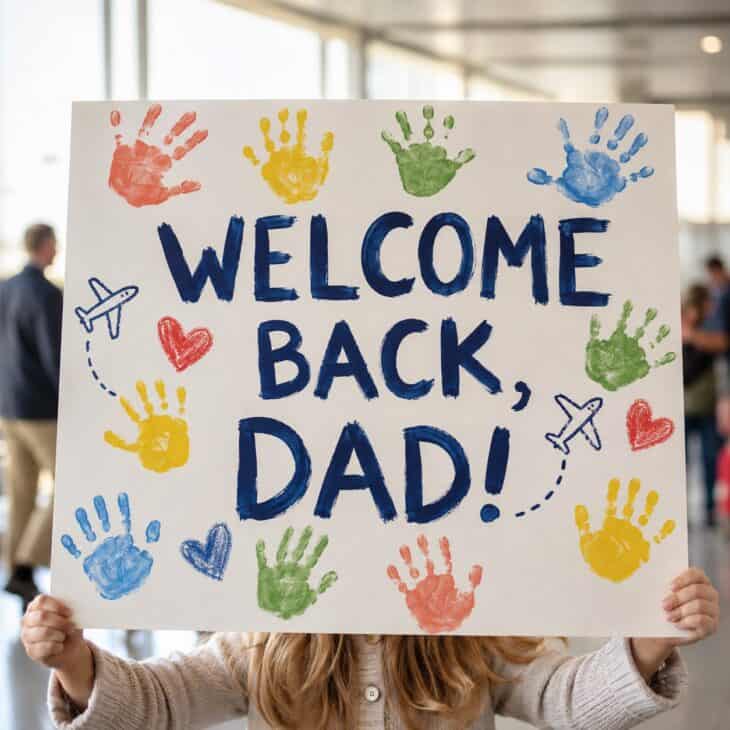
What it is A white poster carrying a short welcome message, surrounded by washable-paint handprints, crayon hearts, and child-drawn airplanes. The uneven marks are the design, so there is no need to make the border symmetrical or tidy.
Why it works Children get a real part in preparing for the reunion, and the returning parent or grandparent receives something more personal than a polished store-bought banner. Every imperfect print records who was waiting at that age.
How to get it Letter the main message yourself before the children begin. Put the board on a washable floor covering and use shallow plates of nontoxic tempera paint. Press one hand at a time around the perimeter, then fill gaps with crayons after the paint dries. Write each child’s name and the date discreetly on the back. Bring wet wipes to the airport anyway, because little hands rarely stay clean for long.
08. The Pet Is Waiting Sign
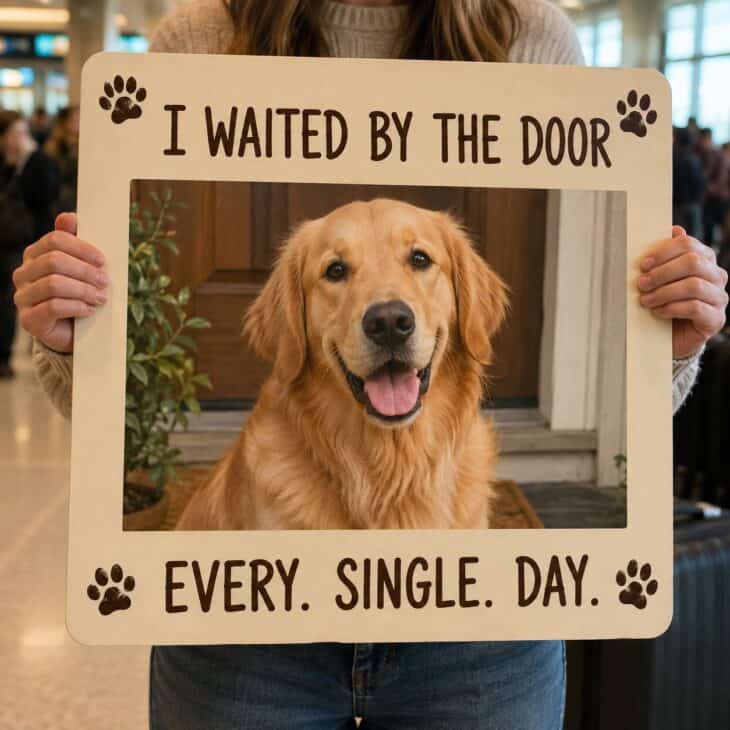
What it is A photo sign written from the family pet’s point of view, with a large portrait, paw-print border, and a line such as “I waited by the door every single day.” It can feature a dog, cat, rabbit, or any other animal the traveler missed.
Why it works A pet photo is instantly recognizable from a distance and shifts the attention toward the reunion still waiting at home. It is sentimental enough for a long separation but funny enough to avoid feeling overly formal.
How to get it Choose a close, bright image where the animal fills most of the frame. Print it at least 10 inches wide and mount it in the center of sturdy board. Put the shorter line above the photo and the punch line below. Stamp or draw three paw prints rather than building a crowded border. Leave the pet safely at home unless your airport explicitly allows animals in the public arrivals area.
09. The Photo-Collage Timeline
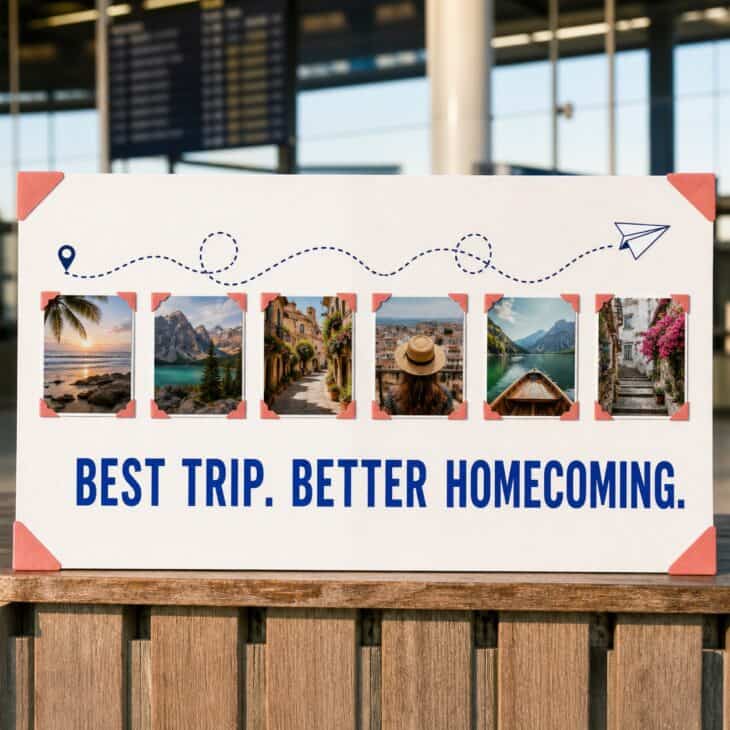
What it is A poster built from four to eight square snapshots arranged along a dotted flight path, finishing with the words “Best trip. Better homecoming.” The photos can show earlier vacations, the traveler’s destination, or moments the two of you shared before departure.
Why it works The sign tells a small story while the traveler walks toward it, and it doubles as a keepsake after the reunion. It also gives all those saved window seat photos somewhere more personal to live than a camera roll.
How to get it Select images with simple shapes that remain clear when printed small. Crop them all to the same square and leave a consistent border around each one. Arrange the timeline on the floor before gluing anything down. Draw the connecting path only after every print is fixed. Keep the final welcome line much larger than the captions, or skip captions completely.
10. The Home-to-Home Route Map
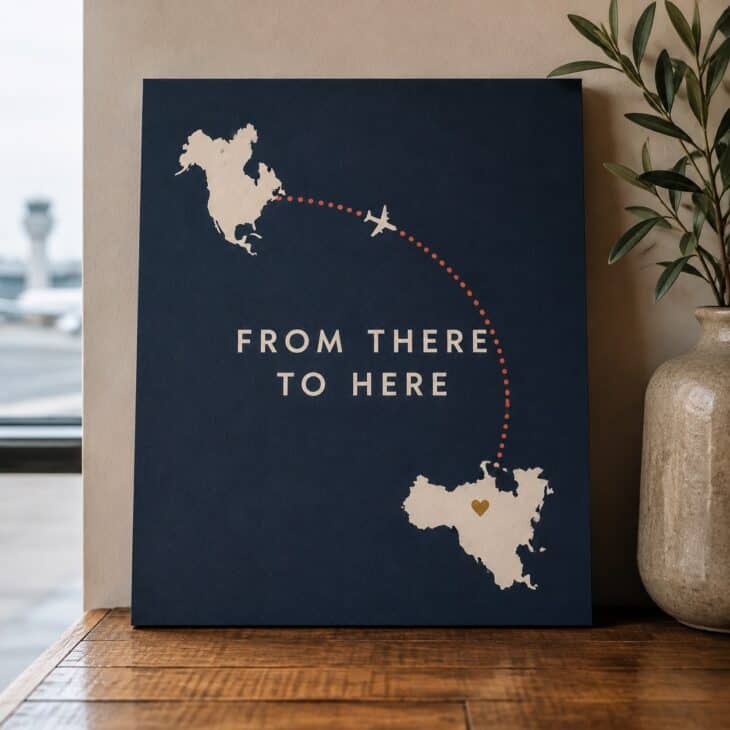
What it is A graphic map sign showing the departure place and home as two simple silhouettes connected by a curved dotted route. A heart marks the destination, while a short line such as “From there to here” or “The long way home” sits below.
Why it works It captures the scale of a long-distance reunion without asking the traveler to read a number or date. The clean geography also looks polished enough to frame later as a small piece of aviation wall art.
How to get it Find or trace simple public-domain outlines of the two countries, states, or cities. Place them far apart on a landscape board and connect them with a broad arc. Use one color for both maps, one for the route, and metallic gold only for the home marker. Avoid tiny place labels that cannot be read across the hall. Write the travel dates on the back if you plan to frame the piece.
11. The Miles-Later Sign
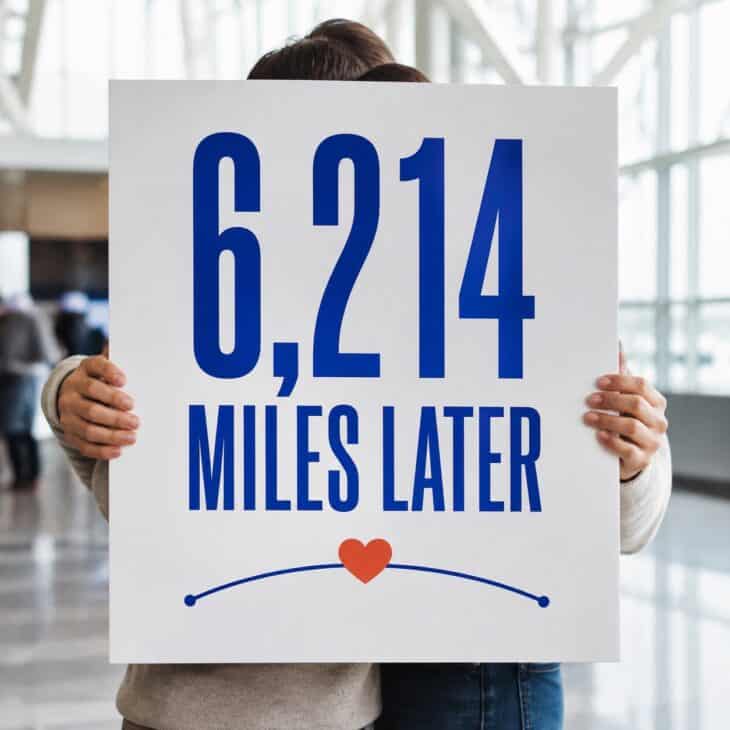
What it is A number-led sign that states the approximate distance between the traveler’s starting point and home, followed by one word: “later.” The number fills most of the board, with a small heart or route line underneath.
Why it works A precise-looking figure makes the separation feel real while keeping the design beautifully simple. It is strongest after a long international trip, deployment, semester abroad, or long-distance relationship visit.
How to get it Use an online distance calculator to estimate the great-circle distance between the two cities. Round to a whole mile so the number stays readable and avoid implying it was the exact flight path. Print large numerals or trace them from a projector. Put the word “later” on a second line at about half the height. Double-check the number before the marker touches the board.
12. The Two-Language Welcome
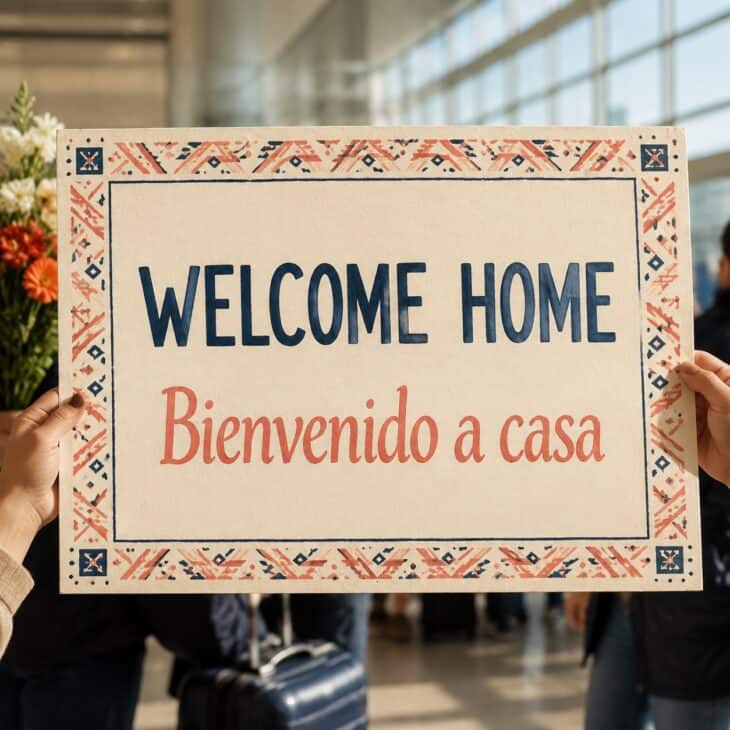
What it is A balanced two-line poster that repeats the same short welcome in two languages, usually the traveler’s home language and the language of the place they visited or grew up. Both lines receive equal size and visual weight.
Why it works The second language adds genuine recognition rather than generic decoration. It is especially thoughtful when welcoming exchange students, relatives, adopted family members, or a partner whose idea of home includes more than one country.
How to get it Ask a fluent speaker to confirm the exact wording, spelling, and level of formality. Set the two lines in equally readable type rather than treating one as a subtitle. Choose colors that matter to the traveler without relying on a busy row of flags. If the scripts differ, print and trace the unfamiliar line instead of copying it by eye. Leave enough space around every character for the sign to read cleanly.
13. The Reusable Chalkboard
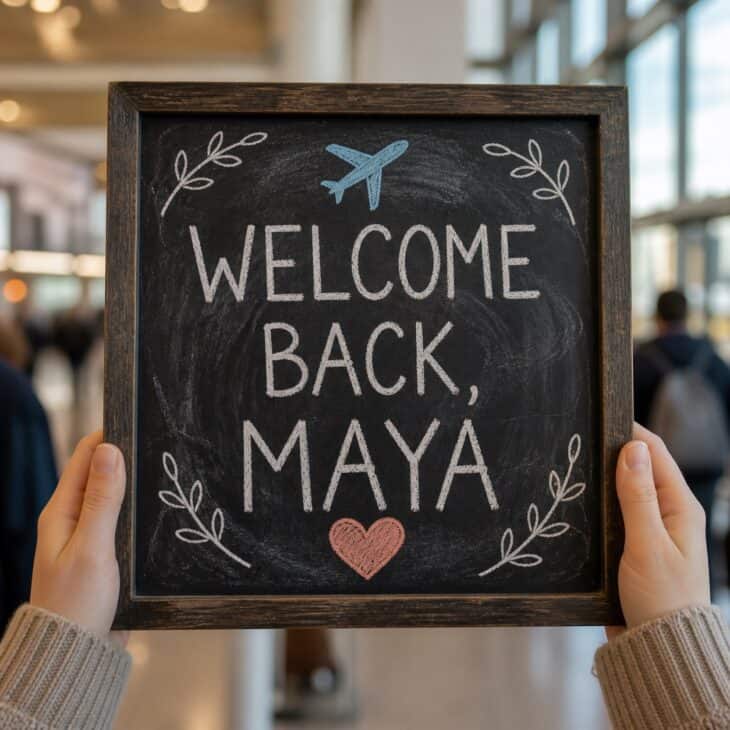
What it is A lightweight framed chalkboard with a changeable name and message, decorated with a few colored chalk details. A surface around 12 by 18 inches is large enough to read but small enough to store between airport runs.
Why it works Families who collect visitors can reuse the same board until it becomes part of the ritual. Chalk also makes last-minute flight changes, nicknames, or jokes easy to add without printing another poster.
How to get it Choose a thin chalkboard with a sealed frame and no heavy glass. Condition a new surface by rubbing the side of a chalk stick over it, then erase before lettering. Use a white chalk marker for the main message and ordinary colored chalk for removable details. Photograph the sign before leaving in case part of it smudges in the car. Pack a cloth and the marker so you can repair it while waiting.
14. The Changeable Letter Board
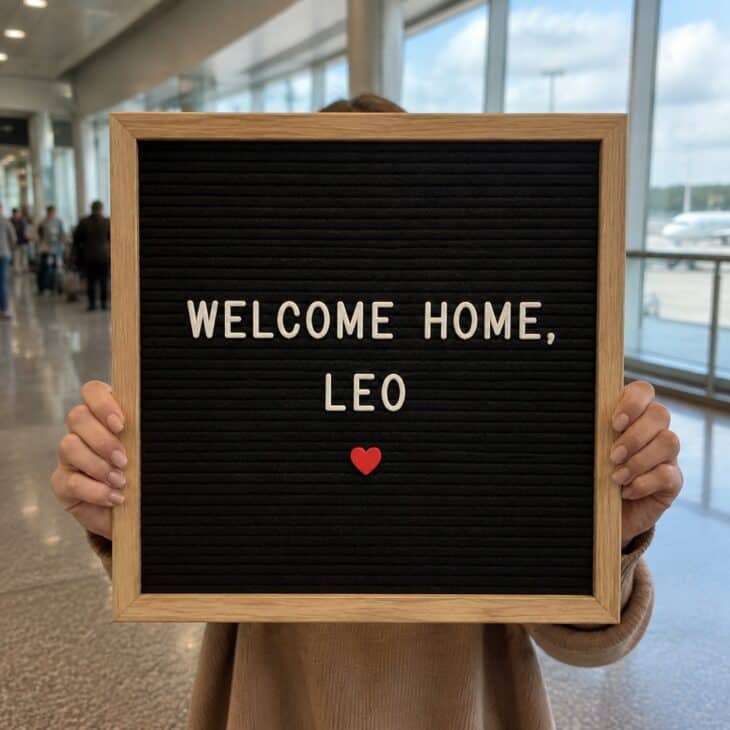
What it is A felt letter board with slide-in plastic characters, usually black with white letters or cream with black letters. A simple two-line welcome and one colored symbol give it a neat cafe-menu look without any drawing or painting.
Why it works The board feels finished even when it was assembled ten minutes before leaving. It can welcome a different person every month, then return to a shelf or kitchen wall between trips.
How to get it Pick a board at least 16 inches wide and use the largest letter set that fits. Build the message from the center outward so each line stays balanced. Press every character fully into the felt and bring a small bag for spares. Check the name twice, especially if you are welcoming someone you have not met before. Carry the board upright so loose letters do not slide out in the car.
15. The Light-Up Marquee Sign
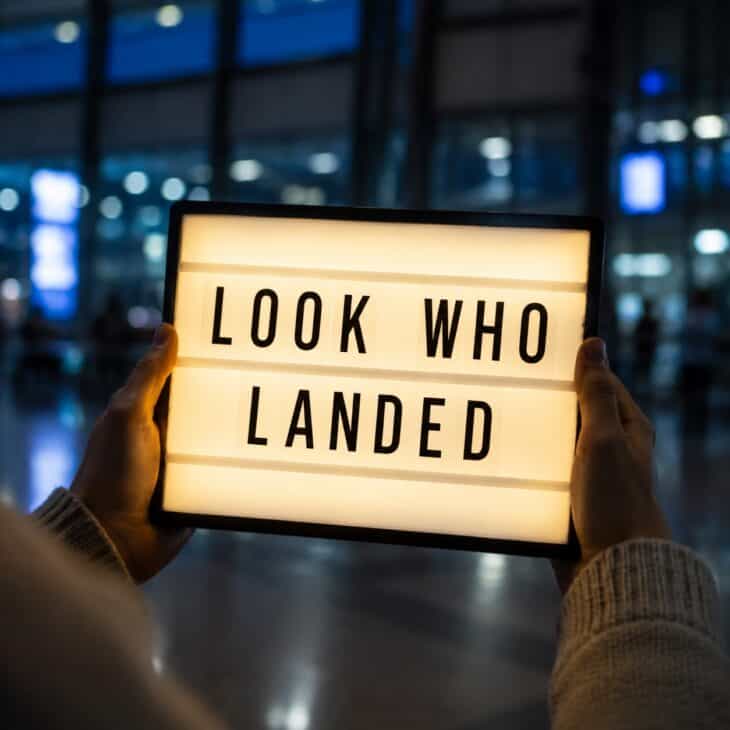
What it is A battery-powered cinema lightbox carrying a short line such as “Look who landed” in black slide-in letters. The internal LEDs illuminate the message evenly, while the shallow plastic case stays light enough to hold with one hand.
Why it works Evening arrivals halls can be dim and visually busy, so a glowing white rectangle separates itself from the background immediately. The marquee style also makes an ordinary pickup feel like an opening night.
How to get it Choose a cordless lightbox at least letter-size and install fresh batteries before the drive. Limit the message to three or four words, since the included letters are usually small. Assemble it at home and tilt it through several angles to check for glare. Pack spare letters in a zip bag instead of loose in your pocket. Switch it on only when the flight is close to landing so the batteries last through delays.
16. The Oversized Boarding Pass
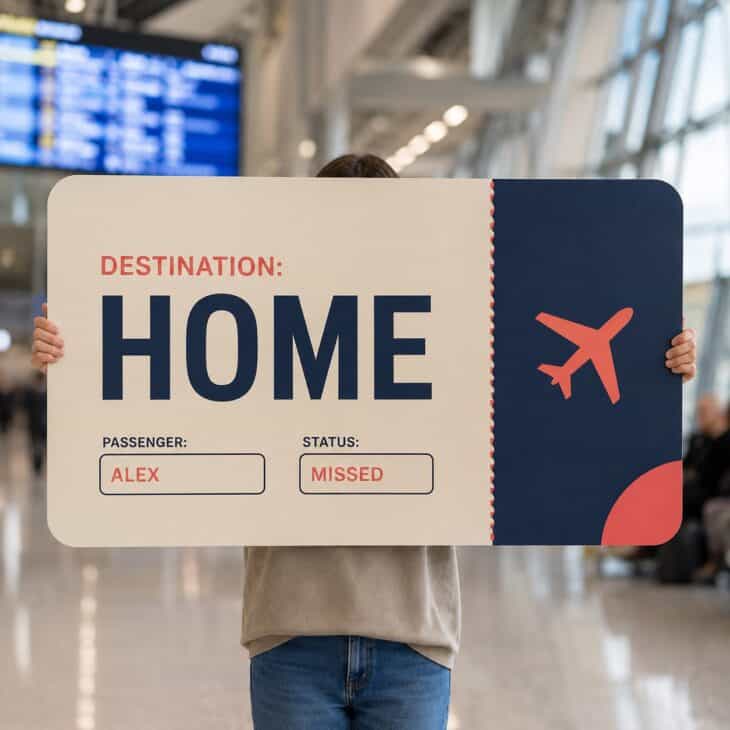
What it is A poster cut into a long boarding-pass shape with fictional fields for passenger, destination, gate, and status. “Destination: Home” becomes the largest line, while playful entries such as “Status: Missed” fill the smaller boxes.
Why it works The familiar layout gives you several places for personal details without making the sign look random. It also suits airplane birthday parties, reunions, and graduation celebrations equally well.
How to get it Design the pass at roughly three times wider than it is tall. Use invented codes and a decorative row of bars rather than copying a real ticket or scannable barcode. Make the traveler’s name and “Destination: Home” the only text meant to read at distance. Mount the print on foam board and round the corners with a craft knife. Keep any genuine flight number, booking reference, or personal document off the finished sign.
17. The Arrivals-Board Design
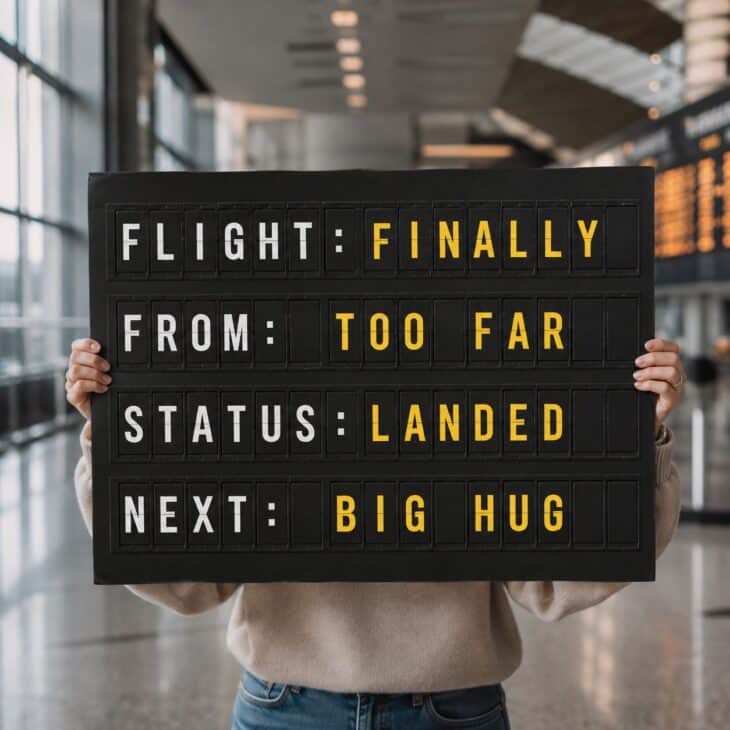
What it is A black poster styled as a simplified flight information display, with four large rows for “Flight,” “From,” “Status,” and “Next.” Fictional entries such as “Finally,” “Too far,” “Landed,” and “Big hug” replace real travel data.
Why it works The format belongs unmistakably to an airport, yet the invented information makes it personal. Strong rows and limited colors give the sign structure, so several jokes can coexist without looking cluttered.
How to get it Use a black landscape board and divide it into four equal horizontal bands. Add the labels in small white capitals and the answers in larger type beside them. Pick one amber or lime accent for “Landed.” Keep every answer under three words and align all text to the same left edge. Compare the layout with your favorite airport photo ideas so the sign will also read clearly in the reunion pictures.
18. The Runway Marker Sign
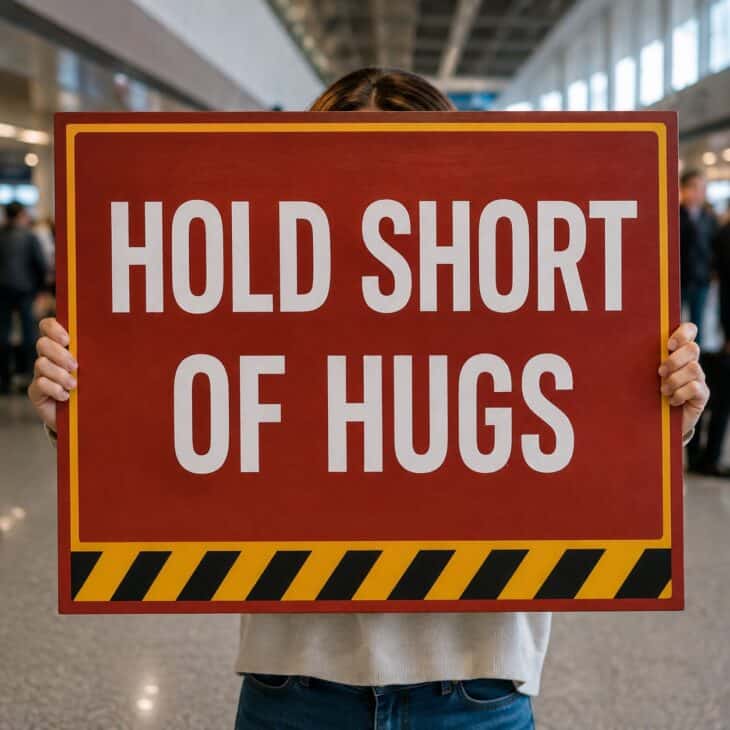
What it is A red, white, yellow, and black placard inspired by runway markings, but carrying the playful line “Hold short of hugs.” Straight borders, condensed capitals, and a striped lower edge create the aviation look without copying operational signage.
Why it works Pilots and serious aviation fans will understand the language immediately, while everyone else still sees the joke. It is more distinctive than another airplane doodle and fits someone who prefers technical references to sentimental messages.
How to get it Paint a landscape foam board deep red and mask a narrow yellow border with painter’s tape. Apply white vinyl letters so the phrase stays crisp. Add one decorative striped band, but avoid real runway numbers or airport identifiers. Label the back “decorative” if you intend to keep it with actual aviation gear. Use the sign only in the public terminal, never near airfield access points.
19. The Team-Colors Welcome
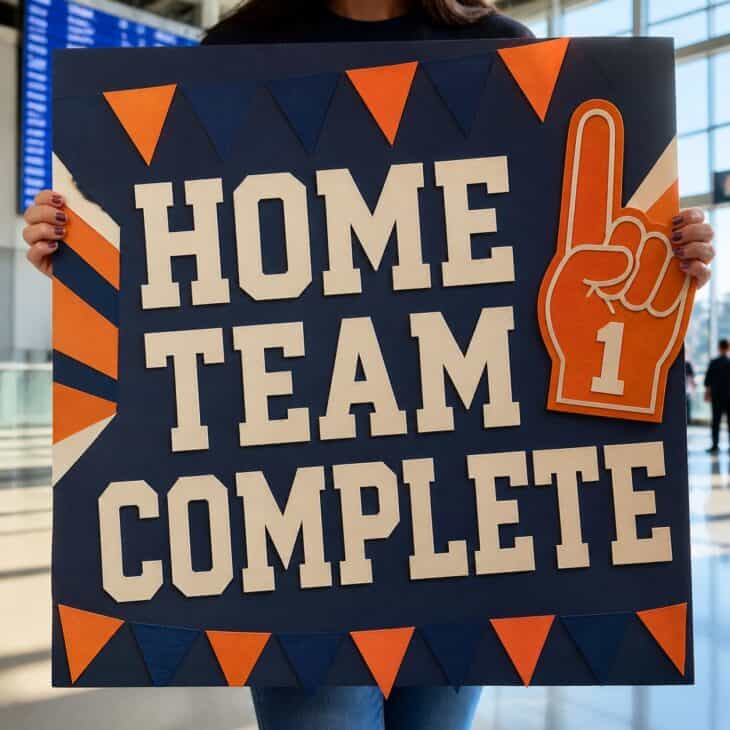
What it is A varsity-style poster built around the traveler’s favorite colors, with pennant shapes and the line “Home team complete.” Cream block letters, a striped border, and one generic foam-finger or ball icon supply the game-day language.
Why it works Team colors carry the feeling of home before the words do. The idea is energetic enough for a group pickup and easy to personalize without needing an official logo or expensive licensed materials.
How to get it Choose the two colors your traveler recognizes most and add cream or white for contrast. Cut pennants from cardstock and line them along only one edge. Letter the main phrase in a tall athletic font, then outline it once. Wear coordinating solid colors if the whole group wants a stronger visual. Leave team names, trademarks, and copied logos off the board.
Plan the meeting point before the artwork
Airport layouts and pickup rules vary. Agree on a terminal, exit, or signed meeting point before leaving home, track the flight itself, and park if you plan to wait inside with a sign. Curb lanes are usually for active pickup, not standing reunions.
20. The Graduation Homecoming Sign
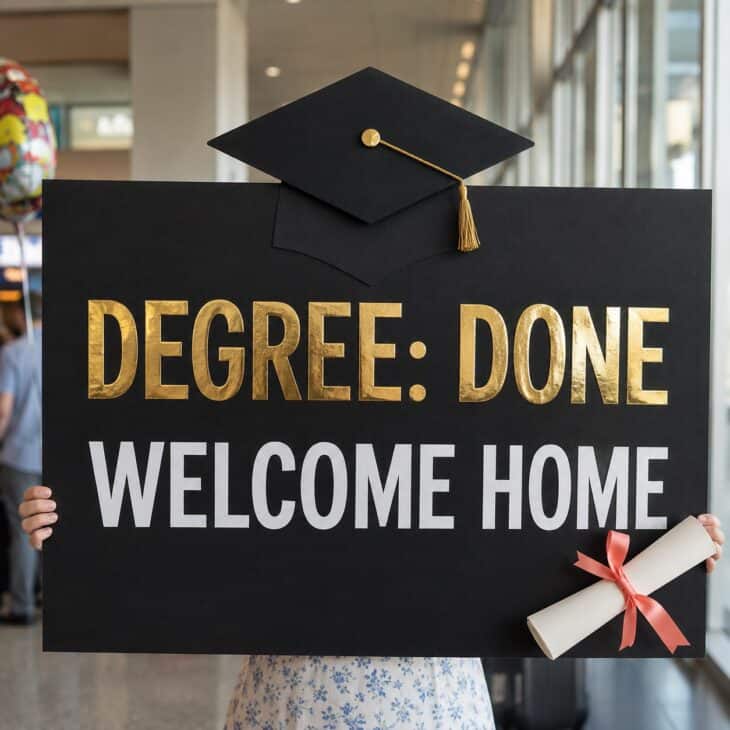
What it is A black, white, and metallic-gold sign combining “Degree: done” with “Welcome home,” plus a paper mortarboard or tiny rolled diploma. School colors can replace gold, provided the main wording still has strong contrast.
Why it works The return home becomes one more milestone instead of the quiet end of graduation week. It is particularly thoughtful when family could not attend the ceremony and the airport is their first chance to celebrate.
How to get it Cut a simple cap from black cardstock and attach it flat so the sign remains easy to carry. Use metallic marker only for the two or three words you want to emphasize. Add the graduation year in one corner, not across the main message. Bring a small bouquet rather than attaching anything heavy to the board. Reuse the colors and paper details later if you are planning a full aviation graduation party.
21. The Study-Abroad Return Sign
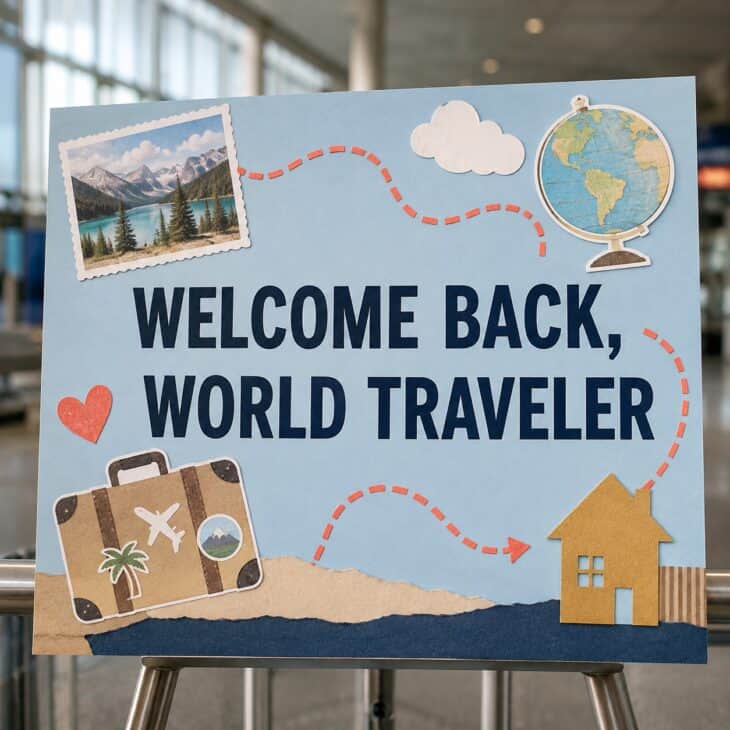
What it is A scrapbook-inspired poster reading “Welcome back, world traveler,” finished with postcard shapes, a small globe, and a dotted route ending at home. Abstract luggage stickers can reference food, architecture, or weather from the semester without copying real travel marks.
Why it works The sign celebrates the independence and experience of studying abroad rather than treating the trip as merely time away. It feels youthful and detailed, and friends can each contribute one small paper element.
How to get it Ask the student for a few favorite photos before the return without revealing the project. Pull three colors from those images and use them across the board. Cut decorations from matte paper so every piece stays flat. Leave blank space around the main line and avoid tiny city lists. Add a pocket to the back for notes from friends who cannot join the pickup.
22. The First Solo Trip Sign
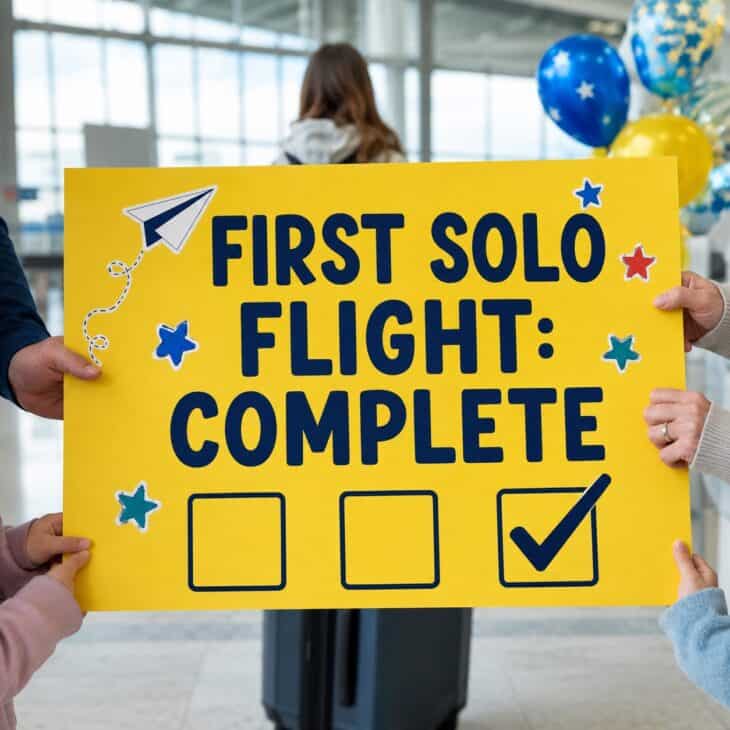
What it is A cheerful checklist sign announcing “First solo flight: complete,” with a bold check mark and a few stars or paper airplanes. It suits a child flying as an unaccompanied minor, a teenager’s first independent trip, or an adult who finally faced a fear of flying.
Why it works The design recognizes courage and independence without making the traveler seem helpless. It also creates a natural milestone photo they may want to repeat after future firsts.
How to get it Use yellow board with navy letters for a bright, friendly combination. Put the full phrase on two lines and draw one oversized checked box beside “complete.” Add the date and route on the back for the family record. Coordinate the handoff point with the airline if the traveler is an unaccompanied minor, since normal public meeting spots may not apply. Let the traveler hold the sign for the final photo after the first hug.
23. The Romantic Finally Here Sign
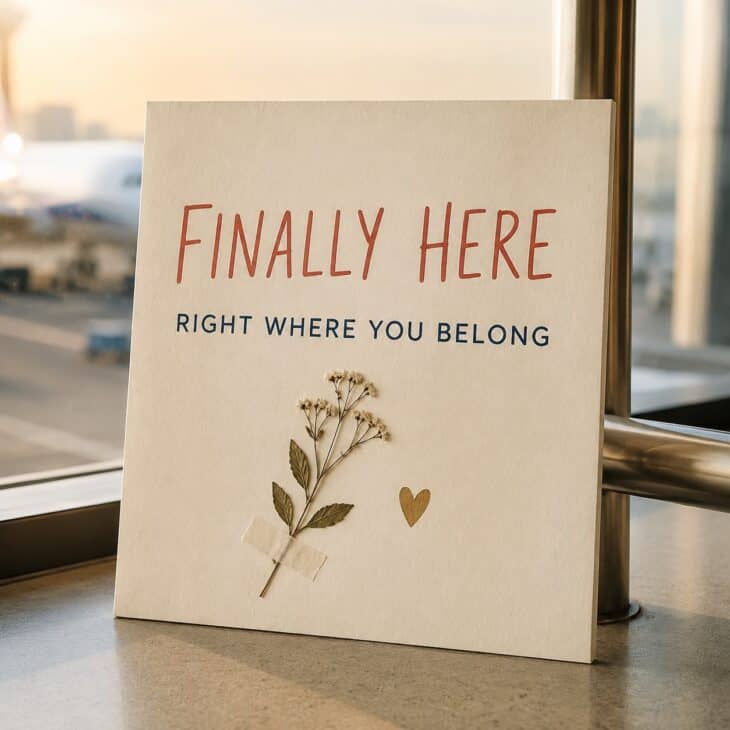
What it is An ivory sign with “Finally here” in loose script and “Right where you belong” in smaller capitals beneath it. One paper flower sprig, a narrow ribbon, or a tiny gold heart supplies the romantic detail without turning the board into a proposal prop.
Why it works The line is warm enough for a partner after months apart but broad enough for a new visit in a long-distance relationship. A restrained design keeps the message intimate even when it is held in public.
How to get it Choose heavy cream paper and limit the palette to two inks plus one metallic detail. Trace the script from a printed guide if freehand lettering feels risky. Attach decorations flat so they do not fall off while you wait. Match the small bouquet or ribbon to one of the ink colors. After the reunion, continue the welcome with one of these aviation date night ideas rather than overloading the airport moment.
24. The Whole-Crew Sign
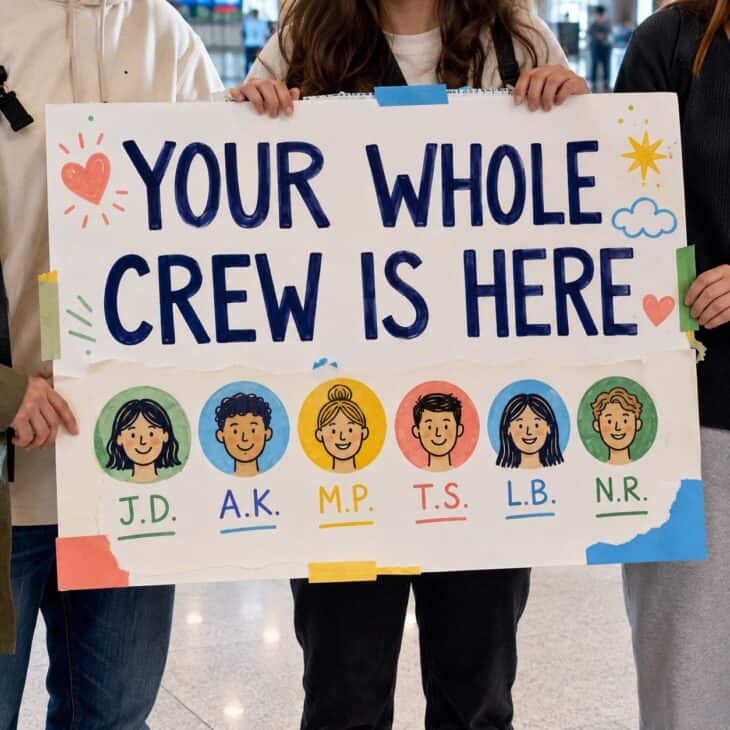
What it is A large shared banner reading “Your whole crew is here,” with one illustrated face, colored circle, or initial for every person at the pickup. Different handwriting and small taped-on pieces make the group authorship visible.
Why it works A returning friend sees the full community before they can count the faces in the crowd. The banner also gives a large group something coordinated to hold, which produces better reunion photos than everyone waving separately.
How to get it Ask each person to decorate one six-inch paper circle at home. Mount the circles along the bottom of a wide white banner and place the headline above them. Assign two tall people to the ends and everyone else to stand where their symbol appears. Keep bags behind the group so the waiting area stays clear. Use burst mode for the reunion and take the posed photo only after the first hug.
25. The Sign-and-Bouquet Combo
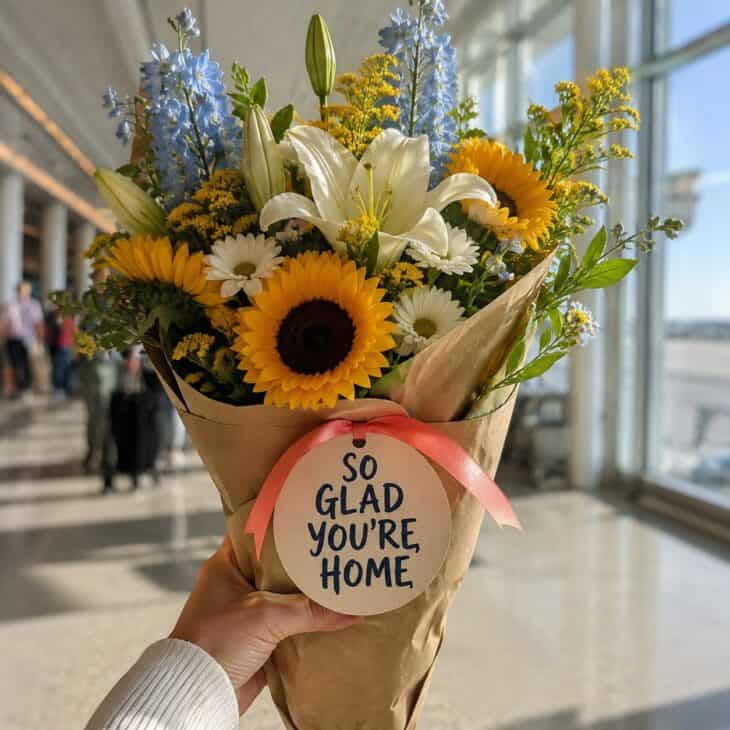
What it is A small round or arch-shaped welcome card fixed to the paper wrap of a bouquet, with a line such as “So glad you’re home.” The flowers provide the color and scale, so the sign needs only strong lettering and one ribbon.
Why it works The traveler receives the message and the gift in the same gesture, and the greeter keeps one hand free for a hug or suitcase. It is polished enough for a partner, parent, grandparent, or honored guest without demanding a giant poster.
How to get it Ask the florist to wrap the stems in sturdy kraft paper and leave a broad flat front. Cut the sign from lightweight board, letter it before assembly, and tape a short wooden pick securely to the back. Slide the pick between the outer wrapping layers rather than into the flower stems. Keep the arrangement compact enough to carry through a crowd. Choose low-fragrance flowers if the traveler has just spent hours in a dry aircraft cabin.
Keep the reunion out of the traffic flow
Stand to the side of the exit where your sign remains visible without narrowing the walkway. Once your traveler appears, lower the board, move clear for the hug, and save the posed photo for an open patch of the arrivals hall.
FAQ
Sources and references used for research and fact-checking.
Get the Newsletter
The latest aviation news and stories sent to your inbox.
About the Author

Hanna writes AeroCorner's aviation-lifestyle and decor guides, turning a love of flight into ideas for your home, celebrations, and gift lists.