

Military Aircraft
The delta-wing V-bomber that carried Britain's nuclear deterrent and flew the Falklands Black Buck raids.
Updated: by Tim de Vries
The latest aviation news and stories sent to your inbox.
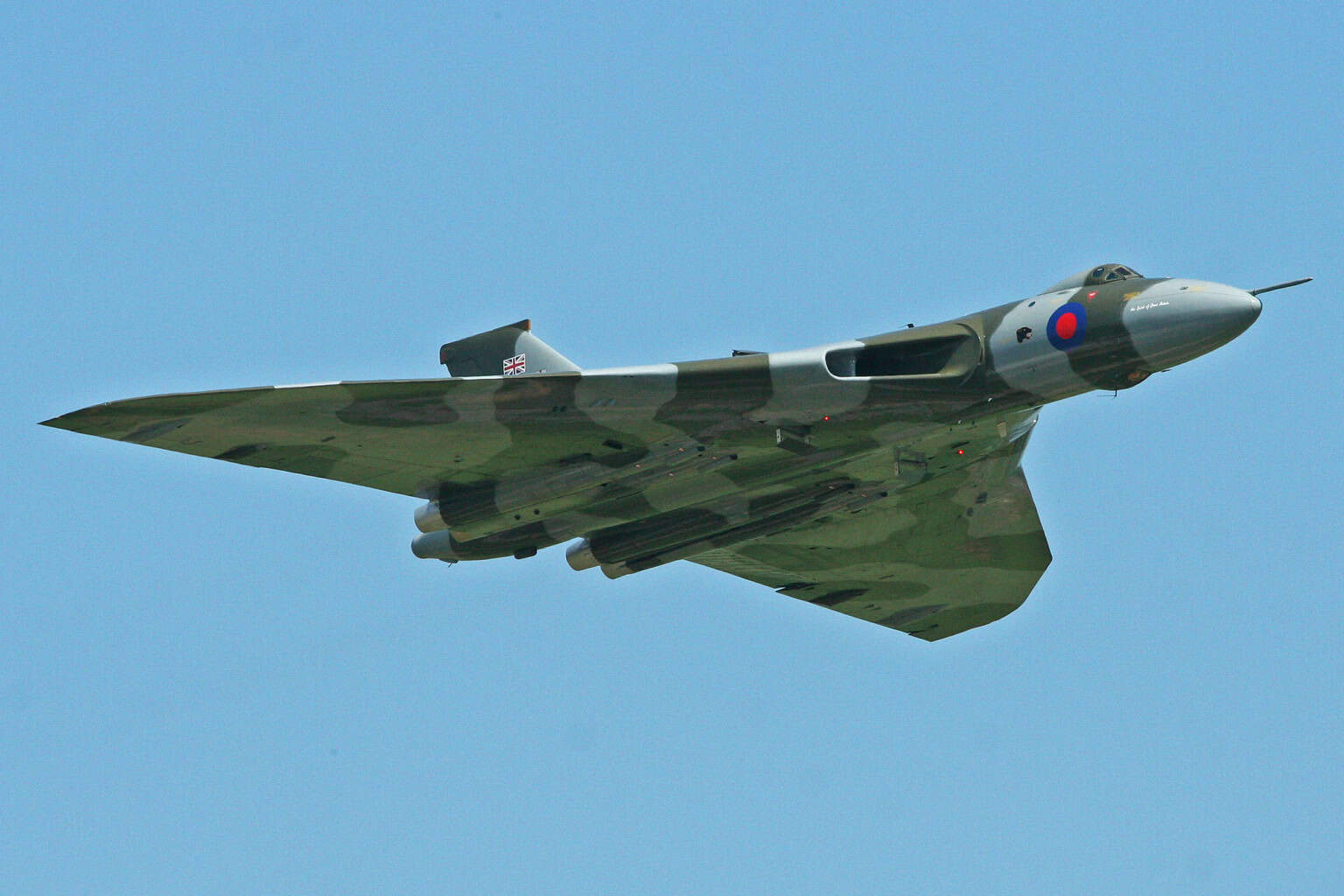
The Avro Vulcan was the delta-wing heart of Britain’s V-bomber nuclear deterrent. It first flew in 1952, served with the Royal Air Force from 1956 to 1984, and flew its only combat missions in the 1982 Falklands War. One restored Vulcan, XH558, flew at airshows until 2015.


The Avro Vulcan was the delta-wing bomber that carried Britain’s nuclear deterrent through the Cold War. It served with the Royal Air Force from 1956 to 1984 and flew its only combat missions in the 1982 Falklands War.
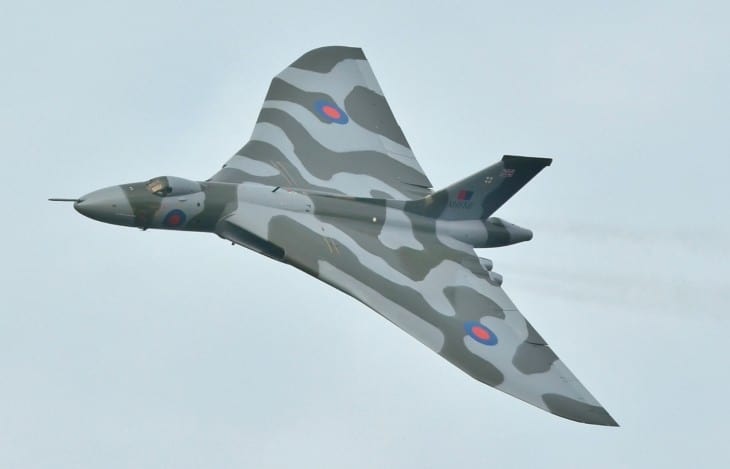
It is also the aircraft behind one of the most recognizable sounds in aviation, the Vulcan howl. Of the three V-bombers, the Vulcan was the most technically advanced and, at the start, the riskiest bet.
Avro built 134 production Vulcans at Woodford: 45 B.1 models and 89 B.2 models. Counting prototypes, the total comes to 136.
The aircraft carried five crew and no defensive weapons. It relied on high speed and high altitude to evade interception, and later on electronic countermeasures.
The specification panel on this page describes the B.2, the later and more numerous version. The three Vulcans that can still run their engines, XH558, XL426 and XM655, are all B.2s.
In January 1947 the Ministry of Supply issued Specification B.35/46. It asked for a bomber able to carry one 10,000 lb (4,500 kg) bomb to a target 1,500 nautical miles from its base, cruising at 500 knots between 35,000 and 50,000 feet.
Avro answered with a delta wing, a shape it had never flown. To learn how it handled, the company built a series of smaller test aircraft, the Avro 707, before committing to the full-size design.
The prototype, VX770, first flew on 30 August 1952 with Avro test pilot Roly Falk at the controls. Falk had argued for a fighter-style control stick instead of a wheel, and the second prototype was fitted with one.

The B.1 was the first production version and reached the RAF in 1956. Twenty-eight B.1s were later upgraded to B.1A standard with electronic countermeasures, in-flight refueling equipment and UHF radio.
The B.2 first flew in September 1958 and entered RAF service in 1960. It brought a larger, thinner wing, much more powerful engines, a better electrical system and a larger tail cone for countermeasures.
Many B.2s were adapted to carry the Blue Steel missile, and nine were later converted for maritime radar reconnaissance. Six became K.2 tankers in 1982, a conversion covered below.
Avro also drew up proposals that never flew, including a larger-winged B.3 for the Skybolt missile and a version that would have carried three Gnat fighters.
All Vulcans used Bristol Olympus turbojets. Early B.1s had the Olympus 101, and the B.2 moved to the 200 series, the Olympus 201 at 17,000 lbf (76 kN).
Later aircraft received the Olympus 301, rated at 20,000 lbf (89 kN). Developed versions of the engine later powered the cancelled TSR-2 and the Concorde.
At around 90 percent power, some Vulcans produced a deep, rising howl that came from the way air entered the intakes. It became a favorite at airshows.
The crew sat in a pressurized cabin on two levels. The pilot and co-pilot sat up front on Martin-Baker ejection seats.
The navigator radar, navigator plotter and air electronics officer sat below and faced rearward, with no ejection seats. They were expected to leave through the entrance door.

The full specification table for the aircraft is on this page. A few figures need context, because published Vulcan numbers vary with the version and the fit.
Range is the best example. Published figures run from about 2,600 miles to about 4,600 mi (7,400 km), depending on the source and the version. Real missions depended on tankers, as the Falklands raids showed.
Top speed also appears as Mach 0.93 to 0.96, depending on source and variant. The Vulcan was built to cruise near Mach 0.86 at around 45,000 feet, and it was never a supersonic aircraft.
The ceiling is also approximate. The B.2 navigation and bombing computer was modified to operate up to 60,000 feet, but some references quote a higher figure.
The Vulcan’s job was to deliver nuclear weapons. Over its career it carried Blue Danube, Violet Club, Yellow Sun Mk 1 and Mk 2, Red Beard, a U.S. Mark 5 supplied under Project E, and finally the WE.177B.
The B.2 could also carry the Blue Steel stand-off missile, and 33 aircraft were modified for it. The U.S. Skybolt missile that was meant to replace Blue Steel was cancelled in late 1962.
Once British Polaris submarines became operational, the strategic role passed to the Royal Navy. The Vulcan stayed on in a tactical nuclear role with the WE.177B and also trained for conventional missions, carrying up to 21 bombs of 1,000 lb (454 kg).
Many people still compare it with bombers like the B-52 and the B-47. For a wider look at the type, see our guide to the best bombers in the world.
The Falklands War in 1982 was the Vulcan’s only combat. Each mission, known as Black Buck, flew from Ascension Island to Port Stanley, a one-way distance of 3,889 miles (6,259 km), with Victor tankers refueling the bomber along the way.
Engineers began preparing five Vulcans on 9 April. They reinstated the long-unused refueling system, fitted a new navigation system and added wing pylons for a countermeasures pod and Shrike anti-radar missiles.
On 1 May, Vulcan XM607 bombed the Stanley runway and scored one direct hit. Two later missions fired missiles at radar sites, and two more were cancelled.
At the time these were the longest-distance bombing raids ever flown. On 3 June, XM597 broke its refueling probe on the way home and diverted to Rio de Janeiro, where the crew was held until the fighting ended.
The raids were of limited tactical use. They did show that the Vulcan’s jamming equipment was effective against Argentine radars.
The Vulcan B.2 was due to leave RAF service in 1982. The Falklands campaign used up so much of the Victor tanker fleet’s airframe life that six Vulcans were converted into tankers as a stopgap.
The government gave the go-ahead on 4 May 1982, and the first K.2 was delivered 50 days later. No. 50 Squadron flew them until it disbanded in March 1984, which ended the type’s operational service.
Two Vulcans carried on as the RAF’s display aircraft. XL426 was replaced by XH558, which flew with the Vulcan Display Flight until 1992, when the Ministry of Defence judged it too costly to run.
XH558 was sold in 1993 to C Walton Ltd, which kept it running on the ground at Bruntingthorpe. The Vulcan to the Sky Trust took ownership in 2005 and led the restoration to flying condition.
It flew again on 18 October 2007 and displayed at airshows every season from 2008 to 2015. Running costs were estimated at about £2 million a year.

XH558’s last flight was on 28 October 2015 at its Doncaster Sheffield base. The Trust said that options to keep it flying, such as building new engines or sourcing parts from other Vulcans, were rejected for engineering, cost and practicality reasons.
No Vulcan is airworthy today. Three are kept in taxiable condition: XH558 at Doncaster Sheffield Airport, XL426 at London Southend Airport and XM655.
In December 2025 the Vulcan to the Sky Trust announced public engine runs of XH558 at Doncaster Sheffield for 2026. Check the Trust for dates, because the aircraft itself will not leave the ground.
XL426 is run by the Vulcan Restoration Trust, which holds regular taxi runs at Southend. Other Vulcans are on static display in museums, among them XL318 at the RAF Museum in London, XM597 at the National Museum of Flight in Scotland and XM612 at the Norwich Aviation Museum.
No. The last Vulcan to fly, XH558, made its final flight on 28 October 2015. Three Vulcans, XH558, XL426 and XM655, are kept in taxiable condition for ground runs, and none can take off.
Four Olympus turbojets powered it, and around 90 percent power some Vulcans also produced a distinctive howl caused by their air intake arrangement. That howl became an attraction at airshows.
The B.2 was due to leave RAF service in 1982, after Polaris submarines took over the strategic deterrent. The Falklands War delayed that by two years because six Vulcans became stopgap tankers, and No. 50 Squadron disbanded in March 1984. XH558 later flew under civilian ownership from 2007 to 2015, when the Trust could not make continued flying practical.
It was considered the most technically advanced of the V-bombers, and it served as the backbone of Britain’s airborne nuclear deterrent. Its only combat use, the Black Buck raids, had limited tactical effect but was a remarkable feat of long-range operation.
Its maximum speed was 561 kt · 646 mph · 1,039 km/h, just below the speed of sound. Its normal cruise was about Mach 0.86 at 45,000 feet.
Avro built 134 production Vulcans, 45 B.1s and 89 B.2s. Including prototypes, the total is 136.
Sources and references used for research and fact-checking.
_cockpit.jpg)