

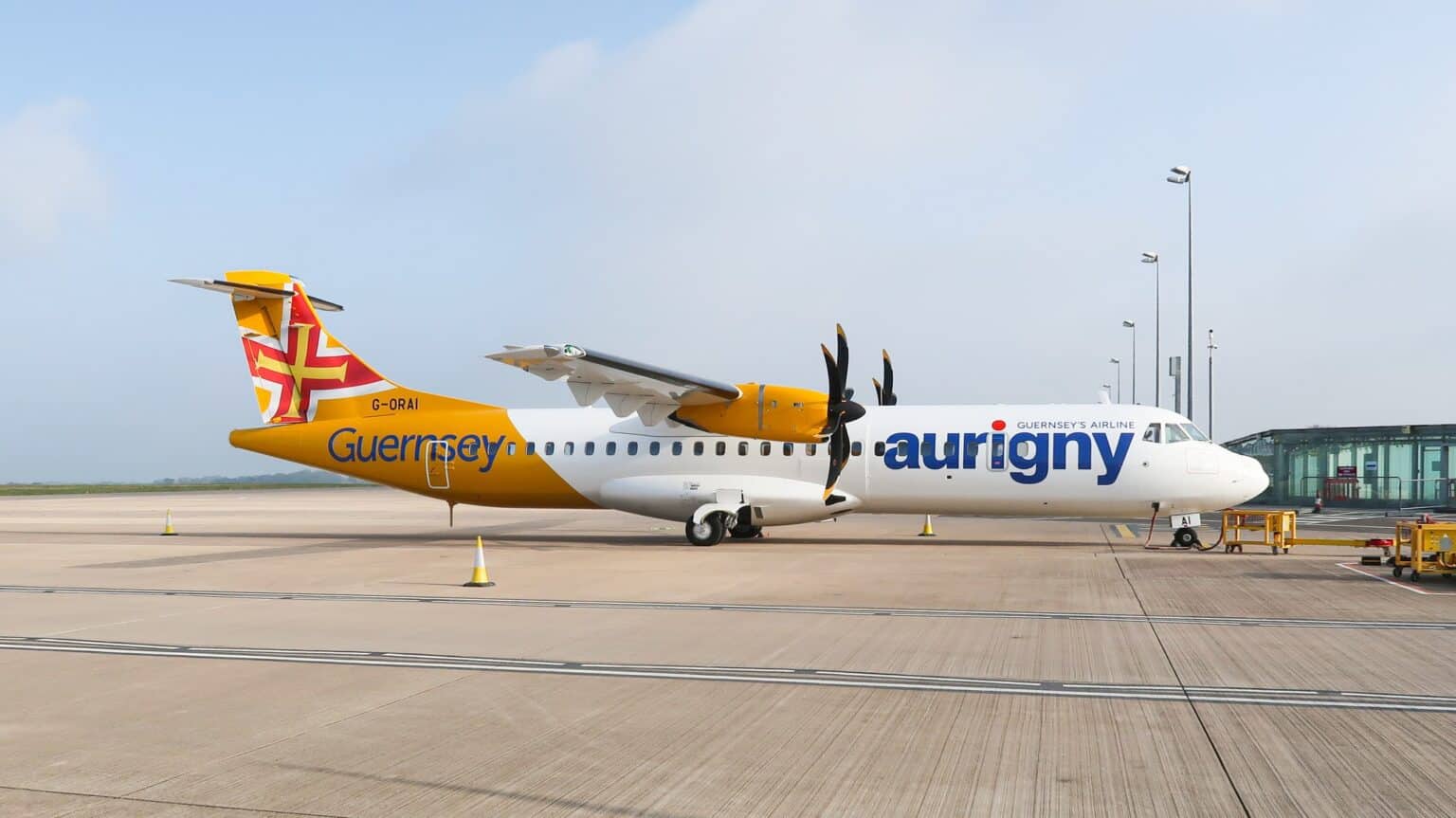
Storm Austen, the storm the Met Office named this week, closed Guernsey and Alderney airports overnight and cancelled most of Jersey’s flights on Friday, October 23, 2026. By early Friday evening, 37 of the 46 flights on Jersey Airport’s board for the day were listed as cancelled.
The storm also reached North Wales, where Airbus cancelled its Beluga transport flights at Hawarden Airport, next to its Broughton wing factory, because of the weather.
A red warning over the Channel Islands
Jersey Met issued a Channel Islands Red Wind Warning on the morning of Thursday, October 22, and re-issued it at 4pm that day. It forecast gale force 8 to severe gale force 9 winds, with gusts of 70 to 80 mph, peaking early on Friday.
The forecast held. Jersey Airport’s weather reports show a peak at 05:50 local time on Friday, with a sustained wind of 50 knots (58 mph) gusting to 73 knots (84 mph). Guernsey Airport recorded a 63-knot (73 mph) gust half an hour earlier.
The Government of Jersey said the red warning was replaced by an orange one at 11:58am Friday. By 1pm, its teams had logged around 170 incidents of fallen trees and debris across the island.
Airport by airport
Guernsey. The airport stopped flying on Thursday afternoon, when the last scheduled departure was a 14:40 flight to London Gatwick and every remaining inbound flight was cancelled, Bailiwick Express reported. Guernsey Ports’ airport director, Richard Thomasson, said the airport and its airlines had agreed a plan built around passenger and staff safety.
The States of Guernsey said the airport reopened at 2pm on Friday, with flights resuming from 4pm, and that it expected to extend its opening hours to help airlines recover. Even so, the airport’s board still showed several evening Aurigny services cancelled, including flights to London Gatwick and Southampton.
Alderney. The island’s airport closed on Thursday and was due to reopen at 4pm Friday. The States of Guernsey said the plan was to fly only two Aurigny flights, GR214 and GR215, weather permitting, but Guernsey Airport’s board later listed both as cancelled.
Jersey. Ports of Jersey warned of severe disruption to flights and sailings, and the airport’s notice cancelled all morning flights, the Express reported. Flights were expected to resume no earlier than 5pm.
The cancellations hit every airline on the board: British Airways, easyJet, Loganair and Aurigny. The first arrival still running was easyJet’s EZY639 from London Luton, estimated at 17:44. Every British Airways flight on the day’s board, to and from Heathrow and Gatwick, was cancelled.
Further west, the Met Office recorded a 76 mph gust at St Mary’s Airport on the Isles of Scilly on Friday morning, according to the same report. Isles of Scilly Travel cancelled its Scillonian III ferry on Friday and Saturday, but its Skybus advisory said no flights had been cancelled when it was posted.
Why Hawarden’s Belugas stayed on the ground
Airbus confirmed that weather was behind the cancellation of Beluga operations at Broughton on Friday, the Chester Standard reported. The Met Office had put a yellow wind warning over the area, with inland gusts of around 45 to 55 mph.
Broughton builds wings, and the BelugaXL fleet exists to carry large assemblies from the plant to Airbus’s final assembly lines in France and Germany.

The wind direction made it worse. Hawarden’s single runway points roughly 040 and 220 degrees, and from late Friday morning the airport’s reports showed the wind from 310 to 320 degrees at 19 to 26 knots, gusting to 37 knots (43 mph). That put almost the whole wind straight across the runway.
The change was sudden. Hawarden reported light winds of 6 knots or less until 11:20 local time, then 25 knots gusting to 35 half an hour later.
A VistaJet business jet flying from Cologne to Hawarden as VJH373 diverted to Birmingham during the day, according to flight-tracking data cited by the paper. No reason for that diversion has been confirmed.
How wind shuts an airport
Wind alone rarely makes a runway unusable. What stops flights is the limit of the aircraft and the people around it: each type has a crosswind it has been shown to handle, and airlines set their own limits within that.
Gusts matter as much as the steady wind. At Jersey’s peak the gusts ran 23 knots above the sustained wind, a swing a crew has to absorb close to the ground.
Ground operations have limits too, and both Guernsey Ports and the States of Guernsey named staff safety alongside passenger safety. Guernsey stopped flying on Thursday afternoon, hours before the strongest gusts, because winds were forecast to exceed safe operating limits that evening.
Five days earlier, Storm Adam closed Ibiza Airport twice in one day, on October 18.
What happens next
The States of Guernsey said the weather will stay wet and windy over the weekend, and the Met Office expects more wind and rain into the start of next week. At the time of writing, Guernsey Airport’s board listed no cancellations among Saturday’s departures.
Both island governments told passengers to check with their airline before traveling to Guernsey Airport or Jersey, and Bailiwick Express noted that further disruption was possible as airlines recovered their schedules.
Sources and references used for research and fact-checking.
- Government of Jersey, Storm Austen: Updates and advice (11am, 22 October)
- Government of Jersey, Storm Austen: Latest update (5.30pm, 22 October)
- Government of Jersey, Storm Austen: Update for Islanders (23 October)
- States of Guernsey, Storm Austen
- Jersey Airport (Ports of Jersey), Arrivals and departures, 23 October 2026
- Guernsey Airport (Guernsey Ports), Arrivals and departures
- Met Office, Storm Austen named
- NOAA Aviation Weather Center, METAR history for EGJJ, EGJB and EGNR, 22-23 October 2026
- Isles of Scilly Travel, Service status: Scillonian III and Skybus
Get the Newsletter
The latest aviation news and stories sent to your inbox.
About the Author

AeroCorner News is the aviation news desk of AeroCorner.com. It covers accidents and incidents, safety rulings, airline and airport disruption, and new aircraft. It works from primary sources such as the NTSB, FAA, EASA and the manufacturers' own announcements.