


On August 14, 2026, FAA Administrator Bryan Bedford said the agency will not let Cleveland close Burke Lakefront Airport, rejecting Mayor Justin Bibb’s push to shut the downtown general aviation field for redevelopment. Two Ohio senators quickly backed him up.
A Downtown Airport City Hall Wants Gone
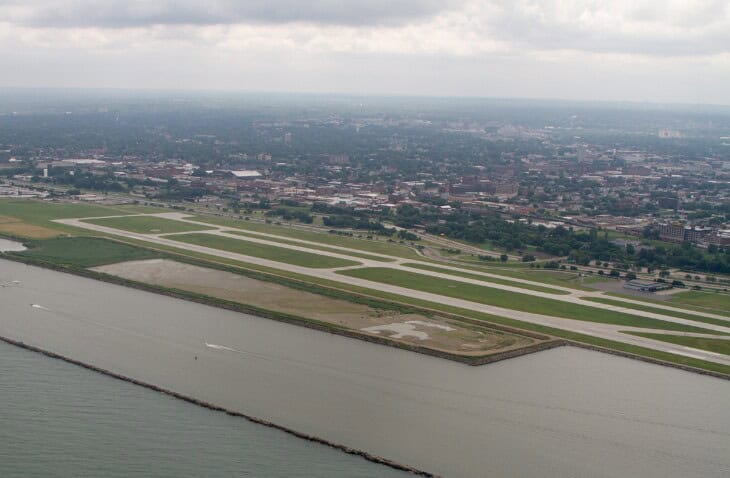
Burke Lakefront sits on the Lake Erie shoreline just east of downtown Cleveland and serves business jets, flight schools, and medical helicopters. Bibb’s administration says it has run at a deficit for two decades, about $1.7 million a year, and calls it an underutilized asset better suited to lakefront redevelopment.
Bedford disagreed, speaking to reporters at an FAA facility in Oberlin, Ohio. “The FAA is against closing airports across the country,” he said, according to NBAA. “We need to talk about how do we open new facilities, not how do we close existing, valuable real estate.”
Bedford pointed to future demand from drones and electric vertical-takeoff aircraft, telling News 5 Cleveland the country doesn’t “have enough airspace capacity for the future as it is.” The FAA’s own MOSAIC rule opened a certification path for exactly that kind of aircraft earlier this year.
Sen. Bernie Moreno, R-Ohio, went further. “There is no scenario in which Burke Lakefront Airport would be closed, given the study and time that the FAA has spent analyzing this,” he said, per NBAA. “The conversation was open. And in my mind, this conversation is now closed.” Sen. Jon Husted also opposed the closure.
Why a City Can’t Just Close a Federal Airport
The fight is legal as much as political. Airports that accept FAA Airport Improvement Program grants sign “grant assurances,” a contract promising the field stays open to the public for as long as those federal dollars are still on the books.
Burke’s existing federal and state grant obligations don’t lapse until 2039, AVweb reported. Closing earlier would need the FAA’s own sign-off, an act of Congress, or repaying the outstanding grants.
How grant assurances work
Airports that take FAA Airport Improvement Program money agree to stay open to the public for the useful life of the funded work, and each new federally funded project can extend that clock. It is why a city can be legally bound to keep an airport open for decades after the runway money was spent.
AOPA’s Great Lakes regional manager, Kyle Lewis, told AVweb that Cleveland had been “counting on” Congress as “the shortcut” to bypass that process. Both Ohio senators declined to pursue it.
Cleveland Isn’t the First City to Try This
In 2003, Chicago Mayor Richard Daley sent bulldozers to gouge X-shaped gashes into Meigs Field’s runway overnight, stranding several aircraft, without the 30-day notice federal law requires before a public airport closes.
The Meigs Field precedent
The FAA fined Daley $33,000, the maximum penalty at the time, and Chicago later repaid $1 million in airport-improvement funds it had used for the demolition. Congress responded by raising the maximum daily fine for an unauthorized closure from $1,100 to $10,000.
That episode is the backdrop every time a US city tries to close a federally funded airport. It’s also why Bedford and the senators framed their opposition as final rather than a starting position for negotiation.
The Numbers Behind the Fight
An Ohio Department of Transportation study cited by NBAA found Burke generates $195 million in direct annual economic activity and supports 664 jobs. Backers also point to its role as a reliever for Cleveland Hopkins International Airport, the region’s main commercial hub.
A spokesperson for Bibb’s office called the federal position disappointing, saying it “appears to bypass the best interests of Clevelanders,” per News 5 Cleveland. City and county leaders have also written to congressional offices and Transportation Secretary Sean Duffy asking for help closing the airport.
Not over yet
Cleveland’s mayor says the city is not giving up on closing Burke, even with the FAA and Senate opposed. Absent a change of position in Washington, the field’s grant obligations don’t run out until 2039.
Get the Newsletter
The latest aviation news and stories sent to your inbox.
About the Author

Tim is the owner and lead editor of AeroCorner since 2019, overseeing aviation content covering aircraft, airlines, airports, and the broader aviation industry. Through years of researching, writing, editing, and publishing aviation-focused content, he has developed extensive practical knowledge of commercial aviation and air travel. Based in Asia and a frequent traveler himself, Tim also brings firsthand passenger experience to AeroCorner’s coverage. Outside of publishing, he has also explored aviation firsthand through hands-on flight training in New Zealand.