

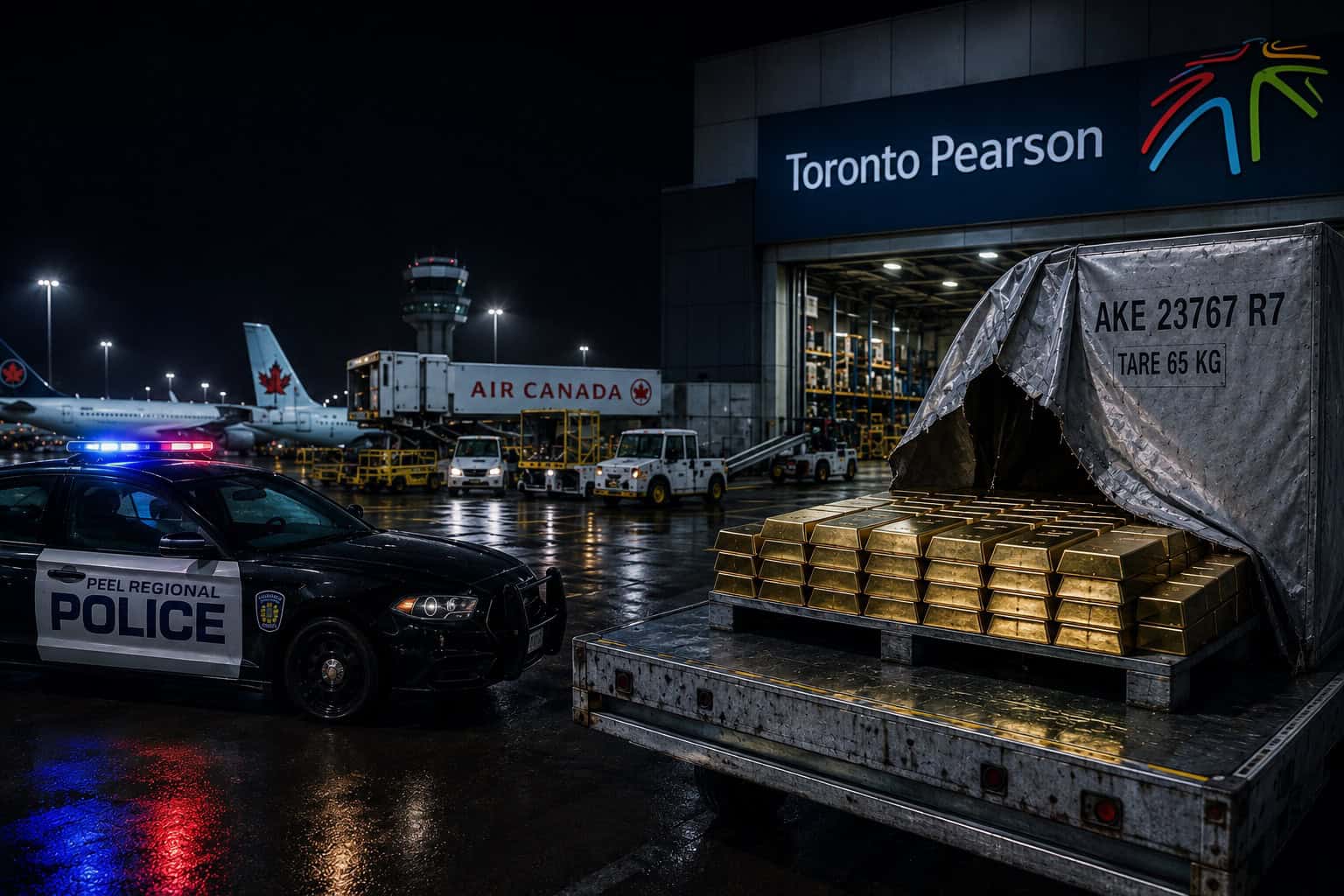
On August 28, 2026, Air Canada confirmed it has settled the lawsuit brought by security firm Brink’s over the theft of about C$20 million in gold and cash from the airline’s cargo warehouse at Toronto Pearson in April 2023. The airline said the appeal Brink’s had filed “has been discontinued” and that it was “pleased the matter has been resolved.”
Neither company disclosed how much Air Canada agreed to pay. Air Canada confirmed the outcome to CP24. The deal ends the civil fight between the two companies, but the criminal cases arising from the theft are still moving through an Ontario court.
What was stolen, and how
The shipment flew from Zurich to Toronto on an Air Canada flight on April 17, 2023. The container held roughly 6,600 gold bars weighing about 400 kilograms (880 pounds), worth around C$20 million, plus about C$2.5 million in foreign banknotes.
Within about an hour of the container being offloaded, someone arrived at the Air Canada cargo facility, presented a forged air waybill, loaded the goods onto a truck and drove away. It remains the largest gold theft in Canadian history, and most of the metal has never been recovered.
Peel Regional Police, working with the U.S. Bureau of Alcohol, Tobacco, Firearms and Explosives, charged nine people in April 2024 in an investigation called Project 24Karat. Two of those charged were Air Canada warehouse employees. Those criminal cases continue in a Brampton, Ontario, courthouse.
Why a $20 million loss led to an $18,000 judgment
Brink’s sued Air Canada in late 2023 for more than C$20 million, arguing the airline’s security was lax. Air Canada denied negligence and said its liability was capped by the Montreal Convention. In January 2025, the Federal Court agreed, ordering the airline to pay 9,988 Special Drawing Rights, about C$18,000.
The Montreal Convention is the treaty that fixes what an airline owes when cargo or baggage is lost, damaged or delayed on an international trip. For cargo it limits liability to 22 Special Drawing Rights per kilogram, roughly C$40, regardless of what the shipment is actually worth. A Special Drawing Right is an International Monetary Fund currency unit, worth about C$1.85 at the time of the ruling.
Applied to about 454 kilograms of gold and notes, that per-kilogram cap produces almost exactly the 9,988-unit figure the court awarded. The limit lifts only if the shipper declares a higher value in advance and pays a surcharge. The Federal Court found Brink’s had not done that, even though, as CBC News reported, its paperwork flagged the shipment as valuable and used the word “gold” repeatedly.
For cargo, that ceiling is close to absolute. The treaty lets a claimant break the passenger and baggage limits by proving the carrier acted recklessly, but that carve-out does not extend to cargo. Airlines lean on liability limits wherever the rules allow, from cargo treaties to the fine print on downgrade refunds.
The settlement figure is sealed
Air Canada and Brink’s both declined to say what changed hands, so it is not public whether the airline paid more than the roughly C$18,000 the court ordered. A settlement reached during an appeal often lands between the trial award and the sum originally claimed, but here that range runs from about C$18,000 to more than C$20 million, and neither side is confirming.
The lesson for anyone shipping valuables by air
The case is a reminder that the headline value of a shipment is not what an airline is on the hook for if it goes missing. Declared-value service and separate cargo insurance exist precisely because the treaty limit is so low, and high-value goods move through secured air cargo terminals under contracts that assume the shipper carries most of the risk.
Brink’s, one of the world’s largest secure-logistics companies, would normally hold that insurance itself. That is how it was able to repay its Swiss clients while the liability fight with Air Canada worked its way through the courts.
Sources and references used for research and fact-checking.
Get the Newsletter
The latest aviation news and stories sent to your inbox.
About the Author

Tim is the owner and lead editor of AeroCorner since 2019, overseeing aviation content covering aircraft, airlines, airports, and the broader aviation industry. Through years of researching, writing, editing, and publishing aviation-focused content, he has developed extensive practical knowledge of commercial aviation and air travel. Based in Asia and a frequent traveler himself, Tim also brings firsthand passenger experience to AeroCorner’s coverage. Outside of publishing, he has also explored aviation firsthand through hands-on flight training in New Zealand.