



Table of Contents
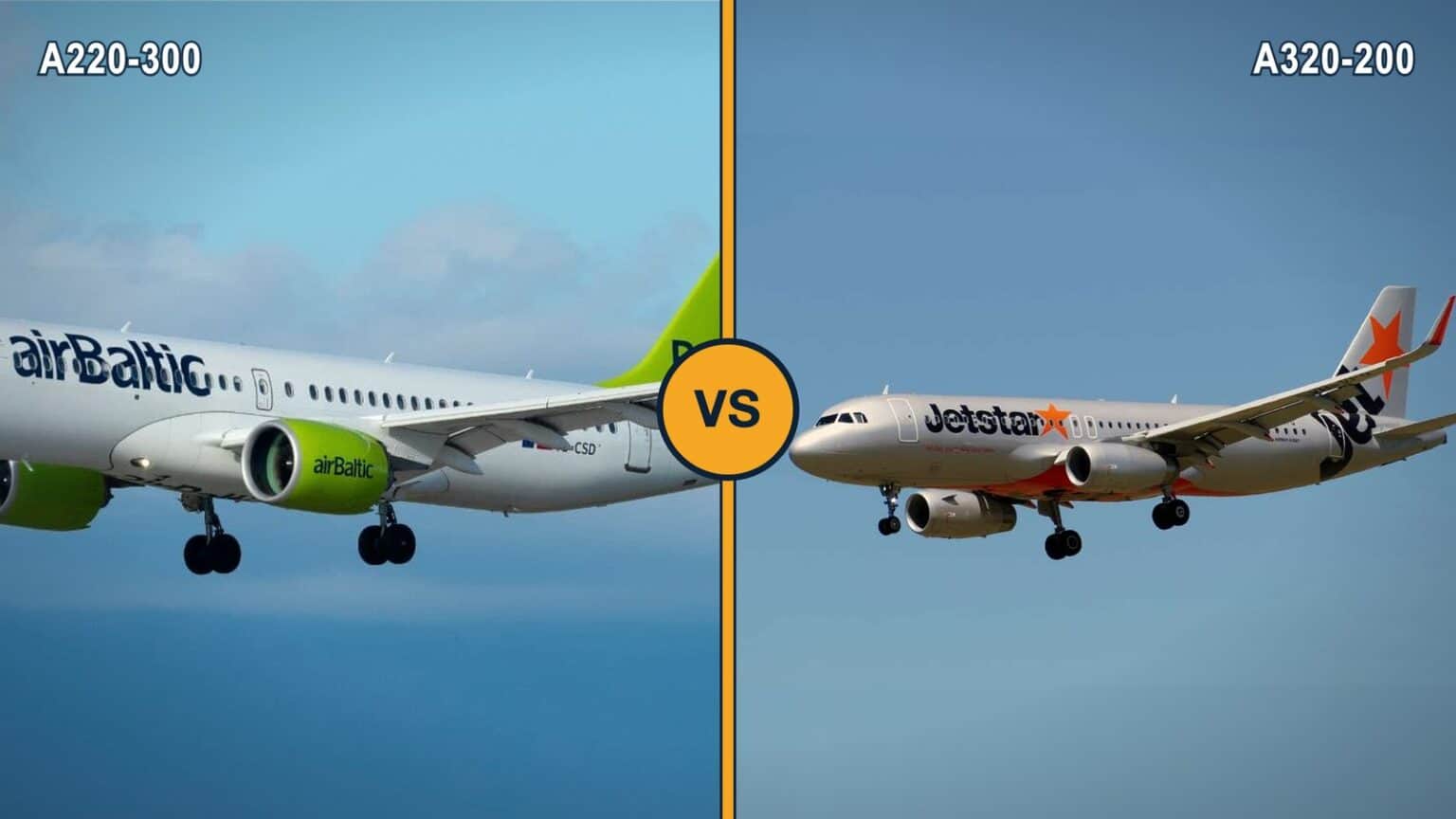
The A220-300 and the A320-200 both wear the Airbus name, but they come from different companies and different decades. The A220 started as a Bombardier design, while the A320 is the jet that made Airbus a household name.
The short answer: the A320 is bigger and sells in far larger numbers, and the A220 is the newer, more comfortable small jet.
| Question | A220-300 | A320-200 |
|---|---|---|
| Origin | Bombardier C Series, launched 2008 | Airbus design, launched in the 1980s |
| First flight | 16 September 2013 (CS100) | 22 February 1987 |
| Entry into service | 14 December 2016 (A220-300, airBaltic) | April 1988 (Air France) |
| Cabin layout | Five abreast, 2-3 | Six abreast, 3-3 |
| Economy seat width | 18.5 inches (47 cm) | Narrower, typically about 18 inches |
| Final assembly | Mirabel, Canada, and Mobile, Alabama | Toulouse, Hamburg, Tianjin and Mobile |
| Orders and deliveries | 1,105 ordered, 559 delivered | 20,598 ordered, 12,955 delivered (whole A320 family) |
| Newer version | None yet; A221 stretch under study | A320neo, in service since 2016 |
Where each jet came from
The A220 began as the Bombardier C Series, a program launched in 2008. The first CS100 flew from Mirabel, Quebec, on 16 September 2013.
Airbus became the majority partner in 2018 and renamed the jet the A220. It took a 75% stake in February 2020, with Investissement Québec holding the rest.
The A320 is an Airbus original. It first flew on 22 February 1987 and entered service with Air France in April 1988.
It was the first airliner with a digital fly-by-wire flight control system. That one decision shaped every Airbus cockpit since.

Size and cabin: five abreast against six
The A220-300 is the smaller jet. Airbus lists it at 120 to 160 passengers, against roughly 150 to 186 for the A320 family.
The bigger difference is the cabin layout. The A220 seats five abreast in a 2-3 pattern, so most passengers sit at a window or an aisle.
The A320 seats six abreast in a 3-3 layout, which leaves a middle seat in every row.
Economy seats on the A220 are 18.5 inches (47 cm) wide, and Airbus pitches the cabin with extra-large windows. That is why passengers often rate it above older narrow-bodies of similar size.

For the full numbers, the spec table above the article compares both jets side by side. This page sticks to what the table cannot show.
Engines and efficiency
The A220 uses Pratt & Whitney PW1500G geared turbofans. Airbus claims a 25% cut in fuel burn and CO2 per seat against previous-generation aircraft, helped by a structure that is 40% advanced materials.
The classic A320-200 flies with older IAE V2500 or CFM56 engines. Its modern answer is the A320neo, which entered service with Lufthansa on 25 January 2016 and offers up to 15% better fuel economy.

So the fair modern comparison is often the A220-300 against the A320neo, not the older A320-200. We list the A320-200 here because it is the most-built A320 and the one most passengers have flown.
Sales: a small program against a giant
The A320 family has 20,598 orders and 12,955 deliveries as of October 2026. It is one of the best-selling airliner families ever built.
The A220 has 1,105 orders and 559 deliveries on the same date. It is a respectable niche, not a challenger to the A320 for volume.
October 2026 shows the gap. Airbus booked 202 gross orders, 163 of them for the A320neo family, and none for the A220. Airbus delivered nine A220-300s and 54 A320-family jets that month.
For the wider picture, see our Boeing vs Airbus comparison.
Where they are built
Airbus assembles the A220 at three lines: two in Mirabel, Canada, and one in Mobile, Alabama. The Alabama line began deliveries in 2020.
A320-family final assembly takes place in Toulouse, Hamburg and Tianjin, plus Mobile, Alabama, since April 2016.

Who flies them, and why airlines choose each
The A220 launch customers were Swiss, which flew the CS100 from 15 July 2016, and airBaltic, which started the A220-300 on 14 December 2016.
Both are airlines that want a jet smaller than an A320 without the cost of a regional aircraft. That is the A220 sweet spot: routes with too few passengers to fill 180 seats.
The A320 family suits the opposite case. Low-cost carriers and network airlines use it on dense routes, where every extra row earns money.
The size gap shows up in real schedules. Swiss has swapped A220s for bigger A320neos on its Geneva to Heathrow route, as our news report covers.
Flight deck and crew
Both jets use fly-by-wire controls. The A320 was the first airliner to carry a digital system, and the A220 also flies by wire.
Pilots do not treat them as the same aircraft, though. The A220 has its own type rating, because it began life as a Bombardier design. A pilot moving between the two takes a type-rating course.
A220 against the other A320 sizes
The A320 is not the only member of its family. The A319 is smaller and the A321 is larger, and the A321 is where the family really pulls away from the A220.
Airbus is now studying a stretched A220, which it calls the A221. If it launches, it would push the A220 closer to the A320 in size.
Until then, the two jets overlap only at the top of the A220-300 range and the bottom of the A320 range.
The A220 vs A320 price question
Neither jet has a single price. Airlines negotiate large discounts, so list prices say little about what a carrier actually pays.
The spec table above shows the database prices for each aircraft. Treat them as a rough guide to the relative cost, not a quote.
Seat count matters as much as price. A bigger jet spreads its costs over more passengers on a full route, while a smaller one costs less to fly when seats would go empty.
That trade-off explains why both jets keep selling. Airbus can offer an airline the right size for the route instead of forcing one compromise.
Which one should you pick?
The verdict
Pick the A220-300 for cabin comfort on a thinner route. Pick the A320 family for capacity and the sheer size of its network. Airbus sells both because they fit different jobs.
Passengers will usually prefer the A220 cabin. Airlines pick the A320 family when they need more seats and the support network that 12,955 delivered jets bring.
The A220 may grow. Airbus is studying a stretch it now calls the A221, but no launch has been announced.
FAQ
Sources and references used for research and fact-checking.
About the Author

Tim is the owner and lead editor of AeroCorner since 2019, overseeing aviation content covering aircraft, airlines, airports, and the broader aviation industry. Through years of researching, writing, editing, and publishing aviation-focused content, he has developed extensive practical knowledge of commercial aviation and air travel. Based in Asia and a frequent traveler himself, Tim also brings firsthand passenger experience to AeroCorner’s coverage. Outside of publishing, he has also explored aviation firsthand through hands-on flight training in New Zealand.