

Table of Contents
A military click, usually spelled klick, is one kilometer: 0.62 miles, 1,000 meters, or 3,281 feet. When a soldier says the objective is 3 klicks north, they mean 3 kilometers north, or roughly 1.9 miles.
It is spoken slang, not a separate unit. A klick is exactly a kilometer, so the conversion never changes: multiply klicks by 0.62 to get miles.
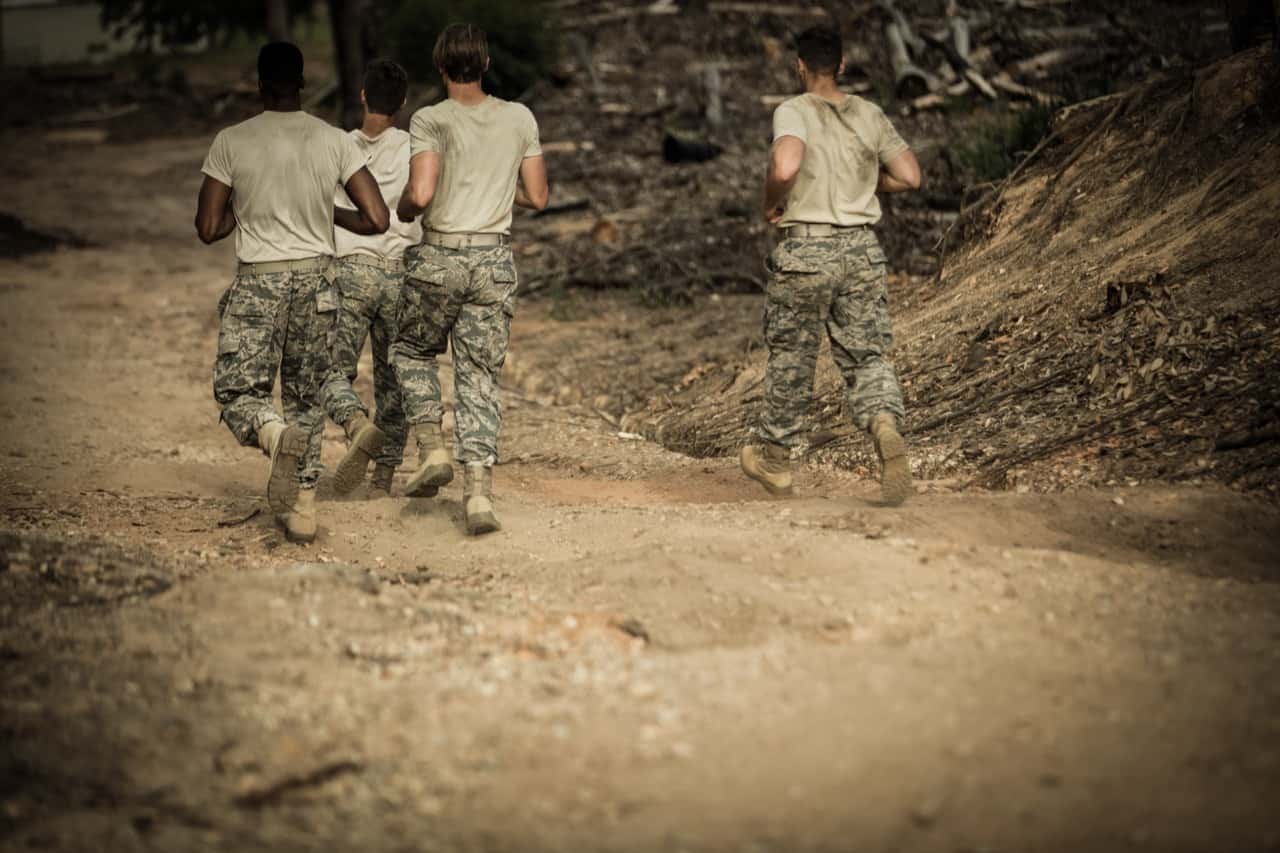
The word is used across the US, British, Australian, Canadian and wider NATO forces because they all navigate on metric maps. On foot, one klick is roughly 15 minutes of marching.
| One klick equals | Value |
|---|---|
| Kilometers | 1 km |
| Miles | 0.62 miles |
| Meters | 1,000 m |
| Feet | 3,280.84 ft |
| Yards | 1,093.6 yd |
| Walking time | About 15 minutes at a standard march pace |
How Far Is a Click in Military Terms?
One click is one kilometer, which is 0.62 miles or 1,000 meters. Half a klick is 500 meters, or about 0.31 miles.
Because a klick is simply a spoken form of kilometer, there is no rounding or approximation involved. A klick is the same distance in every army that uses the word.
The confusion usually comes from the imperial habit of American readers. A kilometer feels like an unfamiliar unit in the United States, so the slang term sounds like it must be something other than a plain metric distance.
Klicks to Miles Conversion Table
To convert klicks to miles, multiply by 0.621371. To go the other way, multiply miles by 1.609344.
| Klicks | Miles | Meters |
|---|---|---|
| 0.5 | 0.31 miles | 500 m |
| 1 | 0.62 miles | 1,000 m |
| 2 | 1.24 miles | 2,000 m |
| 3 | 1.86 miles | 3,000 m |
| 4 | 2.49 miles | 4,000 m |
| 5 | 3.11 miles | 5,000 m |
| 8 | 4.97 miles | 8,000 m |
| 10 | 6.21 miles | 10,000 m |
| 12 | 7.46 miles | 12,000 m |
| 15 | 9.32 miles | 15,000 m |
| 20 | 12.43 miles | 20,000 m |
| 25 | 15.53 miles | 25,000 m |
| 30 | 18.64 miles | 30,000 m |
| 40 | 24.85 miles | 40,000 m |
| 50 | 31.07 miles | 50,000 m |
| 100 | 62.14 miles | 100,000 m |
| 120 | 74.56 miles | 120,000 m |
How Many Klicks Are in a Mile?
There are 1.61 klicks in a mile. A mile is longer than a kilometer, so any distance in klicks is a larger number than the same distance in miles.
That is the single most common mistake readers make. Five klicks is 3.11 miles, not 5 miles, and a 26.2 mile marathon is about 42 klicks.
Why Does the US Military Use Klicks Instead of Miles?
Because the map is metric. American ground forces navigate using the Military Grid Reference System, the geocoordinate standard developed by the National Geospatial-Intelligence Agency and used across NATO.
MGRS divides the earth into squares measured in meters, and its coordinates are given as a string of digits whose length sets the precision. Four digits give you 1,000 meter accuracy, six digits give 100 meters, and a full ten digits pin a point to 1 meter.
That four-digit grid square, the one soldiers read off a map most often, is exactly one kilometer on a side. Counting distance in klicks is therefore just counting grid squares.
A klick is a square on the map, not just a number
The standard grid square on a military map measures 1,000 meters by 1,000 meters. When a soldier estimates a distance in klicks, they are counting the squares between two points on the map rather than converting anything. This is the practical reason the word survives: the unit is already drawn on the paper in front of them.
The second reason is coalition warfare. US units routinely operate alongside British, German, French, Polish and Australian forces, all of whom work in metric, so an American unit calling distances in miles would be the only one out of step.
The United States is one of only three countries that has not adopted the metric system for everyday use, alongside Liberia and Myanmar. Its military simply does not have that luxury.
Where Does the Word Klick Come From?
Nobody knows for certain, and any page that tells you otherwise is guessing. The most credible explanation is also the least dramatic: klick is a compressed way of saying the first syllable of kilometer.
The word emphasizes the hard k and l sounds, which carry over a radio far better than the full four-syllable word. That matters when a fire mission is being called under pressure.
The term appears in print as Vietnam-era slang. Military.com points to a 1965 Associated Press glossary of Viet War Slang that already lists it, which places the word in common use among American troops by the mid-1960s.
Two folk etymologies circulate widely and neither has evidence behind it. One says the word imitates the sound of a vehicle odometer turning over each kilometer.
The other claims Australian soldiers in Vietnam counted 100 meter marks by pacing, then advanced a rifle gas regulator with an audible click after every tenth mark. It is a good story that gets repeated on almost every page covering this term.
The gas regulator story is folklore, not history
The pacing-and-gas-regulator origin is presented as fact across most of the internet, but it traces to anecdote rather than to any documented source. Wiktionary lists the onomatopoeic theories as secondary and treats the shortened pronunciation of kilometer as the likely origin. Treat any confident single-sentence etymology of klick with suspicion, including the odometer version.
Is Klick an Official Military Term?
No. Klick is spoken slang that everyone understands, but it is not approved terminology and it does not appear in formal orders or doctrine.
Written operation orders, fire missions and map references use kilometers, meters or grid coordinates. You would hear klick on a radio and never see it in a published plan.
The spelling reflects that informality. Klick and click are the same word, and the k spelling is preferred mainly because it keeps the distance separate in print from the mechanical sense of a click.
How Long Does It Take to Walk One Klick?
About 15 minutes on a road in daylight. Army foot march doctrine sets a standard rate of 4 kilometers per hour on roads by day, which works out to one klick every quarter of an hour.
That rate drops as conditions get worse. Night marching on roads is planned at 3.2 kilometers per hour, and cross-country movement falls to roughly 2.5 kilometers per hour by day and 1.6 at night.
| Conditions | Planned rate | Time per klick |
|---|---|---|
| Road, daylight | 4 km/h | About 15 minutes |
| Road, night | 3.2 km/h | About 19 minutes |
| Cross-country, daylight | 2.5 km/h | About 24 minutes |
| Cross-country, night | 1.6 km/h | About 38 minutes |
This is why the unit is useful rather than merely metric. A klick is a distance an infantry soldier can convert into time without doing arithmetic.
Klick vs Mike: What Is the Difference?
A klick is a distance and a mike is a minute. The two get confused constantly because they sound like a matched pair, but they measure different things.
Mike is the NATO phonetic alphabet word for the letter M, and radio users borrowed it as shorthand for minute. Wait one mike means wait one minute.
So “we are two klicks out, ten mikes” means two kilometers away and ten minutes out. The same phonetic word turns up in 40 mike mike, troop slang for a 40 millimeter grenade.
| Term | Measures | Meaning |
|---|---|---|
| Klick (click) | Distance | 1 kilometer, or 0.62 miles |
| Mike | Time | 1 minute |
| Oscar Mike | Status | On the move, from the letters O and M |
| Grid | Position | A map coordinate, usually 6 or 8 digits |
| Mike mike | Size | Millimeter, as in 40 mike mike |
The Other Kind of Click: Scope Adjustment
Click has a second meaning that has nothing to do with kilometers. On a rifle scope, a click is one detent of the elevation or windage turret.
Most American scopes are built so that one click moves the point of impact by a quarter of a minute of angle. A minute of angle is one sixtieth of a degree, and a full circle contains 21,600 of them.
At 100 yards, 1 MOA spans about 1.047 inches, so a quarter-MOA click moves the shot roughly a quarter of an inch. Four clicks move it about an inch.
One click is not one MOA
A widely copied claim says that one click equals 1 MOA, or about one inch at 100 yards. On the great majority of scopes it does not: the standard American turret is a quarter MOA per click, and scopes with milliradian turrets move 0.1 mil per click, about 0.36 inch at 100 yards. Check the turret markings before dialing, because assuming 1 MOA per click puts your correction four times too far.
Context makes the two meanings easy to separate. Distance in the field is klicks, adjustment on a turret is clicks.
Do Pilots Use Klicks?
Generally not. Aviation runs on nautical miles, knots and feet, and those units are standard for both military and civil aircraft across almost the whole world.
A nautical mile is 1.15 statute miles, or about 1.85 kilometers, and it exists because it maps neatly onto one minute of latitude. The difference between the two is explained in our guide to statute miles versus nautical miles.
Klicks belong to the ground war, where soldiers navigate on a metric grid. Aircrew supporting those soldiers will still hear distances passed in klicks when they talk to a unit on the ground, which is one of the places the two systems meet.
The pattern shows up throughout military language: terms survive because they are fast to say and hard to mishear, not because they are tidy. The same logic explains terms like military operator, which means something much narrower in service than it does in civilian use.
FAQ
Sources and references used for research and fact-checking.
- Military.com, How Far Is a 'Klick'?
- Wiktionary, klick
- Wikipedia, Military Grid Reference System
- US Army (via Federation of American Scientists), ATP 3-21.18 Foot Marches
- Vector Optics, Turret Clicks Explained: Click Value and Adjustment Range
- Statista, Countries Using the Metric or the Imperial System
Get the Newsletter
The latest aviation news and stories sent to your inbox.
About the Author

Articles credited to the AeroCorner Editorial Team are created or maintained by multiple aviation contributors working under a shared editorial framework. Content is researched using authoritative aviation sources and reviewed to ensure clarity, technical accuracy, and consistency across AeroCorner.