

Table of Contents
The FAA counted 100,704 active women pilots in the United States on December 31, 2025, according to its annual U.S. Civil Airmen Statistics. That is 11.3% of the 887,519 active pilots on its books, up from 91,694 women a year earlier.
The headline share shrinks the higher you climb. Six in ten of those women hold a student certificate, and among airline transport pilots, the certificate every airline captain needs, women hold 10,376 of 188,656, or 5.5%.
How Many Female Pilots Are There?
In the US, 100,704 women held an active pilot certificate at the end of 2025. “Active” means the FAA counts both a pilot certificate and a valid medical certificate, except for glider pilots, who need no medical.
The count covers student, sport, recreational, private, commercial and airline transport certificates. It leaves out 13,963 women flight instructors and 44,274 women remote (drone) pilots, which the FAA tallies separately and does not add to the total.
The count at a glance
100,704 active US women pilots (Dec. 31, 2025), 11.3% of all pilots. 39,940 once student certificates are left out, 7.7% of non-student pilots. 10,376 airline transport pilots, 5.5% of that certificate. Worldwide, women were about 5.8% of airline pilots in a 2021 survey.
Women Pilots by Certificate, 2025
The FAA files each pilot under their highest certificate, so a woman with a private helicopter certificate and a commercial airplane certificate counts once, as commercial. Here is how the 100,704 split, set against every pilot holding the same certificate.
| Highest certificate | Women | All pilots | Women’s share |
|---|---|---|---|
| Student | 60,764 | 370,286 | 16.4% |
| Private | 16,387 | 186,784 | 8.8% |
| Commercial | 12,867 | 134,288 | 9.6% |
| Airline transport | 10,376 | 188,656 | 5.5% |
| Sport and recreational | 310 | 7,504 | 4.1% |
| Total | 100,704 | 887,519 | 11.3% |
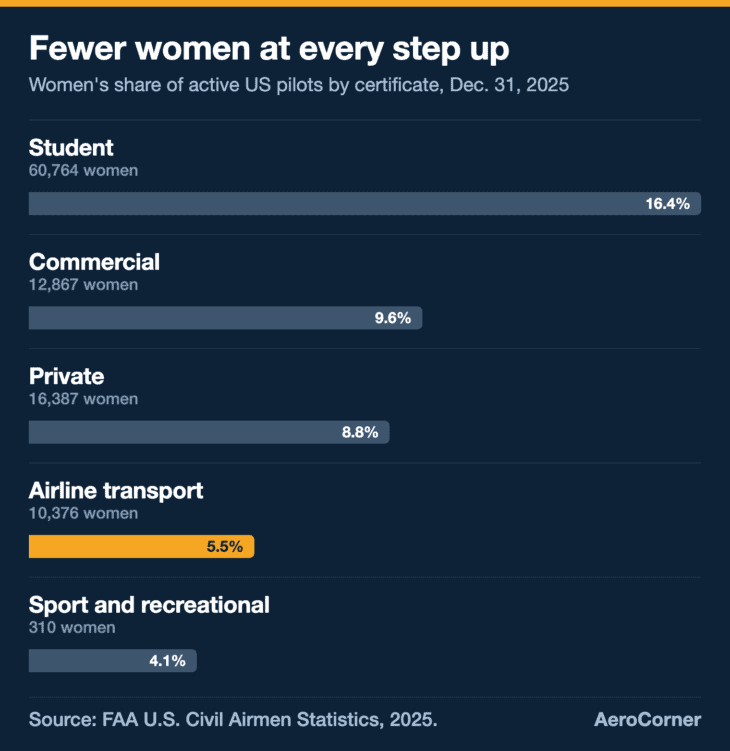
Students dominate the women’s count far more than the overall count. They are 60% of women pilots but 42% of all pilots, which is why the headline share flatters the picture at the top of the profession.
The airline transport row is the one that matters for airline cockpits. At 5.5%, roughly one airline transport pilot in 18 is a woman, against one in six student pilots.
Geographically, Florida has the most women pilots with 11,334, ahead of California with 10,234 and Texas with 8,866. The same three states top the count of all US pilots, with Florida well ahead.
Why the Numbers Differ
Search this question and you will see 5%, 6%, 9%, 9.5% and 11%. Most of them are honest numbers measuring different things, or the same thing in a different year.
The most repeated wrong number
A widely shared line says that of 159,825 pilots flying for airlines, only 6,994 were women. Those are the FAA’s 2017 counts of airline transport certificates, not airline jobs. An airline transport certificate is a qualification, not a job title. Its holders include corporate and charter pilots and instructors as well as airline crews.
Students in or out. Count every certificate and women are 11.3% of US pilots. Leave students out and they are 7.7%, because 60,764 of the 100,704 are students. Pages quoting “about 9%” are usually using the all-in figure from 2020 or 2021, when women were 8.5% and 9.0%.
Student certificates no longer expire. Since April 2016 the FAA issues student certificates with no expiration date, so the student count only accumulates. That inflates the totals for men and women alike, but it moves the women’s share more, because a larger part of it is students.
Certificates versus airline jobs. The 5% to 6% figures usually come from airline staff surveys, not FAA records. The International Society of Women Airline Pilots put women at 5.8% of airline pilots worldwide and 5.5% in the US in its 2021 figures, as reported by Airways Magazine.
Old data. Plenty of top results still quote counts from 2010 to 2018, when there were about 40,000 to 46,000 women pilots. The count has more than doubled since.
How the Number Got Here
For years the count went nowhere. The FAA logged 41,316 active women pilots at the end of 2011 and 39,187 at the end of 2016, as private certificate holders drifted away faster than new students arrived.
Then it took off. Women pilots grew from 39,287 in 2015 to 100,704 in 2025, a 156% rise, while all US pilots grew about 50%. The non-student count grew too, from 24,707 to 39,940, which shows the trend is not only the no-expiry student rule.
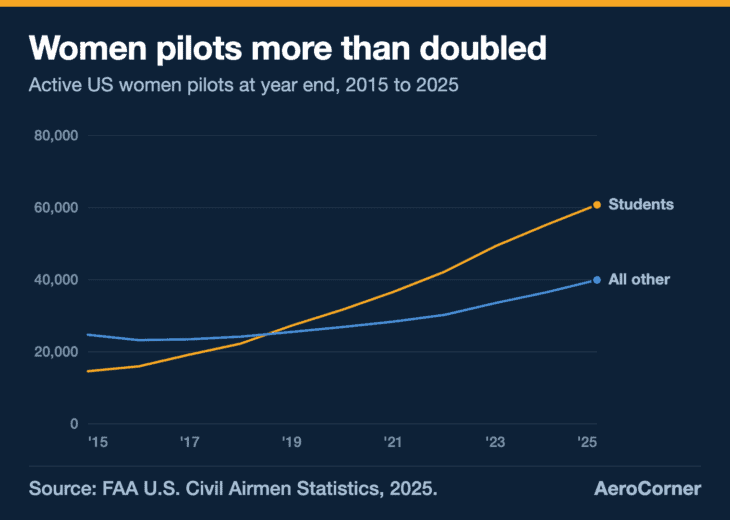
At the top, women airline transport pilots rose from 6,554 in 2015 to 10,376 in 2025, up 58%. Their share of that certificate moved from 4.1% to 5.5%: real growth, but slow, because an airline transport certificate takes 1,500 flight hours, a pipeline years long for anyone who starts from zero.
A younger pipeline
The average active woman pilot was 34.7 years old at the end of 2025, against 42.1 for all pilots. Women airline transport pilots averaged 44.1, six years younger than the 50.2 average for the certificate.
That age gap is the reason to expect the top share to keep rising. The women in today’s student and commercial counts are the airline transport pilots of the 2030s, as the industry’s older, mostly male captains retire, the same squeeze behind the shortage of captains.
How the US Compares With the World
Global figures usually come from surveys of airline pilots rather than license registers. In the International Society of Women Airline Pilots’ 2021 figures, women were 5.8% of airline pilots worldwide, with the US at 5.5%.
India led at 12.3%, more than twice the world average, and Ireland and South Africa followed at 9.9% each. Canada sat at 7.0%, and most countries in the survey were below 10%. For the total behind those shares, see how many pilots there are in the world.
Women have flown since the early decades of aviation, and a few became household names, as the most famous female pilots in history show. The record says the cockpit is opening up, one certificate level at a time.
FAQ
Sources and references used for research and fact-checking.
Get the Newsletter
The latest aviation news and stories sent to your inbox.
About the Author

Tim is the owner and lead editor of AeroCorner since 2019, overseeing aviation content covering aircraft, airlines, airports, and the broader aviation industry. Through years of researching, writing, editing, and publishing aviation-focused content, he has developed extensive practical knowledge of commercial aviation and air travel. Based in Asia and a frequent traveler himself, Tim also brings firsthand passenger experience to AeroCorner’s coverage. Outside of publishing, he has also explored aviation firsthand through hands-on flight training in New Zealand.