

Table of Contents
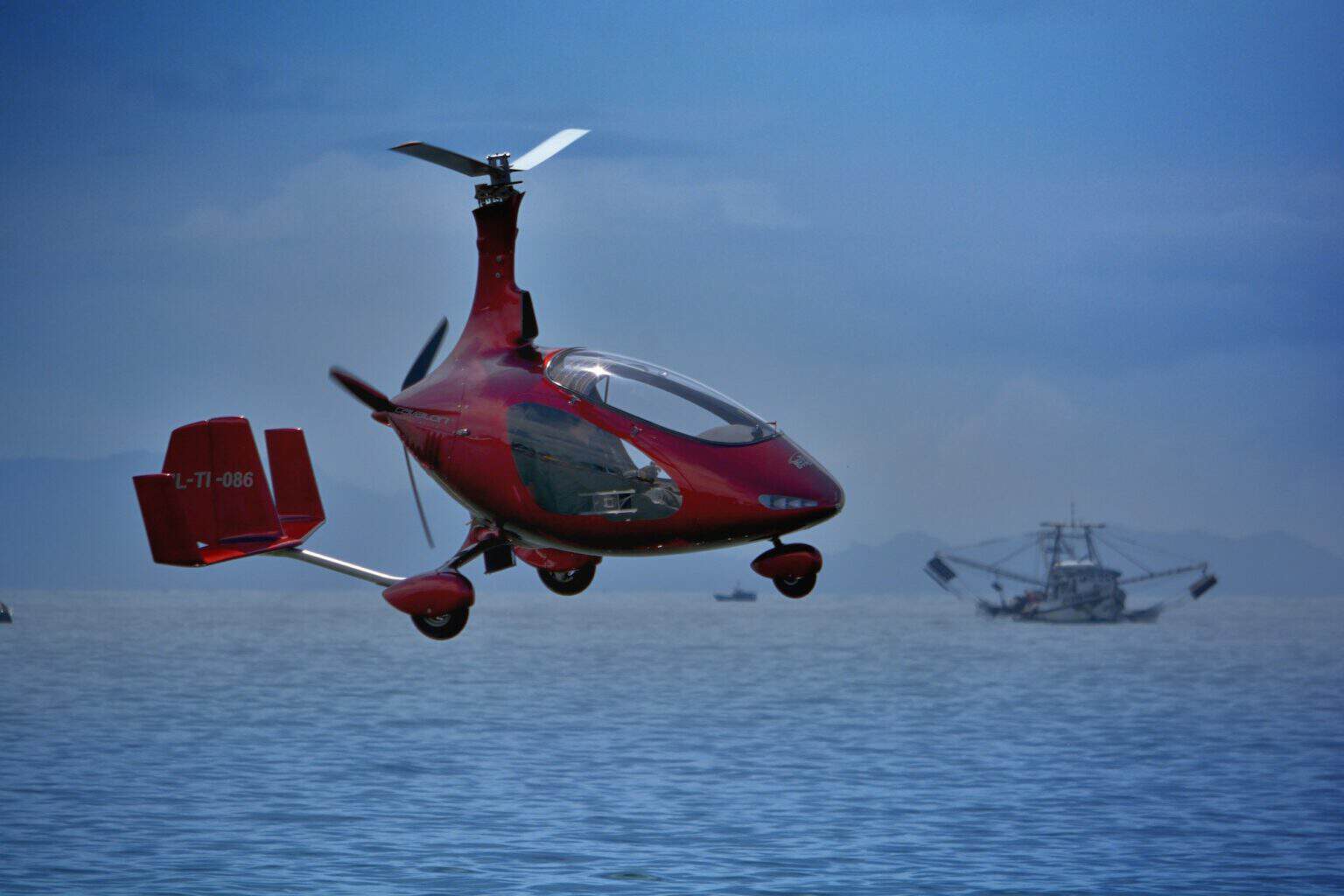
The best gyroplane you can fly in 2026 is the AutoGyro Cavalon: an enclosed, side-by-side two-seater that cruises at up to 115 mph (185 km/h) and is sold factory-built in the US under an FAA type certificate. Most gyroplanes still reach American owners as kits.
This list ranks the nine gyroplanes, also called autogyros or gyrocopters, that a pilot can actually buy and fly as of November 2026. It weighs cockpit, performance, certification and how easily the aircraft reaches a US owner, using the manufacturers’ own published figures.
Below the ranking you will find what it takes to fly one in the US, what the July 2026 light-sport rule change does and does not allow, and the honest picture on safety.
| Rank | Gyroplane | Seats and cockpit | Top speed (published) | Range |
|---|---|---|---|---|
| 1 | AutoGyro Cavalon | 2, side-by-side, enclosed | 120 mph (Vne) | 370 miles |
| 2 | Magni M24 Orion | 2, side-by-side, enclosed | 121 mph | About 4 hours |
| 3 | AutoGyro Calidus | 2, tandem, enclosed | 140 mph (Vne) | 370 miles |
| 4 | Trendak Tercel | 2, side-by-side, enclosed | 130 mph (Vne) | 500 miles (theoretical) |
| 5 | Trendak Taifun | 2, side-by-side, enclosed | 130 mph (Vne) | 530 miles (theoretical) |
| 6 | ELA 10 Eclipse EVO | 2, tandem, enclosed | 124 mph | 370 miles |
| 7 | Magni M16C Tandem Trainer | 2, tandem, open | 115 mph | 300 miles |
| 8 | AutoGyro MTOsport 2017 | 2, tandem, open | Not published | 340 miles |
| 9 | Sport Copter Vortex M912 | 1, open | 110 mph | 240+ miles |
How this ranking works
Only gyroplanes in production and on sale in November 2026 qualify. Each is judged on cockpit comfort, published performance, certification and how it reaches a US owner (factory-built, kit or import). Speeds and ranges are the manufacturers’ own figures, which are measured differently from maker to maker, so they separate classes of aircraft rather than settle close calls. Out-of-production designs such as the ArrowCopter AC20 and the Rotorvox C2A are excluded.
What is a gyroplane?
A gyroplane looks like a small helicopter, but its rotor has no engine driving it in flight. US federal rules define it as a rotorcraft whose rotors “are made to rotate by action of the air when the rotorcraft is moving,” with a separate propeller doing the pushing.
That free-spinning rotor, in a state called autorotation, makes the lift. Because nothing drives it, a gyroplane cannot hover the way a helicopter can, but it needs only a short strip to take off and land, and the mechanics are far simpler than a helicopter’s.
The idea is Spanish. Juan de la Cierva’s C.4 made the first successful autogyro flight near Madrid in January 1923, and in April 1931 the Pitcairn PCA-2 became the first rotary-wing aircraft certified in the United States.
1. AutoGyro Cavalon
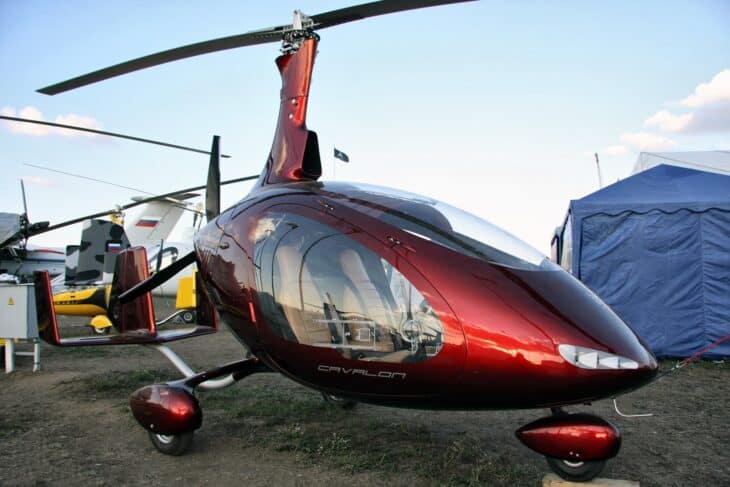

The Cavalon is the gyroplane most people picture when they think of a modern autogyro: two seats side by side under a closed canopy, a Rotax engine behind them and up to 5.5 hours in the air on 100 liters (26 US gallons) of fuel. AutoGyro of Germany introduced it in 2011.
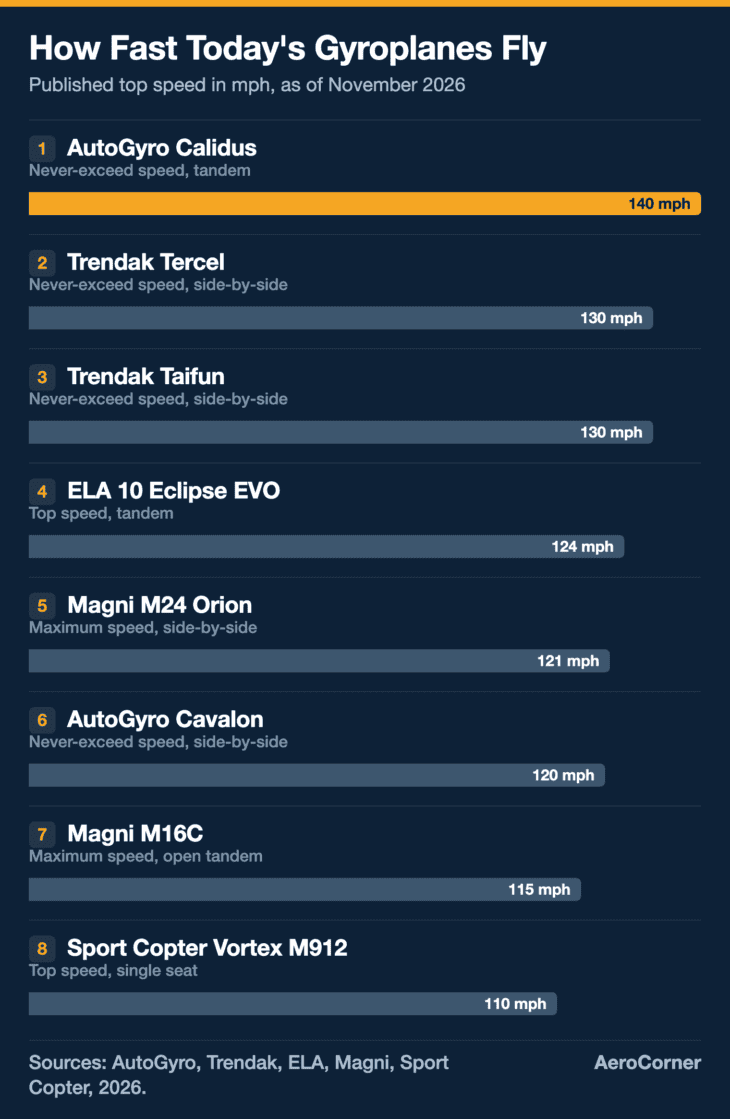
It cruises at 55 to 115 mph (90 to 185 km/h), has a never-exceed speed of 120 mph (195 km/h) and a range of about 370 miles (600 km). Empty weight is 715 pounds (325 kg), and maximum takeoff mass runs from 1,235 to 1,323 pounds (560 to 600 kg) depending on version.
What puts it first is how you get one. AutoGyro USA sells the Cavalon factory-built in the FAA’s primary category, or as an experimental kit with builder assistance. AutoGyro says it is the only maker offering factory-built, type-certificated gyroplanes in the US. AVweb put a well-equipped example at about $160,000 in 2020.
A gyroplane that can fly for hire
The Cavalon Pro is certified by the UK Civil Aviation Authority in the Standard Category, which permits paid aerial work such as air taxi, cargo and survey flights. It adds a certified Rotax engine, a constant-speed propeller and approval for night and instrument flight.
2. Magni M24 Orion
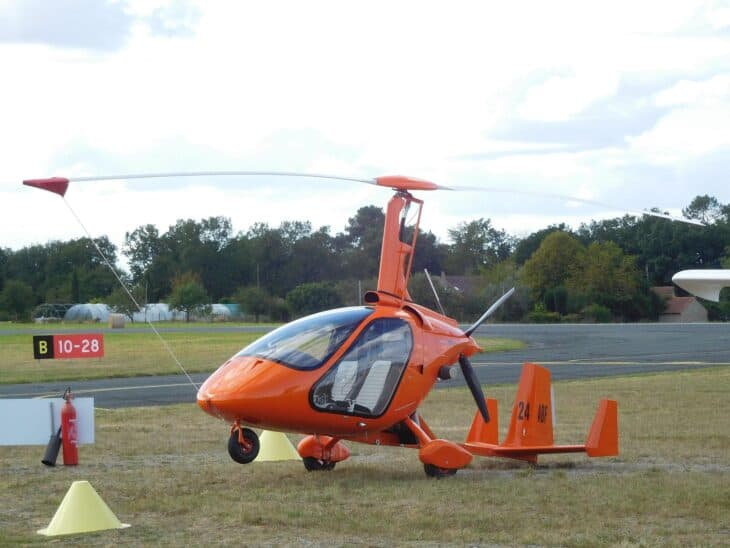

Magni Gyro of Italy is the other big name in the field, and the M24 Orion is its side-by-side touring machine. It first flew in 2008, and more than 300 have been built.
The standard engine is a 115 hp Rotax 914 Turbo, and the Plus version takes the 141 hp Rotax 915 iS. Magni quotes a cruise of 75 to 87 mph (120 to 140 km/h) and about four hours of endurance, and published reference data gives a maximum speed of 121 mph (194 km/h).
The Orion ranks just behind the Cavalon because it does not come with the factory-built, type-certificated US route AutoGyro offers. In the cockpit it is a genuine rival, fully faired, with dual controls and UK Section T certification.
3. AutoGyro Calidus
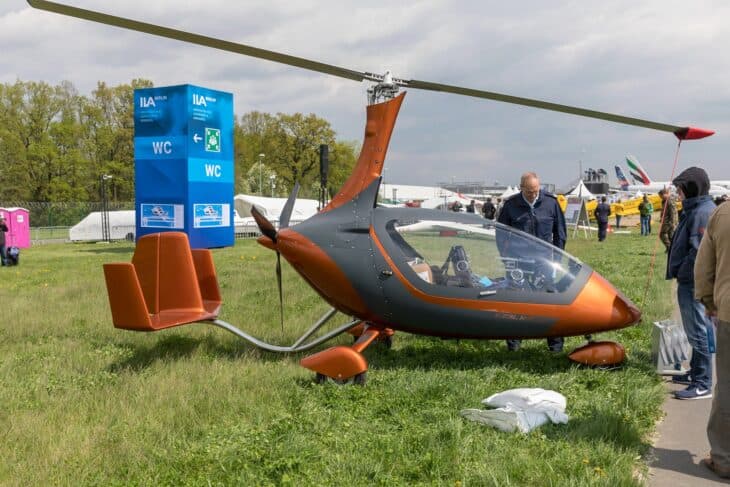

The Calidus puts two people one behind the other under a long bubble canopy, and that slimmer shape makes it the fastest aircraft on this list on paper. AutoGyro gives it a never-exceed speed of 140 mph (225 km/h), against the Cavalon’s 120 mph.
Cruise is 55 to 115 mph (90 to 185 km/h), range is about 370 miles (600 km) and endurance is up to 4.5 hours. It is lighter than the Cavalon too, at 660 pounds (300 kg) empty.
In December 2016 two Calidus versions were certified in the FAA’s little-used primary category. AOPA reported prices then of about €90,000 for the non-turbo version and €100,000 for the turbo.
4. Trendak Tercel
Poland’s Trendak builds the Tercel as a side-by-side, enclosed gyroplane with a fuel-injected AAT 912 engine of 135 to 140 hp. Trendak publishes a 75 percent power cruise of 100 mph (160 km/h), a maximum of 122 mph (195 km/h) and a never-exceed speed of 130 mph (210 km/h).
Its standout is endurance: two 40-liter tanks give up to six hours and a theoretical range of 500 miles (800 km). Maximum takeoff weight is 1,235 pounds (560 kg) with a payload of 521 pounds (240 kg).
It sits below the AutoGyro and Magni pair on US practicality rather than performance. A buyer should confirm the import route and dealer support before ordering.
5. Trendak Taifun
The Taifun is the most powerful gyroplane here, with a 160 hp Rotax 916 iS. Trendak quotes a cruise of 109 mph (175 km/h), a never-exceed speed of 130 mph (210 km/h) and a theoretical range of 530 miles (850 km).
Maximum takeoff weight is 1,323 pounds (600 kg), the top of the field. It is the choice for a pilot who wants to cover ground, with the same US-route caveat as the Tercel it is built alongside.
6. ELA 10 Eclipse EVO
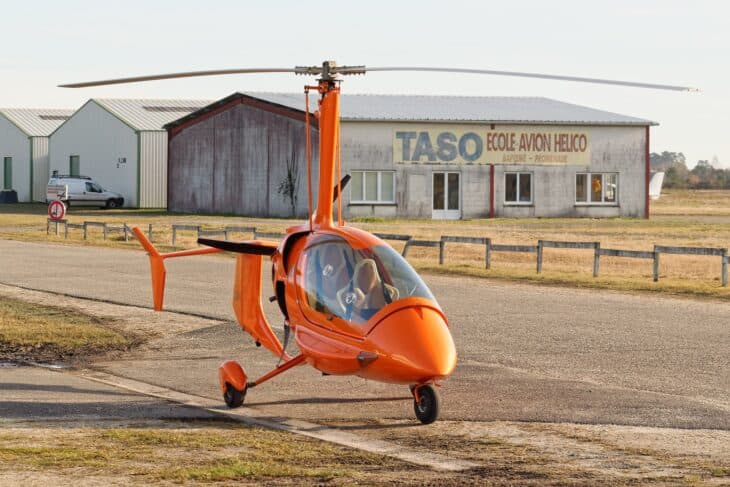
Spain’s ELA Aviación unveiled the ELA 10 Eclipse in 2014, a tandem gyroplane under a bubble canopy. The current EVO version has a 140 hp Rotax 915 iS, a 10-inch Dynon SkyView glass panel, a published top speed of 124 mph (200 km/h) and a range of about 370 miles (600 km).
It is a direct rival to the Calidus, with a more modern panel as standard. ELA prices it on request only, so check the US route with the factory first.
7. Magni M16C Tandem Trainer
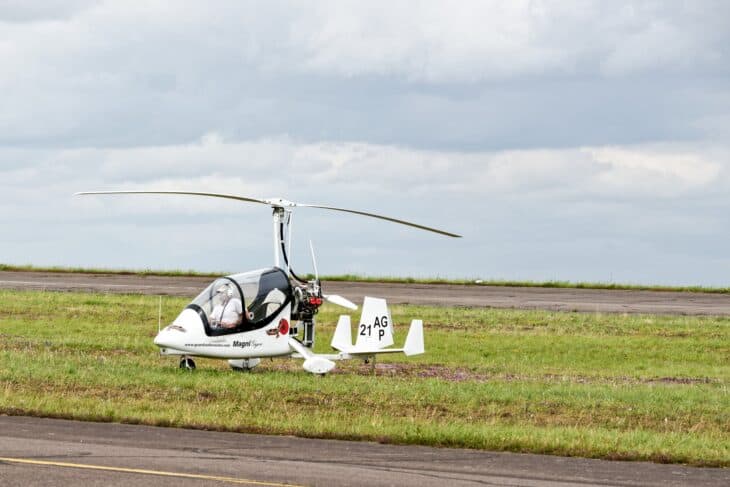

The M16 is an open tandem two-seater with dual controls, built for teaching, and it was the first Magni certified to UK Section T. Engines run from a 100 hp Rotax 912 to the 141 hp 915 iS, and Magni quotes a cruise of 75 to 93 mph (120 to 150 km/h).
Jane’s data for the 2006 model gives a maximum speed of 115 mph (185 km/h) and a range of 300 miles (480 km). An open cockpit is cold and noisy, which is the trade for the visibility and simplicity instructors value.
Around the world in an open cockpit
James Ketchell flew a Magni M16C around the world in 175 days, finishing at Popham, England, on September 22, 2019, after about 27,620 miles (44,450 km). Guinness lists it as the first circumnavigation by autogyro. Norman Surplus had finished his own round-the-world flight in an AutoGyro MT-03 three months earlier, after a trip begun in 2010, so both men have a fair claim to a first.
8. AutoGyro MTOsport 2017
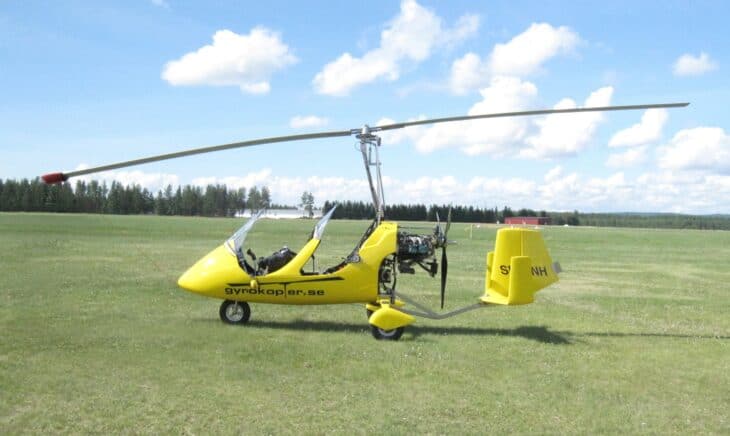

The MTOsport is AutoGyro’s open tandem gyroplane, the one for pilots who want the wind and the view. It weighs 642 pounds (290 kg) empty, cruises at up to 115 mph (185 km/h) and has a range of about 340 miles (550 km).
Like the Cavalon and Calidus, it is on AutoGyro USA’s list in kit and factory-built form. It ranks lower only because an open cockpit limits how far and in what weather most owners will fly it.
9. Sport Copter Vortex M912
The Vortex is the American entry, built by Sport Copter in Oregon as a single-seat, open-frame gyroplane offered as a kit. With a Rotax 912 ULS it cruises at 80 to 95 mph, tops out at 110 mph and covers 240 miles or more.
It is the most traditional machine on the list: one seat, no canopy, 565 pounds (256 kg) empty. That makes it a pure sport flyer rather than a tourer, but it is one of the few gyroplanes still designed and built in the US.
Gyroplanes are not the only cheap way into rotary-wing flying; our ranking of the cheapest helicopters covers the powered-rotor side.
Near misses and the ones you can no longer buy
Magni’s M22 Voyager and M26 Victor are good tandem tourers that sit close to the M16 and M24. The Austrian ArrowCopter AC20, a sleek tandem built from 2011 to 2018, ended production after its maker sought insolvency protection.
Germany’s twin-boom Rotorvox C2A is also out of production, and Air Command says its redesigned US kit will go on sale in 2026 but had not shipped when this was written. Plans for the Bensen B-8, the 1955 design that started the homebuilt gyro movement, are still available.
How to fly a gyroplane in the US
A sport pilot certificate with a gyroplane rating needs at least 20 hours of flight time, including 15 hours of instruction in a gyroplane and 5 hours of solo. A private pilot certificate in the rotorcraft-gyroplane category needs at least 40 hours.
Sport pilots are limited to gyroplanes with a two-blade, semi-rigid, teetering rotor. The FAA kept that limit in 2025 and refused to let sport pilots fly three-blade rotors, citing the risk of ground resonance.
Instructors are the real bottleneck. The Popular Rotorcraft Association’s directory lists only around 50 gyroplane instructors across about two dozen states, so many students travel to train.
Are gyroplanes light-sport aircraft now?
Partly. The FAA’s MOSAIC rule allows gyroplanes to be certificated as light-sport aircraft from July 24, 2026, ending the old ban on light-sport gyroplanes. But the FAA says industry consensus standards for light-sport gyroplanes still have to be written and accepted first, so a gyroplane sold today is still an experimental kit or one of AutoGyro’s primary-category models.
The fleet is small. The FAA counted only 189 experimental amateur-built gyroplanes on the US register in November 2024, against 26,453 amateur-built airplanes. Our guide to light-sport aircraft explains what the wider MOSAIC changes mean for airplanes.
Are gyroplanes safe?
Gyroplanes have a poor accident record, and the best-known studies point at specific design and training failures. AOPA counted 384 NTSB gyroplane accidents since 1983 in a 2022 review, 141 of them fatal, a far higher fatal share than noncommercial fixed-wing flying.
A 2004 UK accident report put the British gyroplane fatal accident rate since 1989 at 27.1 per 100,000 flight hours, against 1.1 for light fixed-wing aircraft. The same report cited a US study in which 8 of 17 fatal accidents from 1999 to 2002 were blamed on pitch instability, all in gyros without a horizontal tail.
The danger is the power pushover, or buntover: on a gyro whose propeller thrust line sits above its center of gravity, a sudden nose-down pitch can unload the rotor. The FAA’s own handbook says an adequate horizontal stabilizer slows that pitch and buys time to recover, and it names pilot proficiency as the most important safety factor.
The ultralight versus kit aircraft question matters here too. Part 103 ultralights must weigh under 254 pounds empty and carry no more than 5 US gallons of fuel, limits that rule out every gyroplane on this list.
A 2002 speed record still stands
The FAI autogyro speed record for the under-500 kg class still belongs to Wing Commander Ken Wallis: 207.7 km/h (129 mph) over a 3 km course at Shipdham, England, on November 16, 2002. Wallis also built Little Nellie, the WA-116 gyro James Bond flew in You Only Live Twice (1967).
FAQ
Sources and references used for research and fact-checking.
- AutoGyro, Cavalon
- AutoGyro, Factory-built primary category gyroplanes
- AutoGyro, Cavalon Pro
- AutoGyro, Calidus
- AutoGyro, MTOsport
- AutoGyro USA, Sales information
- Wikipedia, AutoGyro Cavalon
- Magni Gyro, M24 Orion
- Wikipedia, Magni M-24 Orion
- Magni Gyro, M16 Tandem Trainer
- Wikipedia, Magni M-16 Tandem Trainer
- Magni Gyro, Magni products
- Trendak, Tercel
- Trendak, Taifun
- ELA Aviacion, Eclipse EVO
- Wikipedia, ELA 10 Eclipse
- Sport Copter, Vortex M912
- Wikipedia, FD-Composites ArrowCopter
- Wikipedia, Rotorvox C2A
- Air Command, Gyroplane kits
- Wikipedia, Bensen B-8
- AOPA, Two German gyrocopters certified in primary category
- AVweb, LSA Gyroplanes: FAA Warms to the Idea
- AOPA, Gyro hero: Sorta safe
- Air Accidents Investigation Branch, AAIB Bulletin 9/2004, G-BIGU
- FAA, Rotorcraft Flying Handbook, gyroplane chapters
- Cornell Law School LII, 14 CFR 1.1 General definitions
- Cornell Law School LII, 14 CFR 61.109 Aeronautical experience
- Cornell Law School LII, 14 CFR 61.313
- Cornell Law School LII, 14 CFR 103.1 Applicability
- Federal Register, Modernization of Special Airworthiness Certification (MOSAIC) final rule
- Wikipedia, Autogyro
- Popular Rotorcraft Association, Instructors
- Guinness World Records, First circumnavigation by autogyro
- BBC News, Norman Surplus completes round-the-world autogyro flight
- Wikipedia, Norman Surplus
- FAI, FAI record 7602
- Wikipedia, Wallis WA-116 Agile
Get the Newsletter
The latest aviation news and stories sent to your inbox.
About the Author

Tim is the owner and lead editor of AeroCorner since 2019, overseeing aviation content covering aircraft, airlines, airports, and the broader aviation industry. Through years of researching, writing, editing, and publishing aviation-focused content, he has developed extensive practical knowledge of commercial aviation and air travel. Based in Asia and a frequent traveler himself, Tim also brings firsthand passenger experience to AeroCorner’s coverage. Outside of publishing, he has also explored aviation firsthand through hands-on flight training in New Zealand.