


Table of Contents
Empty leg flights are a genuinely good deal — in the right circumstances. The private aviation industry knows this, which is why broker marketing tends to lead with the discount and leave the fine print for later. This article is the fine print. Not to put you off, but because the people who get real value from empty legs are the ones who understood the constraints before they started searching.
There are five things about empty legs that look very different once you have tried to book one compared to how they look in an advertisement. All five are real, none of them are secrets, and knowing them in advance is the difference between a great experience and a wasted afternoon chasing a flight that was never quite right for your situation.
Browse current private jet empty leg deals on AeroCorner.
1. The route is fixed, and that is a harder constraint than it sounds
The appeal of a private jet is partly the flexibility: go where you want, when you want. An empty leg inverts this entirely. The aircraft is going where the operator needs it to go, and you are either going in that direction or you are not. There is no negotiation on the destination.
In practice this means that finding an empty leg that actually fits your travel need requires one of two things: either you have a flexible destination (you are going somewhere in a general direction, and the specific airport matters less than the experience), or you happen to be monitoring the market at the moment a deal appears on a route you genuinely need. The second scenario happens, but it requires more patience and luck than most people realise when they first hear about empty legs.
The fixed route constraint also applies to the specific airports at each end. Private aviation uses different airports to commercial aviation in many cities: business aviation hubs like Farnborough, Teterboro, or Van Nuys serve as entry points to the London, New York, and Los Angeles metro areas respectively. If the empty leg departs from the “wrong” airport for your journey — one that adds an hour of ground travel to a one-hour flight — the time savings start to disappear even if the price is right.
2. The schedule is less flexible than a charter, more flexible than a commercial flight
Empty legs have a departure time tied to the operator’s scheduling requirements. That time can shift within a window — operators can often accommodate departure adjustments of an hour or two — but the aircraft has to arrive at its next booking on time, and that sets a hard limit on how late it can leave.
This is a narrower constraint than it is on a full charter, where the departure time is set by the client. If the departure window conflicts with how you need to travel — an early-morning business meeting, a connection, a specific event start time — an empty leg may technically go where you need to go but depart at the wrong moment. Always confirm how much flexibility the operator has before committing to a booking.
Check the full journey, not just the flight
A private jet departure that saves two hours in the air can still result in a longer door-to-door journey if the departure airport is inconvenient, the departure time is awkward, or the arrival airport requires additional ground travel. Evaluate the complete trip, not just the flight sector.
3. Cancellation risk is real, and it can happen with very little notice
This is the constraint that matters most for time-sensitive travel. An empty leg exists because an operator has a charter booking that creates a repositioning need. If that original charter booking is cancelled, modified, or changes its routing, the empty leg it generated can disappear — sometimes hours before departure.
Operators are generally not cancelling your booking out of preference; the empty leg disappears because the operational reason for it no longer exists. Most will refund the fare. But the refund does not replace your travel plan, especially if you cancelled your alternative arrangements when you booked the private flight.
Never cancel your backup plan until you are boarding
Empty leg flights can be cancelled at short notice if the original charter that created them changes or cancels. For any journey with a hard arrival requirement — a business meeting, a connection, an event — always keep a commercial alternative available until the empty leg has actually departed. Refunds are cold comfort if missing the flight means missing what you flew for.
The risk profile varies. An empty leg created by a well-established recurring charter — a client who makes the same trip every week — is lower risk than one generated by a one-off booking. An empty leg on a popular route between major hubs, listed well in advance, is lower risk than one that appeared 24 hours before departure because of a last-minute scheduling change. You rarely have full visibility into which situation you are in, which is why the principle holds: keep your alternatives available.
4. Availability is unpredictable, and good deals disappear fast
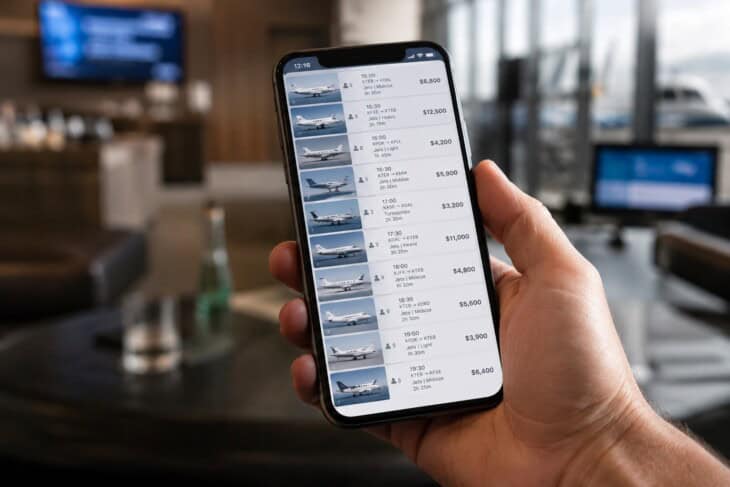
Empty leg hunting works on the market’s timeline, not yours. You cannot decide in January that you want to fly privately from Paris to Ibiza in July on an empty leg and plan around it — the inventory does not work that way. Empty legs are listed when operators know they have a repositioning flight, which can be weeks in advance for a long-planned charter or a few days for something that came together recently.
When a genuinely attractive deal appears on a popular route — a large-cabin jet, a good departure time, a significant discount — it typically does not stay available for long. Operators and brokers are marketing these flights actively, and buyers who have set up alerts move quickly. If you are the kind of person who researches a decision at length before committing, empty leg hunting requires a different operating mode: be ready to decide fast when the right flight appears.
The corollary is that if you are searching for a specific route on a specific date months in advance, your chances of finding a suitable empty leg are low. The market is real-time, not plannable.
5. You still need to get back
Empty legs are one-way by nature. The aircraft is repositioning in one direction; there is no return leg to sell. If you fly from New York to Miami on an empty leg, you need to arrange your own return — which could be commercial, another charter, or another empty leg if you can find one.
This asymmetry catches people off-guard when they first model the economics. If the return journey requires a full commercial business class ticket, or a one-way charter at full price, the total cost of the round trip can exceed what a single full charter would have cost. The empty leg looks like a deal in isolation; the complete trip picture is what matters.
Some travellers solve this by building their trip around the empty leg rather than using it to fill a pre-planned journey: they look for a pair of empty legs in opposite directions, or they accept that one leg will be commercial and value the private experience for the direction where the empty leg happens to be available. Both approaches work, but they require treating empty legs as an opportunity to be taken advantage of when it arises, rather than a reliable booking channel for fixed travel plans.
A note on the marketing
Broker and operator marketing around empty legs leans heavily on the largest possible discount figures. “Up to 75% off a standard charter” is a real data point, but it describes the best-case scenario on a long-haul sector in a large-cabin jet at a moment of genuine operator urgency. It does not describe a typical deal, and applying it mentally to a short domestic hop on a light jet will produce a price expectation the market will not meet.
The savings are real. They are just not uniformly dramatic. On longer routes, in larger aircraft, with flexible timing and the patience to act quickly, empty legs can represent exceptional value. On shorter routes, in smaller aircraft, at convenient times on popular sectors, the discount narrows and the constraints still apply. Going in with calibrated expectations produces better outcomes than going in with the headline figure.

Who empty legs actually suit
Empty legs work best for a specific kind of traveller: someone with genuine flexibility on route and timing, the ability to make a fast decision when the right deal appears, and a travel plan that can absorb a cancellation without catastrophic consequences. That might be leisure travel with a flexible destination, a group trip where the private experience itself is part of the point, or a frequent traveller on routes that regularly generate repositioning flights who has learned to monitor the market consistently.
They work less well for business travel with hard arrival requirements, solo travellers comparing cost-per-head against commercial alternatives, and anyone who needs certainty of departure more than they need the private jet experience.
The five constraints, summarised
Fixed route (no destination flexibility). Limited schedule flexibility (departure window tied to operator needs). Cancellation risk (the original charter can pull the empty leg at short notice). Unpredictable availability (deals appear and disappear on the market’s timeline, not yours). One-way only (return journey requires separate arrangement). Know all five before you book.
If your situation fits the profile, the deals page is the right starting point — availability changes throughout the day, and the best way to assess whether the market has something useful is to look at what is actually listed.
Browse current private jet empty leg deals on AeroCorner.
Where to go next
If the constraints work for your situation and you want to understand how to actually find and book an empty leg, How to Find and Book a Private Jet Empty Leg Flight covers the process step by step. For context on the economics behind the discount, Why Empty Leg Flights Are Cheaper Than Charter explains exactly what the operator is pricing and why. And for the specific question of what happens when a cancellation does occur, What Happens If Your Empty Leg Flight Gets Cancelled? covers your options in detail.
FAQ
Sources and references used for research and fact-checking.
Get the Newsletter
The latest aviation news and stories sent to your inbox.
About the Author

Tim is the owner and lead editor of AeroCorner since 2019, overseeing aviation content covering aircraft, airlines, airports, and the broader aviation industry. Through years of researching, writing, editing, and publishing aviation-focused content, he has developed extensive practical knowledge of commercial aviation and air travel. Based in Asia and a frequent traveler himself, Tim also brings firsthand passenger experience to AeroCorner’s coverage. Outside of publishing, he has also explored aviation firsthand through hands-on flight training in New Zealand.