Military Trainers
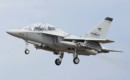
Alenia Aermacchi M-346
ICAO: Y130
Failed post-WWII British trainer aircraft
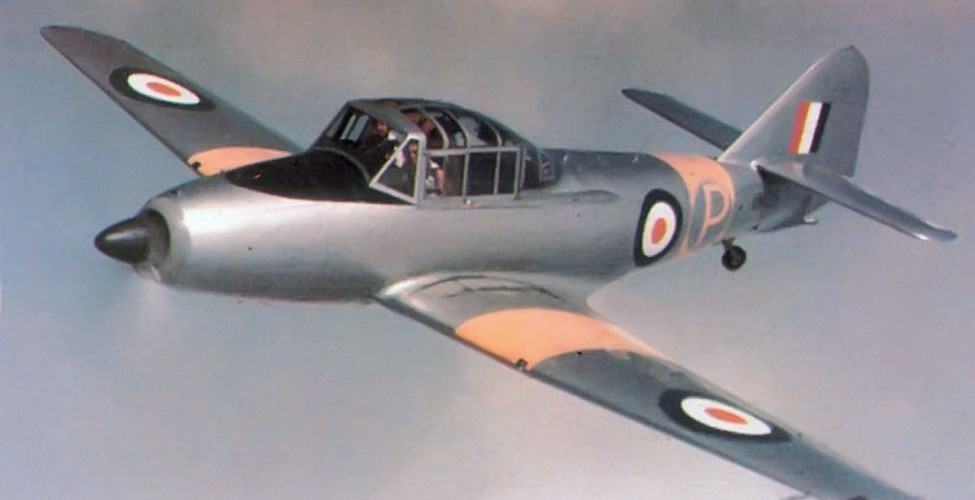
The Avro 701 Athena was produced by the British manufacturer Avro as an advanced trainer aircraft during the late 1940s. It first flew in June 1948 and was introduced in 1950. The aircraft saw service with the Royal Air Force and was built to replace the North American Harvard trainer aircraft, however, the Athena was hardly sold with only twenty-two aircraft built including prototypes.

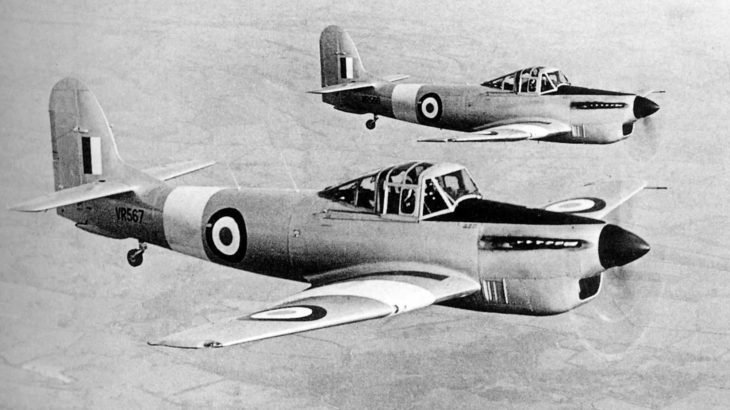
The Avro Athena was built as a response to a requirement for a three-seat turboprop-powered advanced trainer intended for the Royal Air Force. On June 12, 1948, it took to the air for the first time. The aircraft was an all-metal monoplane with a side-by-side seating configuration for two crew members. It has an external length of 11.37 meters, an external height of 3 meters, and a fuselage diameter of 1.45 meters. It was designed with low wings with a wingspan of 12.2 meters and a wing area of 25 square meters. The tail height is 3.93 meters and the wheelbase is 6.8 meters. It has an empty weight of 2,896 kg, a gross weight of 3,688 kg, and a fuel capacity of 130 US gal in two flexible wing tanks and 36 US gal in a fuselage collector tank, with provision for 110 US gal in two under-wing drop tanks.
The Athena is powered by a single Rolls-Royce Merlin 35 V-12 liquid-cooled piston engine with a maximum takeoff thrust of 1,280 hp, a combat rating of 1,245 hp at 11,500 feet, and 1,060 hp in a continuous cruise at 9,250 feet. It also drives a four-bladed constant-speed propeller. The aircraft has a maximum speed of 255 knots at 20,000 feet. It has a maximum cruise speed of 194 knots at 10,000 feet and a stall speed of 70 knots with flaps down. The travel range is 480 nautical miles. It can fly up to 29,000 feet and can climb at an initial rate of 2,050 feet per minute and 2,030 feet per minute at 10,000 feet. The takeoff run to clear 50 feet is 681 meters off concrete and 700 meters off the grass, while the landing run over 50 feet is 680 meters on concrete and 650 meters on the grass.
The aircraft could also be armed with a single 7.70 mm Browning machine gun and has provision for two 27 kg RP-3 rockets.